ritteri success stories???

sabodish

New member
all..id like to purchase a ritteri anemone for my 2 perculas. i know from all my reading they are difficult to keep, need high light and high water movement, which i have. i would like to hear from people who have kept these for at least a year and what you recommed for success...and also a possible reputable online source where i can purchase one.
thanks
mike
 
finding a healthy one is close to imposible

they are not ritteri anymore now they are are H. magnifica most places
 
True, Heteractis Magnifica is the current scientific name.

They're really, really tough to keep alive...very touchy creatures, and like GSM said, real tough to find in good health...

I wish you best of luck!
 
thanks for the words...if these are impossible to keep alive and hard to find, i guess im stuck with a bubble tip for my percs?

my tank is bare bottom, so i need somethign that will more or less hang out in the rocks.
 
I had a Ritteri for about 3.5 years until it got caught in the overflow & ripped. I have bubble tips now. They seem to be easier to care for. The ritteri was not afraid to move around, and naturally wanted to only give you a view of its' foot on the front glass. I spent 2 weeks adjusting the flow & current until it would stay put, without an ugly view. Eventually I lost it because it went on the move again.

The bubble tips seem to like good flow & a place to bury their foot.
 
yeah..thats my problem...i have crazy flow, but being bare bottom theres nowhere to burry a foot, unless they will burry it in the rocks.
 
Magnifica's seem to like the higher rock formations, and i do know of someone on here who had two very healthy magnificas in his tank and they looked wonderful, but I can't for the life of me remember the name...

They're not impossible to keep, but they are a lot touchier than a BTA...have you kept an anemone before? Most would recommend avoiding magnifica's like the plague as a first anemone, as they do tend to be much harder to care for than BTAs, and seem to handle the stress of being moved around a lot harder.
 
<a href=showthread.php?s=&postid=9390722#post9390722 target=_blank>Originally posted</a> by sabodish
yeah..thats my problem...i have crazy flow, but being bare bottom theres nowhere to burry a foot, unless they will burry it in the rocks.

bta's like to bury their foot in rock crevices... e. quadricolor is a fine choice.
 
<a href=showthread.php?s=&postid=9390763#post9390763 target=_blank>Originally posted</a> by Slakker
Magnifica's seem to like the higher rock formations, and i do know of someone on here who had two very healthy magnificas in his tank and they looked wonderful, but I can't for the life of me remember the name...

They're not impossible to keep, but they are a lot touchier than a BTA...have you kept an anemone before? Most would recommend avoiding magnifica's like the plague as a first anemone, as they do tend to be much harder to care for than BTAs, and seem to handle the stress of being moved around a lot harder.

Ron popiel...He has two very nice magnifica's. Up until about a month ago i had kept mine for close to six years.
 
no, this is not my first anemone..ive kept many BTA in the past and had a LTA with a mated pair of saddlebacks for 5 years that i had to sell when i moved 8 months ago.

maybe i should just find a nice rose BTA..they seem to disappear fast online and my LFS NEVER have them in stock.
 
i have 2 magnifica in my tank for over two years,they are situated just below the water surface right under a 400w 20,000k light.they have quite a good flow and have stayed in this position all the time with out moving.derek
 
In my experience, I wouldn't call them extremely difficult to keep once healthy, but they are extremely difficult to find healthy. Thy seem to stay put if given otherwise good conditions they are put on top of a rock pile with lower K light (yellower, less blue) Mine have all shown the behaviour of moving under bluer light.

Look for one with a closed mouth and sturdy looking tentacles and body. I do have to agree with many who say that with the survival rates we see they shouldn't be routinely imported though.

Once we work out propogating them I bet they will become a very desireable critter to keep.
 
I've had my mag for close to 2 years now. It sits right under a 250w 14k hamilton. It does have pretty good current blowing on it. IME with mags they dont really appreciate direct current onto the base, but rather a strong current above the tentacles. Mine has never really moved more than 4'' from where i originally placed it, dispite several aquascaping remakes.

It sits on a flat rock that fairly smooth on top. When i purchased it it was about 8'', now its about 22'' expanded. I only feed it about 2-3 times a month other than what food it catches in the water.

Finding a healthy one from the start is key, as they can be very hard to bring back. Luckily mine survived a current leak from a faulty heater. It did bleach completly from the incident, but in the last 4 months has regained about 80% of its color back. HTH.
 
h. magnifica?

02182007042.jpg
[/IMG]
 
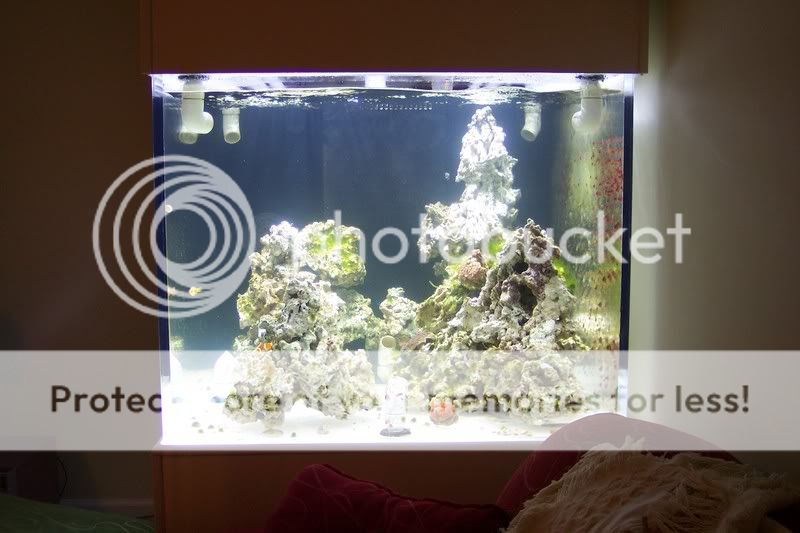
ok..heres my tank as of now...as you can see on the right side i have a pedestal where i think a magnifica would do well. its about 10" from a 400W 20k reeflux bulb and gets alternating current from a closed loop..woudl this be the ideal spot?

also, did any of you guys buy your mags online?

100_0884.jpg
 
I had a huge specimen for a couple of years. Always perched up high but eventually got caught in the overflow. Seemed to like the heavy current through its tentacles.
 
About two more months and I can claim I've had my H. magnifica six years.

To me the ingredients of a succesful long-term husbandry are:
(Ranked in terms of importance, but don't get me wrong, ALL are important)
1) aquascaping and placement
2) current
3) lighting


Most of which you can probably surmise by observing where you are most likely to find them in the wild, i.e., in shallower waters usually, at the top of the reef, where currents and lighting is strongest.

1) Aquascaping and placement.

IME they like to be at the top of the reef. If they can "sense" a way to move higher, they will. I.e., so placement in a tank needs to be as far away from any higher surfaces as possible, including the glass walls. If they can touch a solid surface higher than they are, that's where they're going to go.

In a tank the best thing to do, IMO, is create a "coral bommie" which is a tower type structure with a flat surface on the top for them to be. In your photo, it looks like you have one to the left there, although I think the top looks a little too jagged for optimum placement, I think they'll like a smoother surface. In my tank I used a pizza sized slab of live rock that was pretty flat.

2) Water currents

At the top of the reef the water currents tend to be strong and surging. A wavemaker device of some kind is thus ideal, or a surge tank, or something. I use 2 Tunzes on a multicontroller to get a current that alternates in direction every 10 to 15 seconds. A wash of current from the left, a wash of current from the right. I also have my sump returns piped through a Calfo-style manifold that direct currents from all corners of the tank towards the anemone.

3) Lighting

Again it makes sense that they like lighting but I find that what's more important is that they can sense that they are as close to the light as possible, as opposed to a specific wattage. I kept mine for many years under 2x175W's and now still only a single 250W. But the trick is to place the coral bommie directly underneath a light. This will help "root" the anemone in place.

To further emphasize my point, in my previous tank where I had this anemone, I had 2x175W halides, one on each side of the tank with the anemone directly under one of them. A couple times I had troubles with one of my halides starting (ie. wouldn't start right away, took as long as 20-30 minutes to turn on). One time the light above the anemone was the one that didn't start, and within that half-hour before it turned on, the anemone moved towards the side of the tank where the light was on. "Oh, the sun is over there now." Luckily the same phenomenon worked in my favour when I got the light working again, all I had to do was turn off the light on the side I didn't want the anemone, and it eventually wandered back to where he was before.


...

One warning, be prepared for this species. First of all, getting one to survive might be tricky. And if you do get one that lives, they grow to a large size, will wipe out corals if they get enough contact, can kill off an entire tank's fish stock if disturbed enough to get into a defensive posture, and need a large energy input (ie. lighting and feeding), and will put a tremendous load on a tank's bioload. I've not had a single tank with this anemone that didn't suffer chronically high nitrates. Right now the tank mine is in has a NO3 level of about 30 and I can't reduce it beyond this, so unfortunately until I can upgrade the skimmer or change things around, I can't keep corals in this tank (what's the point, they'll just die in conditions like that).

Not the greatest picture of the setup mine is in, but here's a picture anyhow:

ritteritank1.jpg
 
I know its been said before but I've had a fish store order them and they keep dying. The conditions at the LFS are great...its just really really hard to get one that is healthy. They just dont ship well. I ended up getting a bta.
 

Similar threads

Back
Top