
RO/DI Set Up

Irishman360

New member
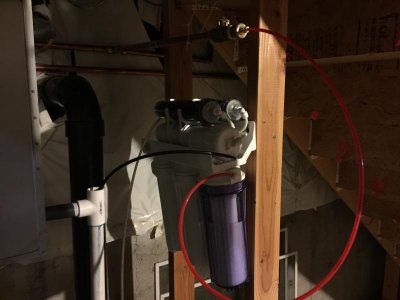
So I just set up my RO/DI unit in the basement and plumbed the cold water line into it.

This is my unit

https://www.amazon.com/gp/aw/d/B00LK9QNV0/ref=yo_ii_img

Can someone confirm that it has an inline flow restriction on it or should I buy one? It came with directions that said it was inside the black tubing, however I couldn't get that thing off if my life depended on it to see if it did have one in it. My system is on a ball valve and I don't have it running on full blast since I don't want to destroy my unit.

Another question for storage is that I plan on having a storage for RO and salt water. Do I have to have temps in both of them? And for the salt do I have to keep the powerhead/pump running 24/7?
 

Attachments

  • image.jpg
    image.jpg
    42.9 KB · Views: 4
For the record. Salt mixes better in cold water. If you are going to heat it do so AFTER mixing.

No, you don't need to keep the pump running. Personally I do but you will want to aerate it prior to use. Some salt mixes store better than others, some come with vitamins and other "benificial" things that don't store well.

If there is no flow restrictor the unit won't produce much water. We actually like to bypass the flow restrictor to do a fast flush on the RO unit before and after water production. It keeps the membrane clean, it will last longer.

It likely has a capillary type restrictor, push the hose into the fitting, press in the retaining ring, pull out on the hose. They come out but it does take a bit of practice.

Anyways, open up the ball valve and measure the water output. You should be getting 4x the amount of waste water as you get product water.
 
For the record. Salt mixes better in cold water. If you are going to heat it do so AFTER mixing.

No, you don't need to keep the pump running. Personally I do but you will want to aerate it prior to use. Some salt mixes store better than others, some come with vitamins and other "benificial" things that don't store well.

If there is no flow restrictor the unit won't produce much water. We actually like to bypass the flow restrictor to do a fast flush on the RO unit before and after water production. It keeps the membrane clean, it will last longer.

It likely has a capillary type restrictor, push the hose into the fitting, press in the retaining ring, pull out on the hose. They come out but it does take a bit of practice.

Anyways, open up the ball valve and measure the water output. You should be getting 4x the amount of waste water as you get product water.

I was doing what you recommended with pushing the hose into the fitting and pressing the retaining ring, and then pull out the hose but didn't want to budge. I've tried all the other connections just to make sure it wasn't me and they came out no problem.
 
I guess what makes you think that the flow restriction is not there? If it's brand new, I wouldn't worry about it. As long as you see the right rejection ratio you expect (based on your RO rejection percentage) you will know it's in there.
 
Not to hijack the thread and get it off topic. How do you like that RO unit?

So far I love it and it was at a decent price. I am currently adding on a pressure gauge and waiting for my in line TDS meter to show up so I really know how well it works. Company that sent it is really hands on about customer service for pats that didn't come with it and questions I have about it.
 
Ugh. Guys, guys, guys.

Avoid using GAC as a prefilter on the high capacity systems used in this hobby. Carbon blocks are a far superior product.

Don't buy a carbon block unless the chlorine capacity is specified by the vendor.

The micron rating on any carbon block should be about the same as or LARGER than the sediment filter rating.

On typical tap water and with decent pressure you'll want a 1 micron sediment filter, not a 5 micron.

Don't buy an RO membrane unless the vendor specifies the rejection rate and pressure specs.

Never orient your DI stage(s) horizontally. This is a kindergarten-level configuration flaw for anyone building RODI systems.

You need two "tools" to run these systems: TDS meter, and pressure gauge.

Russ
 
Ugh. Guys, guys, guys.

Avoid using GAC as a prefilter on the high capacity systems used in this hobby. Carbon blocks are a far superior product.

Don't buy a carbon block unless the chlorine capacity is specified by the vendor.

The micron rating on any carbon block should be about the same as or LARGER than the sediment filter rating.

On typical tap water and with decent pressure you'll want a 1 micron sediment filter, not a 5 micron.

Don't buy an RO membrane unless the vendor specifies the rejection rate and pressure specs.

Never orient your DI stage(s) horizontally. This is a kindergarten-level configuration flaw for anyone building RODI systems. Why not orient the stages horizontally? I am new to this hobby and don't have anyone to turn to when setting these things up. So I guess you could say it's "kindergarten-level" configuration. It's been working great for me, but thanks for your "opinion" though.

You need two "tools" to run these systems: TDS meter, and pressure gauge.

Russ
 
This is from our FAQ's:
Horizontal DI housings are a design intended to minimize the original cost of the system - you should be prepared for the tradeoffs. Horizontal DI units typically contain 8 oz. to 16 oz. of resin. Typical 10” x 2.5” vertical DI cartridges contain 20 oz. of resin. Obviously the more resin contained in the housing the longer it will last and the better treatment it will provide.

Some horizontal DI housings are not refillable - you'll therefore have to pay for a new housing every time you need to replace the DI resin. The cost of repeatedly replacing the horizontal housing will far outweigh any money saved up-front in purchasing the unit.

Perhaps most importantly, horizontal DI housings are a less than ideal arrangement for water treatment. DI resin beds shrink/settle through normal use over their life span. You'll note that a cartridge that was full when new can sometimes have a ¼ inch of empty space in it when fully expended. When DI resin settles in a horizontal housing, it leaves a pathway (of least resistance) along the top of the housing where water can flow while coming into minimal contact with the DI resin.

You’ll note that the output from the DI housing is at the center of the end of the housing. Depending upon how your system is configured, RO water may enter the DI housing in port, fill up the housing until the water level reaches the out port (i.e., fill up the bottom half of housing), and then exit the DI housing. Your RO water has been in contact only with half the resin in the housing.

Russ
 
I am new to this hobby and don't have anyone to turn to when setting these things up.

But you do! We've been a sponsor of Reef Central for years and years and have helped countless folks just like you figure out anything and everything related to water treatment!

Russ
 
But you do! We've been a sponsor of Reef Central for years and years and have helped countless folks just like you figure out anything and everything related to water treatment!

Russ

First sorry OP.. Not trying to hijack your thread.. but maybe you might like this answered as well.

I have a auto shut off on my RO/DI UNIT.. But really do not use it. I usually will use up 50 gallons . then make another 50 gallons. Turning the water into the filter off between use.
Is it best to make a Bunch at once.. Or just let the Auto Shut off work and make a bit at a time..

Which is easier on the filters life... ?
Does it matter ?
 
The important thing is:
One one end of the spectrum, you don't want to short-cycle your RO system. This can happen if for instance you have your system feeding a float valve in your sump. Everytime you get 1/8" of evaporation, the system will kick on for a short time, and then off, and then on, and off, and on 24/7.

At the other end of the spectrum you'll make and store large amounts of DI water. This is a better approach, but only store enough such that your system must kick on for an extended period AT LEAST ONCE A WEEK.

Russ
 
The important thing is:
One one end of the spectrum, you don't want to short-cycle your RO system. This can happen if for instance you have your system feeding a float valve in your sump. Everytime you get 1/8" of evaporation, the system will kick on for a short time, and then off, and then on, and off, and on 24/7.

At the other end of the spectrum you'll make and store large amounts of DI water. This is a better approach, but only store enough such that your system must kick on for an extended period AT LEAST ONCE A WEEK.

Russ

Thanks.. I have 3 55 gallon tanks.. i use 1 for mixing and two for ro/di.. So i have 150 gallons of water when i let the complete topping everything off. Plus my ato tank that is about 15 gallons. I have a float Valve in the top of the main ro/di tank and one in the top of the ato tank.. When the ato tank gets half low i will turn on the water to ro unit and let it fill . OHH THE Float Valves are on a T Coming out of the di unit.

So it does Run every week long enough to fill the ATo... I have the float valves because i forget to turn it off. I just do NOT Trust the auto shut off

Thanks for the Reply .
 
But you do! We've been a sponsor of Reef Central for years and years and have helped countless folks just like you figure out anything and everything related to water treatment!

Russ

Do you propose I change out my DI stage now or wait for it to run its time? How easy would it be to make it a vertical stage? Why do most of the time I see the DI stage horizontal on almost all of the RO/DI stages?
 
I would unclip your two DI housings and orient them both vertically with flow from the bottom to the top. I'd do this now. Change the resin only when needed. Add resin now if you note that the tubes are not 100% full/packed tightly. If you need clips to mount them vertically we have clips for 2" and for 2.5" tubes.

The only place we see horizontal DI stages is on systems built by low end ebay vendors. Typically they are drinking water RO systems assembled overseas, and the local vendor slaps on a couple of clear horizontal housings (intended for GAC typically) and calls it an RODI. When we see this configuration it immediately calls into question the qualifications of the vendor.

Russ
 
The important thing is:
One one end of the spectrum, you don't want to short-cycle your RO system. This can happen if for instance you have your system feeding a float valve in your sump. Everytime you get 1/8" of evaporation, the system will kick on for a short time, and then off, and then on, and off, and on 24/7.

At the other end of the spectrum you'll make and store large amounts of DI water. This is a better approach, but only store enough such that your system must kick on for an extended period AT LEAST ONCE A WEEK.

Russ

What's the reasoning behind the per week interval? I'm asking, because I make and store 90gal once a month.
 
Membrane manufacturers indicate that if a membrane sits idle for more than a week it should be removed and put into a preservative so you avoid biological fouling in the membrane. Remember that the membrane is soaking in dechlorinated water - i.e., water with no disinfectant. Remember when you installed the membrane and handled it with your hands? And when you started using the system w/o sanitizing the inside of the system? Its a good assumption that the inside of the system is not 100% sterile.

Does this mean that if you don't use your membrane for 8 days it's ruined? No.

It's just good practice to set up your routine so that use use the system regularly.

Russ
 
Two points to add on.

1) Everyone really should consider buying from Russ. The long term support you get far outweighs a few dollars saved on inferior units. He's also the only vendor I ever seen actually explain the correct way to setup and maintain an rodi unit. So many vendors just slap a product together and sell it with little to know instructions. Which leads me to my second point.

2) Upon initial setup and replacement of any filter you should flush each individually prior to using the system as a whole. This is especially important for the carbon block as they are unavoidably loaded with carbon fines from the manufacturing process. If you run the system as a whole without flushing each filter seperately you then compromise the next filter inline. All of those carbon fines will go through your RO membrane and substantially reduce its lifespan. That's why we have the sediment filter first. To remove any particles from ever prematurely clogging up the pores of the carbon block AND hitting the membrane.
 
Two points to add on.

1) Everyone really should consider buying from Russ. The long term support you get far outweighs a few dollars saved on inferior units. He's also the only vendor I ever seen actually explain the correct way to setup and maintain an rodi unit. So many vendors just slap a product together and sell it with little to know instructions. Which leads me to my second point.

2) Upon initial setup and replacement of any filter you should flush each individually prior to using the system as a whole. This is especially important for the carbon block as they are unavoidably loaded with carbon fines from the manufacturing process. If you run the system as a whole without flushing each filter seperately you then compromise the next filter inline. All of those carbon fines will go through your RO membrane and substantially reduce its lifespan. That's why we have the sediment filter first. To remove any particles from ever prematurely clogging up the pores of the carbon block AND hitting the membrane.

+1

even though my unit wasn't built by Buckeye Hydro, Russ has helped me a few times trouble shooting my system and getting me parts that I needed to make the system work much better. he tells you what each thing does and why you need or don't need certain things, doesnt sell you stuff you don't need just to make extra money. an all around stand up guy and my new place to buy all my replacement filters and parts.

Thanks Russ
 
Back
Top