Conky
New member
Mr. Borneman,
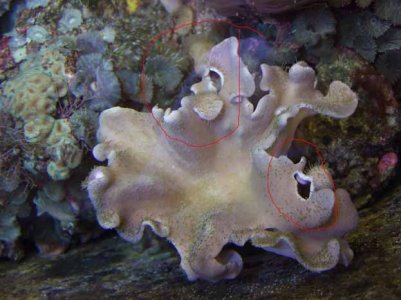
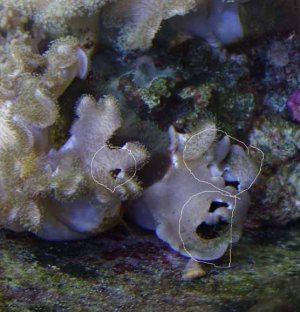
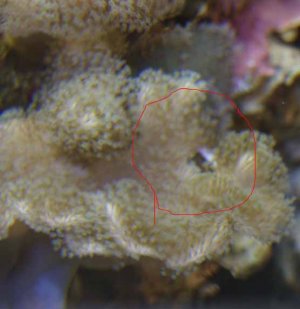
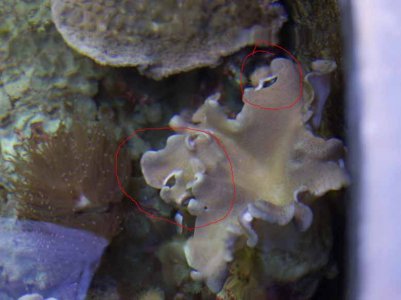
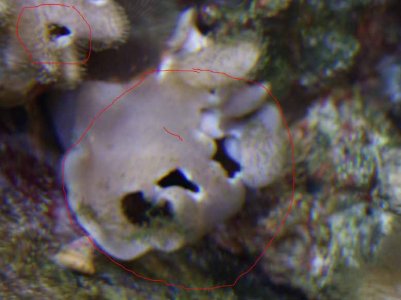
I contacted you a couple of weeks ago regarding some problems I've been experiencing with some Sarcophytons at work. To refresh your memory, I was concerned a bit by the abundance of flatworms found on all of the afllicted specimens, as well as the effects of a night when the chiller remained off (temp spike to 88 degrees). You can review our interchange by searching for "coldwater invert" under your forum. I promised you pictures, and have attached 5 separate pictures (in the following 5 posts...too big for one posting) of some of the worst afflicted specimens. I have not been able to get pics of the flatworms yet, but they do not appear similar to the "red planarians". They are much less defined in form (more rounded in all aspects, much slower moving, with perhaps 3 tails), and though they appear a very light pink when on the coral, under the stereoscope they look mottled brown (as if they were eating tissue). I will send you a picture of them as soon as I can work out the logistics.
Tank params are as follows:
2 x 1000 watt MH
2 x 400 watt MH
~1200 gallon display
Not sure of exact flow...it's incorporated into a 4000 gallon system
These specimens are situated several inches below the overflow, and thus receive a moderate flow at all times.
Additional water flow provided by 2 700 gph powerheads(planning more on wavemaker)
pH 8.070-8.250 (approx)
Ca = 400 ppm, Alk = 3.0 meq/l (both were lower when problem began...maybe 380 and 2.5)
Equipped with calcium reactor (120 dpm/45 bpm...21.0 meq/l, pH 6.5) for the last month
Dose Mg, Ca/alk(balanced) when necessary
Occasionally drip Kalkwasser
Temp ~ 77 deg (with chiller)
Ammonia, nitrite undetectable, nitrates 3.6 ppm, phosphates 0.01 ppm (spectrophotometer readings)
Magnesium is maintained 1200-1300 (difficult)
Salinity=34, probably 32.5 when problem started
I can furnish you with a graph with all of the parameters for the period in which I first noticed the problem if it will help at all. I have values for most on an every day basis.
As of now, things seem to be improving. All specimens seem to be lacking further damage and polyp extension is good, though the wounds do not seem to be experiencing any regrowth at the edges. The flatworms have receeded dramatically, and smaller specimens have stopped detaching from the rock (may have been unrelated). I basically just wanted to know what you felt were the more likely sources of this damage (in case I encounter it again). I can have the vets do cultures, but they have no idea what to look for (i.e. what is pathogenic).
I apologize for the quality of the photos, but they were taken from the surface without a tripod.
Thanks in advance,
Mike
I contacted you a couple of weeks ago regarding some problems I've been experiencing with some Sarcophytons at work. To refresh your memory, I was concerned a bit by the abundance of flatworms found on all of the afllicted specimens, as well as the effects of a night when the chiller remained off (temp spike to 88 degrees). You can review our interchange by searching for "coldwater invert" under your forum. I promised you pictures, and have attached 5 separate pictures (in the following 5 posts...too big for one posting) of some of the worst afflicted specimens. I have not been able to get pics of the flatworms yet, but they do not appear similar to the "red planarians". They are much less defined in form (more rounded in all aspects, much slower moving, with perhaps 3 tails), and though they appear a very light pink when on the coral, under the stereoscope they look mottled brown (as if they were eating tissue). I will send you a picture of them as soon as I can work out the logistics.
Tank params are as follows:
2 x 1000 watt MH
2 x 400 watt MH
~1200 gallon display
Not sure of exact flow...it's incorporated into a 4000 gallon system
These specimens are situated several inches below the overflow, and thus receive a moderate flow at all times.
Additional water flow provided by 2 700 gph powerheads(planning more on wavemaker)
pH 8.070-8.250 (approx)
Ca = 400 ppm, Alk = 3.0 meq/l (both were lower when problem began...maybe 380 and 2.5)
Equipped with calcium reactor (120 dpm/45 bpm...21.0 meq/l, pH 6.5) for the last month
Dose Mg, Ca/alk(balanced) when necessary
Occasionally drip Kalkwasser
Temp ~ 77 deg (with chiller)
Ammonia, nitrite undetectable, nitrates 3.6 ppm, phosphates 0.01 ppm (spectrophotometer readings)
Magnesium is maintained 1200-1300 (difficult)
Salinity=34, probably 32.5 when problem started
I can furnish you with a graph with all of the parameters for the period in which I first noticed the problem if it will help at all. I have values for most on an every day basis.
As of now, things seem to be improving. All specimens seem to be lacking further damage and polyp extension is good, though the wounds do not seem to be experiencing any regrowth at the edges. The flatworms have receeded dramatically, and smaller specimens have stopped detaching from the rock (may have been unrelated). I basically just wanted to know what you felt were the more likely sources of this damage (in case I encounter it again). I can have the vets do cultures, but they have no idea what to look for (i.e. what is pathogenic).
I apologize for the quality of the photos, but they were taken from the surface without a tripod.
Thanks in advance,
Mike