
You are using an out of date browser. It may not display this or other websites correctly.
You should upgrade or use an alternative browser.
You should upgrade or use an alternative browser.
Skimming Part-Time
- Thread starter pbnj
- Start date

izzy123
New member
If its something new that doesnt cost me money but will help my tank im down lol
:lolspin:

SoFloReefer
New member
I think its a good idea but I've noticed that my skimmers have been sensitive to any change and will stop producing foam if they are reset, food is added, or hands go into the water.
mikezalewski
New member
it sounds like a good Idea but does it really benefit anything. There is not a real power bill advantage either!

pbnj
Member
No good...the author addresses this:How about just sizing your skimmer to half of what is needed. In theory, this would be the same as turning off the skimmer for half the day. Right?
At this point in time you are probably asking yourself, "œThen why not just turn down the skimmer and run it 24/7?" or even, "œWhy not use an undersized or cheapo skimmer and put the money elsewhere in the system?" The key here is having skimmer reliability, and you simply won't get that with the cheapo skimmers on the market. When they go "œon strike" or flood the collection cup, when the air intake crystallizes, or the water level varies, or the pump disconnects, or stops entirely, you don't have a skimmer, and you can't predict when this will happen. With a well designed skimmer, you buy peace of mind and in the long run, you pay less because you buy just one skimmer. In other words, do it right the first time, and do it once.
The other option of running a premium skimmer on a slow and steady, conservative setting is a "œneither here nor there" solution. You end up with the worst of both worlds because the skimmer neck will slow down efficiency with skimmate build-up in the neck, which you will have to clean manually. It also doesn't achieve our goal of leaving the tank "œnatural" during the nightly plankton swim.
pbnj
Member
Thus, the word experiment.It sounds like a good idea, but does it really benefit anything?

skeeter7424
New member
i have been kicking this idea around as well. i am interested to see what you find. i am waiting to have my apex up and running so i can change it as i please and also monitor pH during the night. it will be nice to put the graph up and see where it goes...
cheers
Jordan
cheers
Jordan
Skimmers,
Interesting topic. I have had a reef tank for over 10 years now and I found this following article and study extremely interesting. My oversized modified skimmer is very efficient and takes a lot of of my tank. But, I have had very poor results with raising softies long term of any type. This sturdy answered a lot of my questions as to why I can't raise softies. My tank is too low on nutrients.
One finding which really surprised me was that a skimmed reef tank had only about 10% of the available bacteria for the coral to feed on when compared to a natural reef. A non- skimmed softie tank ended up balancing out, even after over feeding, to have about the same bacteria as a natural reef. Could explain why softies seem to grow match better in tanks that are not heavily skimmed.
We skim the hell out of SPS tanks to reduce bacteria nutrients and use Zeo like product to reintroduce bacteria nutrients. I think we still have a lot to learn about running the optima reef tank.
Article: (do a search)
Bacterial Counts in Reef Aquarium Water: Baseline Values and Modulation by Carbon Dosing, Protein Skimming, and Granular Activated Carbon Filtration
By Ken S. Feldman, Allison A. Place, Sanjay Joshi, Gary White
Interesting topic. I have had a reef tank for over 10 years now and I found this following article and study extremely interesting. My oversized modified skimmer is very efficient and takes a lot of of my tank. But, I have had very poor results with raising softies long term of any type. This sturdy answered a lot of my questions as to why I can't raise softies. My tank is too low on nutrients.
One finding which really surprised me was that a skimmed reef tank had only about 10% of the available bacteria for the coral to feed on when compared to a natural reef. A non- skimmed softie tank ended up balancing out, even after over feeding, to have about the same bacteria as a natural reef. Could explain why softies seem to grow match better in tanks that are not heavily skimmed.
We skim the hell out of SPS tanks to reduce bacteria nutrients and use Zeo like product to reintroduce bacteria nutrients. I think we still have a lot to learn about running the optima reef tank.
Article: (do a search)
Bacterial Counts in Reef Aquarium Water: Baseline Values and Modulation by Carbon Dosing, Protein Skimming, and Granular Activated Carbon Filtration
By Ken S. Feldman, Allison A. Place, Sanjay Joshi, Gary White
pbnj
Member
Day 15....
First, some observations which may just be my impression:
Next, some indisputable facts:


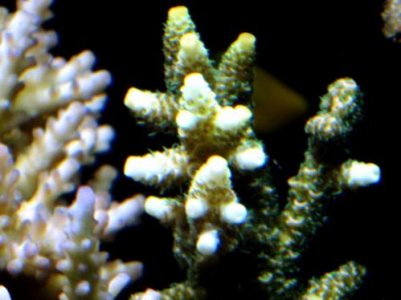
These corals have been in my tank since May and have shown no growth. I almost gave away the green millipora (maybe prostrata), but I'm glad I didn't because it's now sprouting significant new lemonade-colored tips.
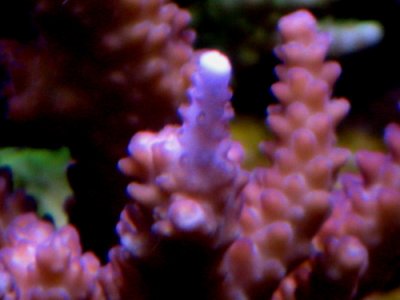
The other is some kind of purple stag or meridiana.....finally, growth!
---
First, some observations which may just be my impression:
- Increased/thicker skimmate production (maybe there's an initial surge of skimmate every morning that makes the cup seem more full?).
- Increased polyp extension during daytime hours, especially on the Montiporas (blue & red digitatas, green spongodes, and purple capricornis).
Next, some indisputable facts:
These corals have been in my tank since May and have shown no growth. I almost gave away the green millipora (maybe prostrata), but I'm glad I didn't because it's now sprouting significant new lemonade-colored tips.
The other is some kind of purple stag or meridiana.....finally, growth!
---
Attachments
Last edited:
Sweet, looks like it might be helping. The idea of turning off the skimmer makes sense, but the O2 thing and possibility of the skimmer not restarting always kept me from going that route. I've found skimming all the time and just feeding more also produces good results though.

bigworm175
New member
No good...the author addresses this:
At this point in time you are probably asking yourself, "œThen why not just turn down the skimmer and run it 24/7?" or even, "œWhy not use an undersized or cheapo skimmer and put the money elsewhere in the system?" The key here is having skimmer reliability, and you simply won't get that with the cheapo skimmers on the market. When they go "œon strike" or flood the collection cup, when the air intake crystallizes, or the water level varies, or the pump disconnects, or stops entirely, you don't have a skimmer, and you can't predict when this will happen. With a well designed skimmer, you buy peace of mind and in the long run, you pay less because you buy just one skimmer. In other words, do it right the first time, and do it once.
The other option of running a premium skimmer on a slow and steady, conservative setting is a "œneither here nor there" solution. You end up with the worst of both worlds because the skimmer neck will slow down efficiency with skimmate build-up in the neck, which you will have to clean manually. It also doesn't achieve our goal of leaving the tank "œnatural" during the nightly plankton swim.
I like this experiment. However, I don't understand this argument against a smaller skimmer having a similar effect. The author seems to be suggesting against a cheap skimmer. There is a difference between running a quality skimmer made for a smaller water volume and cheap. So I'm still curious as to why people running "underpowered" skimmers at full capacity wouldn't get the same effect.


Gorgok
New member
So I'm still curious as to why people running "underpowered" skimmers at full capacity wouldn't get the same effect.
I think the goal with only turning it off is to have a time of the day when there is some nutrients, while the time it is on to have very little to none. A skimmer too small will simply leave nutrients in the tank all the time, and since you still add more and more food it will eventually build up.
In fact with part time skimming i would probably go even another step above what you would normally size (a single step above is normal) just to make sure it actually does its job in the time limit it has.

victor_c3
Premium Member
Running a skimmerless tank has been something that I've been looking into quite a lot over the last year. The more that I read about what a protien skimmer does and how the parameters compare in skimmed tanks to un-skimmed tanks to natural reef levels, the more that I realize that skimmers are creating an unnatural version of the reef environment.
I came accross this article where they analyzed the skimmate and performance of protein skimmers in general:
http://www.advancedaquarist.com/2010/2/aafeature
What is interesting is that they showed that a skimmer removed roughly 30% of the TOC (total organic carbon) from the water and that skimmate is made up of mostly inorganic molecules (mostly caclium carbonate and silicone dioxide). So, it can be argued that skimmers don't really do all that much for our aquariums other than facilitate gas exchange and remove a little bit of waste.
Coupling the authors notes in the above mentioned article with some of the points of the article posted below about bacteria counts in aquaria, you could reasonably conclude that a majority of skimmate/TOC removed is the bodies and "guts" of bacteria removed from the water.
http://www.advancedaquarist.com/2011/3/aafeature
And a really fascinating point to me in the article about the bacteria is that it has been shown that some bacteria are more prone to being skimmed than others, which could create an imbalance in our aquariums or at least a condition of selection favoring bacteria that are less prone to be pulled from the water column via skimming.
Furthermore, in the article about the bacteria, they highlight that the systems analyzed where a skimmer was not employed have bacteria counts more in line with those found on a natural reef environment. Within that study, the 29 gallon Sanjay tank was able to roughly match both the TOC and bacterial counts of a natural reef environment.
With the above in mind, I've been leaning towards running a skimmerless system and a methodology like that of Steve Tyree or a duplex sump like that mentioned here:
http://www.reefcentral.com/forums/showthread.php?t=969713&highlight=duplex+sump
I would just make sure that you have large enough sump with enough live rock to be able to support your system. I'm probably going a little overkill, but I'm planning on setting up a 20-30 gallon display tank on my desk at work with a 60 gallon duplex sump and not running skimmer.
I came accross this article where they analyzed the skimmate and performance of protein skimmers in general:
http://www.advancedaquarist.com/2010/2/aafeature
What is interesting is that they showed that a skimmer removed roughly 30% of the TOC (total organic carbon) from the water and that skimmate is made up of mostly inorganic molecules (mostly caclium carbonate and silicone dioxide). So, it can be argued that skimmers don't really do all that much for our aquariums other than facilitate gas exchange and remove a little bit of waste.
Coupling the authors notes in the above mentioned article with some of the points of the article posted below about bacteria counts in aquaria, you could reasonably conclude that a majority of skimmate/TOC removed is the bodies and "guts" of bacteria removed from the water.
http://www.advancedaquarist.com/2011/3/aafeature
And a really fascinating point to me in the article about the bacteria is that it has been shown that some bacteria are more prone to being skimmed than others, which could create an imbalance in our aquariums or at least a condition of selection favoring bacteria that are less prone to be pulled from the water column via skimming.
Furthermore, in the article about the bacteria, they highlight that the systems analyzed where a skimmer was not employed have bacteria counts more in line with those found on a natural reef environment. Within that study, the 29 gallon Sanjay tank was able to roughly match both the TOC and bacterial counts of a natural reef environment.
With the above in mind, I've been leaning towards running a skimmerless system and a methodology like that of Steve Tyree or a duplex sump like that mentioned here:
http://www.reefcentral.com/forums/showthread.php?t=969713&highlight=duplex+sump
I would just make sure that you have large enough sump with enough live rock to be able to support your system. I'm probably going a little overkill, but I'm planning on setting up a 20-30 gallon display tank on my desk at work with a 60 gallon duplex sump and not running skimmer.
getsmart111
New member
i have a similar setup... got a 50G main tank, EXTREMELY overpowered skimmeri have been running a skimmerless tank since i built my tank back in february.
i don't dose anything and i feed 2-3 cubes per day with only 3 fish on a 40B. however, i have an algae turf scrubber.
going skimmerless is nothing new to the ATS guys.
 (rated up to 300G), and my 10G sump only has one baffle which IMO acts as an ATS because the water runs down the baffle about 8 inches or so and it has the same algae (that ATS's grow) growing on it. I haven't changed the water for about 6 months now(tanks been up for about a year, and i only changed it cause i was hesitant that i would get a spike, but now i'm willing to see how far i can go), and i run the skimmer for about 2 hours a week. everything doing perfect. I'll say my secret is the "ATS" i got going
 but then again i have a pretty light bio load(3 fish:fish1:, about 10 softies)
Last edited:

Big E
Premium Member
I read somewhere that someone spilled a little skimmate in his tank and his corals seemed to really like it. Skimmers can be sensitive especially right after a cleaning or powering on and off. They need a mini breakin period and I would worry about the mini breakin periods on a daily basis. Never heard of anyone adding some skimmate back into the tank to feed the corals but I guess it would be feasible. That way you keep the skimmer running all the time and you can experiment with how much skimmate to add back to your system. Sounds crazy and counter productive to me but hell if the corals like a little skimmate every now and then why not?:hmm3:
Youl'll get the same response & benefits by hitting your rocks with a baster, plus it kicks up that crap that can cause nutreient problems down the road.
Similar threads

- Replies
- 11
- Views
- 193

- Replies
- 2
- Views
- 109
- Replies
- 8
- Views
- 351

