Hello everybody,
Been out of the hobby for a while, but trying to help a neighbor who just recently purchased small and large juvenile Picassos directly from ORA.
Clowns were received directly from ORA on Saturday the 24th, acclimated using the "recommended" method provided by LiveAquaria (1/2 cup water every 4 minutes).
Water in bag was 1.025 SG, PH 7.6, water in QT, 1.024, PH 8.2.
They are in a freshly cycled 20 gallon long QT, with 4 inch ceramic pot and some PVC, HOB filter, heater.
Parameters since introduction;
* SG - 1.024
* Temp - 78
* Ammonia/Nitrite = 0 (API/Salifert)
** Tested Morning, afternoon and night.
* 10% water change nightly
Timeline:
* Day 1-2, no eating, swimming around very rapidly as new clowns do, elevated breathing.
* Day 3 Clowns started eating, Mysis, Reef Frenzy, tigger pods, settled down in Pot hanging out together, started boding behavior, continued elevated breathing.
* Days 4-7, larger clown eating very well, smaller clown eating small bits here and there, continued elevated breathing.
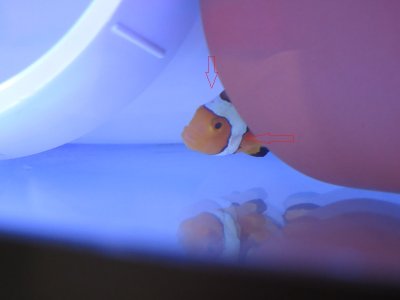
* Day 8, larger clown eating slowed down, only eats brine shrimp and tigger pods, breathing still elevated small red mark develops on head.
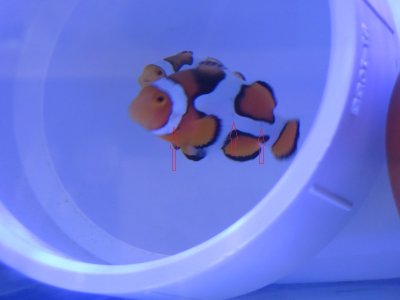
* Day 9, small red marks start to appear on body, some slightly raised, still eating brine shrimp and tigger pods.
* Today, couple more red marks, others same size, still eating, elevated breathing, not lethargic, but hiding a bit.
No Prophylactic treatment has yet been administered.
My first reaction when he called yesterday was either Parasite (Brook), exposure to Ammonia or even aggression between the two. Given they came straight from ORA, I questioned the likelyhood of Brook.
It sill has good color, no powder or mucus developing, fins don't seem to be clamped, no flashing, Gills little swollen but don't appear red. Aggression between the two appears minimal.
First time I have seen these kind of red marks, so a little stumped.
Any insight would be greatly appreciated.
Been out of the hobby for a while, but trying to help a neighbor who just recently purchased small and large juvenile Picassos directly from ORA.
Clowns were received directly from ORA on Saturday the 24th, acclimated using the "recommended" method provided by LiveAquaria (1/2 cup water every 4 minutes).
Water in bag was 1.025 SG, PH 7.6, water in QT, 1.024, PH 8.2.
They are in a freshly cycled 20 gallon long QT, with 4 inch ceramic pot and some PVC, HOB filter, heater.
Parameters since introduction;
* SG - 1.024
* Temp - 78
* Ammonia/Nitrite = 0 (API/Salifert)
** Tested Morning, afternoon and night.
* 10% water change nightly
Timeline:
* Day 1-2, no eating, swimming around very rapidly as new clowns do, elevated breathing.
* Day 3 Clowns started eating, Mysis, Reef Frenzy, tigger pods, settled down in Pot hanging out together, started boding behavior, continued elevated breathing.
* Days 4-7, larger clown eating very well, smaller clown eating small bits here and there, continued elevated breathing.
* Day 8, larger clown eating slowed down, only eats brine shrimp and tigger pods, breathing still elevated small red mark develops on head.
* Day 9, small red marks start to appear on body, some slightly raised, still eating brine shrimp and tigger pods.
* Today, couple more red marks, others same size, still eating, elevated breathing, not lethargic, but hiding a bit.
No Prophylactic treatment has yet been administered.
My first reaction when he called yesterday was either Parasite (Brook), exposure to Ammonia or even aggression between the two. Given they came straight from ORA, I questioned the likelyhood of Brook.
It sill has good color, no powder or mucus developing, fins don't seem to be clamped, no flashing, Gills little swollen but don't appear red. Aggression between the two appears minimal.
First time I have seen these kind of red marks, so a little stumped.
Any insight would be greatly appreciated.