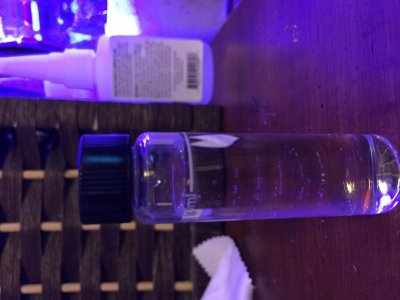
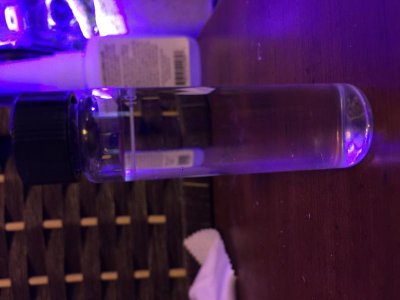
Keep in mind that for a colorimetric test that is a "completion reaction" rather than a titration, a relatively small volumetric error won't make any difference at all. This would be true for tests like nitrate, phosphate and ammonia. Titration tests like calcium, magnesium and alkalinity will suffer from inaccurate volumetric measurements.
The reason it doesn't make any difference for completion reaction tests is that the reagents are formulated in such a way that all, or very nearly all, of the analyte in question (phosphate, nitrate, etc...) is converted by the reagents in the test to a colored end-product. The intensity of that end-product color is either digitally quantitated by something like a Hanna Checker, or interpreted through the side of the vial against a color chart.
Beer's law is the applicable equation; it essentially states that the color intensity is a function of the path length (how much solution you're looking through), the concentration (the factor of interest - e.g., "how much nitrate") and a constant that's a characteristic of the color compound that's formed (called the "extinction coefficient").
Since all of the nitrate in a particular sample will be turned into the colored end-product, and by reading through the side of the vial the path length is the same, adding a little bit more or less water to the test vial won't change the results at all.
Though again, this is not true for drop-by-drop titration tests.