
You are using an out of date browser. It may not display this or other websites correctly.
You should upgrade or use an alternative browser.
You should upgrade or use an alternative browser.
The Ultimate DIY Rocks!
- Thread starter JohnL
- Start date
- Status
- Not open for further replies.

Kurt03
Active member
<a href=showthread.php?s=&postid=8448030#post8448030 target=_blank>Originally posted</a> by Zestay
ok quick question.
whats the diffrence between curing and kuring?
im guessing curing is the cement hardening.. and kuring is the salt and ph leeching out of the rock?
rigth or wrong? feed back?
You are correct

lildraken
New member
Rhodophyta, quick question if you may. In the hyperlink you provided for latex forifyers, I could only find a product that is an acrylic fortifyer. Same thing? Do you use this product in the mixture before you form the rocks or do you seal the rocks after they've hardened?
I've been trying to Kure my DIY rocks for 8 weeks now and the pH is still very high. There's so many pages to this thread. I think I've read somewhere that someone added vinegar to the water to kure it or did I imagine that?
I've been trying to Kure my DIY rocks for 8 weeks now and the pH is still very high. There's so many pages to this thread. I think I've read somewhere that someone added vinegar to the water to kure it or did I imagine that?

Zestay
New member
also so i make sure i did everything correctly, i mixxed my rocks, formed them, let them sit for 48+ hours, put them im a batch of water. and change the water about everyother day.. do i need a period of them being dry at all ( after the inital 48 hours? )
or just wait till my water tests come back normal?
or just wait till my water tests come back normal?

Rhodophyta
New member
<a href=showthread.php?s=&postid=8448915#post8448915 target=_blank>Originally posted</a> by lildraken
Rhodophyta, quick question if you may. In the hyperlink you provided for latex forifyers, I could only find a product that is an acrylic fortifyer. Same thing? Do you use this product in the mixture before you form the rocks or do you seal the rocks after they've hardened?
I've been trying to Kure my DIY rocks for 8 weeks now and the pH is still very high. There's so many pages to this thread. I think I've read somewhere that someone added vinegar to the water to kure it or did I imagine that?
Acrylic fortifiers are what I'm talking about. I incorrectly called them latex, a common faux pas since they smell just like latex paint. They are added to the dry mix replacing about half of the water, before the rocks are made. Kuring is a made up word, only known on this thread. Kuring = cleaning. It is easier to spell than neutralizing or leaching, the two cleaning processes really going on after the concrete begins to cure or harden. Neutralizing happens when an acid like vinegar or muriatic acid is poured over the rock. Leaching happens with water changes, whether continuous like in a stream, or periodic like in the tank of a toilet, or set out in the yard in a rainy climate, all mentioned earlier in this thread or it's splitoff. I'm sure the invented word was intended to reduce confusion between the hardening/curing process and our attempt to clean off excess alkalinity in the next step. It think it seems to be confusing more people than it has helped. All we are doing is cleaning the rock so it can be used, and cleaning has two general approaches leaching and neutralizing.
Old aquarium water seems to be a good choice to clean the rocks. The more mulm the better. After you have leached or neutralized the rock for a while, you can add old aquarium water, and then add plain household ammonia. Once the ammonia has all converted to nitrate, rinse them off with more old aquarium water, and test them again before use. The ammonia does not clean the rock but it does encourage the growth of thigmotrophic bacteria, the good ones we want anyway. They seal off the rock and naturalize it.
Rhodophyta
New member
After the rocks are made, it's important to mist them whenever they begin to dry out, or cover them with plastic to hold in humidity, for one week before cleaning (Kuring) them. If you shorten this step to 48 hours, it's likely the rock will not be fully cured, and lots of needed calcium will be unbonded to the rock, weaking the rock and elevating the pH.<a href=showthread.php?s=&postid=8449180#post8449180 target=_blank>Originally posted</a> by Zestay
also so i make sure i did everything correctly, i mixxed my rocks, formed them, let them sit for 48+ hours, put them im a batch of water. and change the water about everyother day.. do i need a period of them being dry at all ( after the inital 48 hours? )
or just wait till my water tests come back normal?

Travis L. Stevens
Active member
Zestay, in simple terms, yes. Curing is the act of hardening the rock. Kuring, like Rhodophyta has stated, is just something used in this thread to alleviate confusion since the process of decreasing the pH was also called Curing. So, instead, the act of the rock becoming stronger is Curing and the act of decreasing the pH is called Kuring.
Now, the process of Cured and Uncured live rock is the act of "uncured" rock that has die off and organic decomposition to give the bacterial population a chance to catch up. I have even occassionally heard the act of making base rock/DIY rock into live rock Curing, too. But I normally just call it aquaculturing
Now, the process of Cured and Uncured live rock is the act of "uncured" rock that has die off and organic decomposition to give the bacterial population a chance to catch up. I have even occassionally heard the act of making base rock/DIY rock into live rock Curing, too. But I normally just call it aquaculturing

RandyStacyE
New member
This may sound strange, but I’ve actually used this stuff before and it did appear to help a lot and it is cheaper than dirt. It’s called ‘Right Now Bacteria’ made by Hiatt Distributors Limited Products www.hdltd.com
Right Now Bacteria Page:
http://www.hdltd.com/products/p_rightnow.html
My idea was to use this product to ‘help colonize’ the DIY Rock with bacteria. This company does make almost unbelievable claims like “Right Now! Bacteria is a totally different way of addressing the Nitrogen Cycle. Instead of 28 days, following our protocol at 25oC, the Nitrogen Cycle will be established in one day every timeâ€Â. I don’t know about all that, but it did truly help me with some problems I was having with my system when it was relatively new and I was very new to this hobby. It also helped a few others that I have previously suggested it to.
After reading their site a bit this is my impression: Based on what they say about ‘how it works’ I assume that it would be necessary to use old tank water to bathe your rocks. I would run the water change water through a filter sock to get out any gunk first. The RN Bacteria supposedly requires some ammonia or fish in the rock holding tank in order for the bacteria process to begin. They say that the more surface area for bacterial to grow the better. Well a tub full of DIY Rock sounds like a lot of surface area to me. It’s worth reading into.
They sell carbon for the intended use for maximum bacteria colonization many times used inside of a carbon tube (just a simple tube filled with carbon which water passes through). I don’t think that’s necessary.
Right Now Bacteria Page:
http://www.hdltd.com/products/p_rightnow.html
My idea was to use this product to ‘help colonize’ the DIY Rock with bacteria. This company does make almost unbelievable claims like “Right Now! Bacteria is a totally different way of addressing the Nitrogen Cycle. Instead of 28 days, following our protocol at 25oC, the Nitrogen Cycle will be established in one day every timeâ€Â. I don’t know about all that, but it did truly help me with some problems I was having with my system when it was relatively new and I was very new to this hobby. It also helped a few others that I have previously suggested it to.
After reading their site a bit this is my impression: Based on what they say about ‘how it works’ I assume that it would be necessary to use old tank water to bathe your rocks. I would run the water change water through a filter sock to get out any gunk first. The RN Bacteria supposedly requires some ammonia or fish in the rock holding tank in order for the bacteria process to begin. They say that the more surface area for bacterial to grow the better. Well a tub full of DIY Rock sounds like a lot of surface area to me. It’s worth reading into.
They sell carbon for the intended use for maximum bacteria colonization many times used inside of a carbon tube (just a simple tube filled with carbon which water passes through). I don’t think that’s necessary.

Chasmodes
Well-known member
<a href=showthread.php?s=&postid=8449519#post8449519 target=_blank>Originally posted</a> by Travis L. Stevens
Zestay, in simple terms, yes. Curing is the act of hardening the rock. Kuring, like Rhodophyta has stated, is just something used in this thread to alleviate confusion since the process of decreasing the pH was also called Curing. So, instead, the act of the rock becoming stronger is Curing and the act of decreasing the pH is called Kuring.
Now, the process of Cured and Uncured live rock is the act of "uncured" rock that has die off and organic decomposition to give the bacterial population a chance to catch up. I have even occassionally heard the act of making base rock/DIY rock into live rock Curing, too. But I normally just call it aquaculturing
How about this:
Queuring: RF conversion of the word for cement hardening.
Kuring: cement leeching out salt and pH.
Curing: rock growing bacteria for aquarium use.
 :lolspin: :twitch: :spin2:
Seriously, I'm ready to get started. My rocks will be the 2:1 mix as discussed, but I'm going to add whole oyster shells rather than crushed oyster. I'm creating an oyster reef and the blennies that I'm going to breed prefer to breed in clumps of oyster shells rather than loose ones laying on the bottom (yes, LOL, there actually was a study confirming this). I'm going to mix shells into the rock and then stick some on the outside to simulate live oysters. I may make a few rocks with mussel shells too. Should be fun. I'll post pics when I'm done. Gotta gather the materials first. The easy part is the stuff from the store, the oyster shells are a bit more difficult but I have some good leads

Rhodophyta
New member
<a href=showthread.php?s=&postid=8448030#post8448030 target=_blank>Originally posted</a> by Zestay
ok quick question.
whats the diffrence between curing and kuring?
im guessing curing is the cement hardening.. and kuring is the salt and ph leeching out of the rock?
rigth or wrong? feed back?
Yes curing = the true hardening of the cement. Keep the concrete misted or covered with plastic for one week before going to the next step. Rushing this will release lots of calcium that should have become part of the chemical structure of the cement, and mean that you have a problem completing the next step.
"kuring" = the cleaning of the cement. One part of cleaning is to neutralize excess alkalinity; the other part is to leach away excess alkalinity.
The cleaning process transforms into "cycling". As the beneficial bacteria colonize the surface of the rock, they seal it up, and any sealed in calcium will have an opportunity to gradually bond chemically with the concrete making it harder and stronger over time.
Rhodophyta
New member
<a href=showthread.php?s=&postid=8453105#post8453105 target=_blank>Originally posted</a> by ROR
Rhodophyta
(1.) How much calcium chloride are you adding to your mix? I tried 200gm of flake mixed into 4 litres of water. I'm not sure if I couldn't have gone a bit more.
(2.) Are you saying that holding off submerging the rock in water for a week will speed up the neutralizing process?
1. I didn't add the calcium chloride myself. I bought a quick curing mix that already had it in the ingredients. I would follow the instruction on the container if I bought the calcium chloride as a seperate ingredient.
2. Yes. Yes. Yes. I was trying to say it clearly, but during that one week curing period, water molecules combine with the calcium compounds in the portland cement, recreating the molecules that were in the limestone the portland was made from (by having superheated it enough to drive out the H's and O's, releasing water). No amount of heat lower than kiln temperatures is able to drive out the water once it has chemically recombined. it is much harder to dissolve this reverted compound than to dissolve the unrecombined portland. But if you submerge the concrete early, you interfere with this chemical process, and instead of a strong concrete in which the calcium compounds are chemically bonded with water, you greatly increase the amount of alkalinity that has to be neutralized or leached away. I can't think of a perfect analogy, but if you've refinished furniture, it would be like not waiting for the shellac to dry before steel wooling it. Instead of just smoothing off the dry shellac imperfections with the steel wool, you'd gouge out swaths of wet shellac and clog the steel wool instantly.
lildraken
New member
So just a recap for those who are following the evolution of the ultimate DIY rocks.
1. dry mix consists of cement/ rock salt (or Calcium Chloride)/ acryclic fortifyer
2. after shaping the rocks. Allow them to harden in a moist or humid environment for a week before soaking them in water
3. Once the pH neutralizes (in a couple of weeks) soak them in ammonia and old aquarium water to start the nitrogen cycle.
4. Once the ammonia is converted to nitrite then to nitrate, rince your rocks off and it should be safe to put in the the aquarium.
do I have that right?
i've been waiting for 2 months already for my first batch of rocks to stop raising the pH. this new method seems like it would cut the time in half.
1. dry mix consists of cement/ rock salt (or Calcium Chloride)/ acryclic fortifyer
2. after shaping the rocks. Allow them to harden in a moist or humid environment for a week before soaking them in water
3. Once the pH neutralizes (in a couple of weeks) soak them in ammonia and old aquarium water to start the nitrogen cycle.
4. Once the ammonia is converted to nitrite then to nitrate, rince your rocks off and it should be safe to put in the the aquarium.
do I have that right?
i've been waiting for 2 months already for my first batch of rocks to stop raising the pH. this new method seems like it would cut the time in half.

ROR
New member
A quick update: I was able to move my rock, and it was quite solid after 24 hours. About 3 times faster than before without the added calcium chloride.
I am using:
3 parts sand
1 part crushed coral
1 part white cement
1 part rock salt
water- 200gm calcium chloride to 4 litres of water
I am using:
3 parts sand
1 part crushed coral
1 part white cement
1 part rock salt
water- 200gm calcium chloride to 4 litres of water
Zestay
New member
<a href=showthread.php?s=&postid=8452915#post8452915 target=_blank>Originally posted</a> by Rhodophyta
Yes curing = the true hardening of the cement. Keep the concrete misted or covered with plastic for one week before going to the next step. Rushing this will release lots of calcium that should have become part of the chemical structure of the cement, and mean that you have a problem completing the next step.
"kuring" = the cleaning of the cement. One part of cleaning is to neutralize excess alkalinity; the other part is to leach away excess alkalinity.
The cleaning process transforms into "cycling". As the beneficial bacteria colonize the surface of the rock, they seal it up, and any sealed in calcium will have an opportunity to gradually bond chemically with the concrete making it harder and stronger over time.
ok so is it bad that i just left them in a bed of rock salt for a week? i think it rained once...
....
?
Travis L. Stevens
Active member
DOH! I knew I've forgotten something. I have so much on my plate. I apologize for not breaking a rock yet. I'll try to do that this weekend if things go smoothly.
March 1, 2006

Here is my most recent picture. It was taken some time in mid-October. If I didn't know what rocks were DIY already, I wouldn't be able to tell the difference. The tank looks devoid of life now because of an old bulb. I've been having difficulty getting a new bulb in and it's starting to really take it's toll. Lesson learned: change out your bulbs often or you WILL lose livestock.
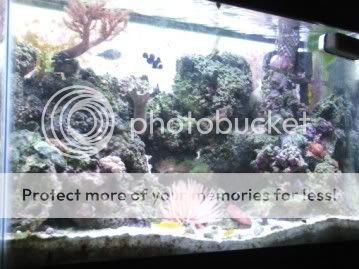
March 1, 2006
Here is my most recent picture. It was taken some time in mid-October. If I didn't know what rocks were DIY already, I wouldn't be able to tell the difference. The tank looks devoid of life now because of an old bulb. I've been having difficulty getting a new bulb in and it's starting to really take it's toll. Lesson learned: change out your bulbs often or you WILL lose livestock.
Travis L. Stevens
Active member
I used to. All my Montiporas died because of the light. I've been battling this for 6 months. It can only be the light. Water parameters have been spot on for 6 months. No predators. Same temperature. You name it. It has to be the bulb. Here's what I've lost:
Almost all the Zoanthids that you see on the left side of the tank. Half the Corallimorphians on the right side (Ricordea included), all of my Montiporas, all of my Candy Canes, all of my Euphyllia except a Torch and a Hammer that is slowly going downhill, and a few other things. Seriously, never let your bulbs get too old. Mine is about 2 going on 2.5 years. I wanted to replace it when it was about a year old but I didn't have the money for a few months, and now I'm having trouble getting it in. Let this be a lesson to everyone that reads this to change your bulbs!
Almost all the Zoanthids that you see on the left side of the tank. Half the Corallimorphians on the right side (Ricordea included), all of my Montiporas, all of my Candy Canes, all of my Euphyllia except a Torch and a Hammer that is slowly going downhill, and a few other things. Seriously, never let your bulbs get too old. Mine is about 2 going on 2.5 years. I wanted to replace it when it was about a year old but I didn't have the money for a few months, and now I'm having trouble getting it in. Let this be a lesson to everyone that reads this to change your bulbs!
- Status
- Not open for further replies.
Similar threads


- Replies
- 0
- Views
- 164