The Ultimate DIY Rocks!

Status
Not open for further replies.
<a href=showthread.php?s=&postid=9474727#post9474727 target=_blank>Originally posted</a> by WarDaddy
quick search I found this...

So this may suggest that by submerging the rocks too soon, calcium hydroxide is removed from the rocks (water soluble), resulting in more free silica dioxide and weaker rocks due to the production of less C-S-H. However, as silica is implied to be the limiting factor, it is hard to say whether the normal "kuring" process of water changes would result in calcium hydroxide becoming limiting.
 
<a href=showthread.php?s=&postid=9475201#post9475201 target=_blank>Originally posted</a> by MusMusculus
So this may suggest that by submerging the rocks too soon, calcium hydroxide is removed from the rocks (water soluble), resulting in more free silica dioxide and weaker rocks due to the production of less C-S-H. However, as silica is implied to be the limiting factor, it is hard to say whether the normal "kuring" process of water changes would result in calcium hydroxide becoming limiting.

Which leads to my question... are we better off putting these I water early on or even at all? Should we just let it cure 8 weeks in the sun, give it a good soak to be sure any "nasties" are out of the rock, and then start seeding it?
 
<a href=showthread.php?s=&postid=9475234#post9475234 target=_blank>Originally posted</a> by WarDaddy
Which leads to my question... are we better off putting these I water early on or even at all? Should we just let it cure 8 weeks in the sun, give it a good soak to be sure any "nasties" are out of the rock, and then start seeding it?

I think that is a good question that is best answered with a series of experiments. But, I've heard that even cement blocks will need to be Kured before placing in an aquarium. I've never had cement blocks in my aquarium, but I've seen people who have.
 
I'm also thinking of making my background on the 240G out of greatstuff foam and painting it with colored concrete. I won't be able to cure it under water other then misting it. Do you think this is a problem considering this small volume of cement in such a large system?
 
WarDaddy,

I think you are on the right track. Stronger rocks would certainly result from a longer moist curing (not submerged-moist and warm). This would give time for more C-S-H to be produced, and consequently a reduction in the levels of both calcium hydroxide and silica dioxide. I just don't know what "stronger" would be--0.1% more C-S-H or 700% more?

According to wikipedia the formula for C-S-H is:

"2(CaO) • SiO2 • 0.9-1.25(H2O) and/or
CaO • SiO2 • 1.1(H2O) and/or
0.8-1.5(CaO) • SiO2 • 1.0-2.5(H2O) and more!"

Kind of a mess, but since the starting materials are C3S and C2S it seems there will always be an excess of calcium (ending up as calcium hydroxide) that will eventually need to be removed by "kuring". Which your article mentions and indicates that more free silica dioxide should be added for more CSH production and therefor stronger cement. So is this chemical reaction (possibly with additional silica dioxide) a faster way to "remove" the calcium hydroxide than soaking in water? Maybe a moist/warm month of curing would only take 2 extra weeks of "kuring" and produce stronger rocks with less free silica dioxide. Maybe not. Only way to tell is a side-by-side test, I think. pH would be a valid, if indirect, test for the amount of free calcium hydroxide remaining in the rocks.
 
I've been saying and saying to leave the rocks out of the water for a minimum of a week, and longer if you can stand it - the last "Super Long Post" of tips, etc. even had an updated bit about it. Nice to see some research to back it up.

I am in a position to try this experiment, Travis, as I have a few pounds of rubble from my first attempt at my nanos' back wall. It broke up because I didn't follow my own advice and tried to see what I had made the next day. It should be 5-7 weeks old (I can't remember exactly), and was never placed in water. I also didn't make it with salt, so there should be no issue with whether the salt messed with it.

A perfect sample for an experiment. Since it was made with the same recipe the wall that didn't break up used, I can use the backwall as the basis to compare. My backwall went into water a week after being cast, and took 3 weeks in my toilet to kure.

I will dump this rubble into some water and see what we see.

pH would be a valid, if indirect, test for the amount of free calcium hydroxide remaining in the rocks.

Would a basic calcium test be better?
 
<a href=showthread.php?s=&postid=9475572#post9475572 target=_blank>Originally posted</a> by Insane Reefer


Would a basic calcium test be better?

Edited:

A calcium test may work (I would need to read up on the chemistry) but I realize that I was misleading above. The pH test is a measure of the OH from Ca(OH)2 (it is actually a measure of H+level, but as the available H+ will bind with available OH-, we indirectly see the effects of the OH-). Anyway, in the absence of any other buffer, pH should be a very easy way to measure the amount of Ca(OH)2 dissolving into the water.

Hopefully I'm not missing anything here. My inorganic chemistry classes were a LONG time ago!
 
Last edited:
<a href=showthread.php?s=&postid=9475810#post9475810 target=_blank>Originally posted</a> by MusMusculus
A calcium test may work (I would need to read up on the chemistry) but I realize that I was wrong above. The pH test is a direct measure of the OH from Ca(OH)2, not indirect. So, in the absence of any other buffer, pH should be a very easy way to measure the amount of Ca(OH)2 dissolving into the water.

Hopefully I'm not missing anything here. My inorganic chemistry classes were a LONG time ago!

I hear ya! :lmao: FWIW, that's what I was attempting to conclude in my long post of my theories above.
 
<a href=showthread.php?s=&postid=9475852#post9475852 target=_blank>Originally posted</a> by Travis L. Stevens
I hear ya! :lmao: FWIW, that's what I was attempting to conclude in my long post of my theories above.

Oops, I saw WarDaddy's link and got so interested in the article that I didn't realize that you had a new post above his! Sorry! Now I understand your post below WarDaddy's about "Chemical X". :)
 
<a href=showthread.php?s=&postid=9476013#post9476013 target=_blank>Originally posted</a> by Insane Reefer
Wasn't "Chemical X" what Professor Utonium accidently added to the mix when he made the Powerpuff Girls?

:lmao:
 
<a href=showthread.php?s=&postid=9476013#post9476013 target=_blank>Originally posted</a> by Insane Reefer
Wasn't "Chemical X" what Professor Utonium accidently added to the mix when he made the Powerpuff Girls?

Try as I might, my rocks still look and act nothing like the Powerpuff girls. Though one did seem to hop off the table and attack my foot the other day, so maybe I'm getting closer....
 
Ok - test batch 1 is in to soak in 1g of FW - I will test in the morning and report the results, and do so again for each of the next 2 days. I have a liquid test kit, so should be pretty accurate.

It took a total of 4 weeks from casting to kure the backwall I have in my tank now - funny thing is it actually lowered my pH, but raised my ALK. One of you science geeks want to hazard a guess why that might be?

These test rocks are a few days older and never submerged. If the pH on this test water is <8.6, I will proceed to kure the rock out, as I did the final piece, in my toilet, and see if "time until safe" is any shorter.

It would be nice to sort of prove that the kuring can be done dry, with a short week or two soak to remove impurities - this could save lots of $$$, effort and water. I really hate how much water I am wasting to do this - waste water to save the reef...
hummm...

I was going to make more rock tonight, so I will make 4 extra test pieces, from 2 separate mix batches for diversity and more data. Flat softball size, 2-3"in thick. 2 will sit outside as suggested, in a black bag with added moisture. 2 will sit for 3 days dry, and then go into the kuring bin. At the end of 4 weeks, both will be tested in FW and results will be posted.

Any suggestions or comments for running this test? Maybe I should also do a batch with the grey portland? I can't get type III here, so would use what I have on hand, type I/II.

 
<a href=showthread.php?s=&postid=9475403#post9475403 target=_blank>Originally posted</a> by zachtos
I'm also thinking of making my background on the 240G out of greatstuff foam and painting it with colored concrete. I won't be able to cure it under water other then misting it. Do you think this is a problem considering this small volume of cement in such a large system?

Why can't you cure it underwater? Is the tank already up and running? If it isn't, just fill it with FW (you should anyway to test the plumbing) and allow the rock a few weeks in that - then empty, and go at it :)

Even so, it really depends on how thick your cement paint is. If less than 1/4in, I really couldn't see you having too much trouble.

Just be prepared to lower your pH chemically if it becomes a problem.
 
Eureka!

Eureka!

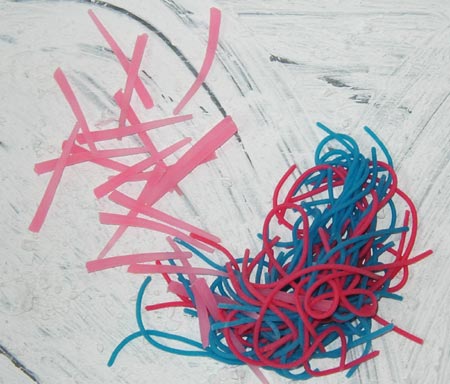
I have been searching and searching for a better way to make small tunnels in my rocks. I finally found it.

125181tunnel-stuff1.jpg


125181tunnel-stuff2.jpg


These are from those squidgy toys made of like jelly silicone. They do not need to be oiled - they release with a few gentle tugs, and best of all, they are reusable! Just leave the end sticking out, and you are set. The longer ones are almost 5" and you can make some really convoluted tunnels with it.

I picked the "Mondo Ultimate Spaghetti ball" up at Wal-Mart for just under $4 - the shorter ones are from a dollar store Flashing Urchin jelly toy.

I also tried jelly Fishing Bait - the wormy kind - these made thicker tunnels and released well too. Only thing is they are sort of slimy and stink :(

Just thought I would share :)
 
to make tunnels, my buddy made a simple suggestion. Just use drinking straws. Put your thumb over the end and just stick em in the rock after you mold it before it dries. Placing your thumb over the end prevents the cement from getting in the straw. After it cures, just trim the straw out with a razor blade. These holes can be big like drinking straws, or small like stirring straws.

*I guess I can try to cure the thin layer of cement on the great stuff foam for a week or two with regular fresh water, it'll be a while till I fill it up anyways I guess. I'll make a posting in a few weeks when I get time to start my 240gallon.
 
The only problem with your suggestion Zach is that you only get straight shots, which don't happen in nature very often - the result is less than convincing, but does work. If you lube the straws with veggy oil, you can usually pull them out with pliers...
 
Re: Eureka!

Re: Eureka!

<a href=showthread.php?s=&postid=9477001#post9477001 target=_blank>Originally posted</a> by Insane Reefer
I have been searching and searching for a better way to make small tunnels in my rocks. I finally found it......


Great idea! Just a warning, though; I went out for some of these and some of the squishy toy things proclaim themselves to be anti-bacterial. Pure marketing crap, but they are likely putting in something like triclosan. I couldn't find the strings you have there, but I got some squishies with various length legs that I will cut off and try out. Thanks!
 
Last edited:
Re: Re: Eureka!

Re: Re: Eureka!

<a href=showthread.php?s=&postid=9479393#post9479393 target=_blank>Originally posted</a> by MusMusculus
Just a warning, though...and some of the squishy toy things proclaim themselves to be anti-bacterial

Good to know, but I am not too sure how much I'd worry about an anti-bacterial agent. I think by the time all is said and done, that stuff will be long gone. The Mondo Ball does have a Choking Hazard warning on it though. I find that particularly funny as the thing won't fit into my fist - it almost doesn't fit into my doubled fists; how big of a mouth would one need to get it in so far as to choke?!?
:eek2:

I couldn't find the strings you have there, but I got some squishies with various length legs that I will cut off and try out. Thanks!

I think any you find would be ok - I was just pleased that these strings were so long - not often do you find them longer than 2 inches or so.
At Wal-Mart, or at least the one I went to, these were in the next isle down from the bikes, and near the toy pool stuff - had a lot of little "dog toys" made for kids in that section, as well as toy balls - not real basketballs and the like, just toy and hand balls...

HTH
 
Re: Eureka!

Re: Eureka!

<a href=showthread.php?s=&postid=9477001#post9477001 target=_blank>Originally posted</a> by Insane Reefer
....the shorter ones are from a dollar store Flashing Urchin jelly toy.

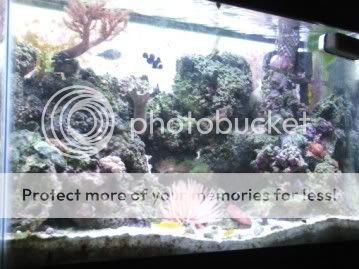
I use these as surrogate anemones for my clownfish.
29gOctober2006.jpg
 
Status
Not open for further replies.
Back
Top