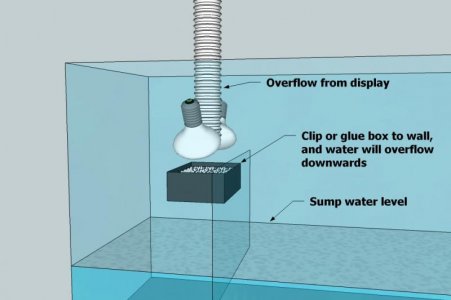
thinking about ATS on new tank, have questions

elmatth1

Premium Member
First, the tank is a standard 75 glass aquarium that is not drilled... yet.

Every tank I have set up in the past has had a refugium with cheato. It always worked ok for nutrient export, but I hated dealing with the small bits of cheato that would get into the display and take hold in my live rock and grow. Now, i'm reading up on waterfall ATS units and think I'm going to try that route, but I have a few questions.

First question: I would like to feed the ATS from my drain, and since the tank is not drilled yet, what type of drain would best accomplish this feat? Is this even a good idea? I have an 800gph pressure rated external pump and a 1000gph internal pump to choose from to feed the tank. I will be "t"ing off the return for a media reactor, so I would think adding another piece of equipment to the feed line would take too much away from what gets returned to the tank.

Second question: will an ATS cause my alk to drop to the point that I will need to start dosing it! The tank will house mostly softies and LPS and I will be using kalk in my topoff to maintain calcium and really don't want to start having to dose two part as well. Will running a protein skimmer help get enough CO2 into the water to eliminate this issue?

Third question: what is a good screen size for this tank and wilk it handle the flow from the drain? I will only be feeding one to two cubes at first and probably no more than 3 to 4 cubes later on down the road. I don't really expect to have a high bioload.

Any help would be most appreciated.
 
Thanks, but I did. Show me where in the basic thread it talks about the best overflow type to use with the ATS or how much alk consumption changes with use of an ATS. I also also understand that I need about 12 square inches of screen size per cube fed with a flow rate between 35 to 50gph, but it doesn't say if the 1/8 slot cut into the pvc will keep up with the flow rate I will be using for a given screen size. I appologize if the thread does address these issues, but I just didn't see them.

I don't mean to sound like a d**k, but how does telling me to read the sticky or google it (as alot of people like to say) help me with my questions? If you have any suggestions or answers to my questions above, I would love to hear them.
 
People feed from the overflow all the time. You can even do it with an overflow-fed upflow version, if you "pour" it down on it. Pulling in CO2 is not really of use, but the bubbles will probably help (the air/water interface helps growth). And the overall flow-through rate of the overflow is not important to the scrubber, so size it to fit whatever else you need it for (a scrubber only removes a tiny amount of nutrients on each pass, but does so continuously).

The kalk will probably supply whatever alk you'll need. Unless your scrubber starts growing mega amounts, you probably won't have to add more alk. Adding a skimmer probably won't add much CO2 beyond what your already large air-touching scrubber will (waterfall area, or bubble upflow). The LPS won't demand much alk, but if you get lots of corraline you might get a urchin etc to keep in down. Besides, even if you needed to add alk, some baking soda once a week would do fine.

For size, a waterfall needs up to 50 gph per inch of width, so you might plan for 18", but this would only need to be 3" or so tall for 48 total; so it might be better to bypass more than half of it and go with 6" wide X 8" tall. This way it can hit the water below. However if you do an overflow-fed upflow (pic), it does not matter how much flow there is; more is better.
 

Attachments

  • placement above.jpg
    placement above.jpg
    35.3 KB · Views: 9
I plan on using my overflow to feed my ATS, it's the dirtiest water so that's best. IMO feeding several times per day will help the algae growth ( 2-3 times anyway ) don't think that there will be much of an alk swing at all if you program ATS lights to be on for at least an hr before display lights are off. That way there are no dark periods at all
 
First question: I would like to feed the ATS from my drain, and since the tank is not drilled yet, what type of drain would best accomplish this feat? Is this even a good idea? I have an 800gph pressure rated external pump and a 1000gph internal pump to choose from to feed the tank. I will be "t"ing off the return for a media reactor, so I would think adding another piece of equipment to the feed line would take too much away from what gets returned to the tank.

I 'feed' my ATS with water from my main tank drain, works fine. If you have not yet drilled your tank, set it up with a dual drain herbie and feed the ATS from the siphon.

Second question: will an ATS cause my alk to drop to the point that I will need to start dosing it! The tank will house mostly softies and LPS and I will be using kalk in my topoff to maintain calcium and really don't want to start having to dose two part as well. Will running a protein skimmer help get enough CO2 into the water to eliminate this issue?

I have not noticed that my ATS affects calcium or alkalinity levels at all.

Third question: what is a good screen size for this tank and wilk it handle the flow from the drain? I will only be feeding one to two cubes at first and probably no more than 3 to 4 cubes later on down the road. I don't really expect to have a high bioload.

I forget the exact calculation, but I think it is something like 12 square inches of dual sided screen per cube of food daily. Check the ATS thread, that info is there somewhere. other thing to consider is that ideal water flow is 35 gph per linear inch of feed pipe, so if you are running 700 net gallons per hour, implies a 20" pipe (which is impractical probably) so you may need to divert part of your drain away from the ATS. I run a 12" pipe with approx. 400 gph and it seem to work fine.
 
Here you go:

Scrubbers are sized according to feeding. Nutrients "in" (feeding) must equal nutrients "out" (scrubber growth), no matter how many gallons or liters you have. So...

An example VERTICAL upflow or waterfall screen size is 3 X 4 inches = 12 square inches of screen (7.5 X 10 cm = 75 sq cm) with a total of 12 real watts (not equivalent) of fluorescent light for 18 hours a day. If all 12 watts are on one side, it is a 1-sided screen. If 6 watts are on each side, it is a 2-sided screen, but the total is still 12 watts for 18 hours a day. This screen size and wattage should be able to handle the following amounts of daily feeding:

1 frozen cube per day (2-sided screen), or
1/2 frozen cube per day (1-sided screen), or
10 pinches of flake food per day (2-sided screen), or
5 pinches of flake food per day (1-sided screen), or
10 square inches (60 sq cm) of nori per day (2-sided screen), or
5 square inches (30 sq cm) of nori per day (1-sided screen), or
0.1 dry ounce (2.8 grams) of pellet food per day (2-sided screen), or
0.05 dry ounce (1.4 grams) of pellet food per day (1-sided screen)

High-wattage technique: Double the wattage, and cut the hours in half (to 9 per day). This will get brown screens to grow green much faster. Thus the example above would be 12 watts on each side, for a total of 24 watts, but for only 9 hours per day. If growth starts to turn YELLOW, then increase the flow, or add iron, or reduce the number of hours. And since the bulbs are operating for 9 hours instead of 18, they will last 6 months instead of 3 months.

HORIZONTAL screens: Multiply the screen size by 4, and the wattage by 1 1/2. Flow is 24 hours, and is at least 35 gph per inch of width of screen [60 lph per cm], EVEN IF one sided or horizontal.

FLOATING SURFACE SCRUBBERS WITH RIBBONS: Screen size is the size of the box (Lenth X Width), and is 2-sided because the ribbons grow in 3D.

LEDs: Use half the wattage as above. 660nm (red) is best. You can mix in a little 450nm (blue) if you want.

Very rough screen made of roughed-up-like-a-cactus plastic canvas, unless floating surface, which would use gravel and strings instead.

Clean algae:

Every 7 to 21 days, or
When it's black, or
When it fills up, or
When algae lets go, or
When nutrients start to rise
 
Back
Top