Two Clownfish Fighting--Please Help!

ScubaPrawn

New member
I have had two clownfish for over a year in a 47g column tank. They were purchased from the same LFS and were in the same tank together as the only two clownfish in the tank, so I thought they'd be friends.

Well when they get to my tank, Clownfish 1 attacked Clownfish 2 every now and then to assert her dominance. Clownfish 2 did the submissive "C" shape and everything was fine. They usually spent time on different parts of the tank but they lived peacefully except for an occassional attack by Clownfish 1 to reassert her dominance.

NOW...tonight Clownfish 2 has absolutely gone berserk! He is attacking Clownfish 1 and not letting up. He's biting her, tearing her apart, and chasing her all over the place. She's staying up in the corners of the tank trying to go unnoticed but Clownfish 2 is relentless. This isn't like the earlier attacks by Clownfish 1 asserting dominance...it's like he's trying to kill her. I can't figure this out.

Anyone got any ideas or seen anything like this before? I never would have thought the dominant clownfish would so quickly become the victim. :(
 
try to catch the one who's gone berserk on your female and keep him in a specimen container or something near where the female normally sleeps for a few days or a week. let her get her territory established again and try again. that is pretty odd behavior to me. the only possibility i could offer to the male attacking the female would be the female may have become ill and the male is trying to get her out, OR if they are similar in size, since they spent time apart maybe the male started to become a female?

someone else should chime in
 
It's going to be hard catching him. Will he be ok in a small breeder net cage? I can't believe this. Up until last night they were fine....then WWIII broke lose!
 
What type of clowns?

Agree with Ethan, it is a bit strange after all this time that the male would try and take over. Are there any other clowns in the tank besides these two?

Edit: Also what is the size difference between 1 and 2?
 
Yeah that's what I don't get...how does the dominant one turn weak and the weak one turn dominant? I'm not sure that the first clown has turned female yet but I assumed she did b/c she was dominant for about a year.

They're both ocellaris clowns. They are about the same size with the originally dominant clownfish (the one getting picked on now) being a little bigger.

Is there any way possible that both could have morphed into female being in a small tank together???
 
Depending on their size they don't change sex until they ate big enough approx 11/2 to 2 inches usually a year old or little longer they were probably juveniles when u got them they established territory now establishing sex just my thought could just be stress if u added anything
 
Yeah that's what I don't get...how does the dominant one turn weak and the weak one turn dominant? I'm not sure that the first clown has turned female yet but I assumed she did b/c she was dominant for about a year.

They're both ocellaris clowns. They are about the same size with the originally dominant clownfish (the one getting picked on now) being a little bigger.

Is there any way possible that both could have morphed into female being in a small tank together???

I'm surprised after a year the growth has been more pronounced bewteen the two. However, if they are both roughly the same size currently there is a chance that the dominace is just now coming into play. I just read another post earlier where someone has had some success just separating two black and whites for a few days by keeping one in a breeder box . After the separated clown was released they went back to their previous behavior and aggression stopped. Maybe you say this post already but wanted to mention it. However, it is likely this is going to have to work itself out eventually. Fortunately my pair never showed any severe aggression so I am not sure where the line is between wanting to kill each other and just working out who will be the female.

I'm sure someone with more experience will chime in.
 
It's going to be hard catching him. Will he be ok in a small breeder net cage? I can't believe this. Up until last night they were fine....then WWIII broke lose!

that should be fine. my clownfish are pigs and try to eat everything. therefore they are easy to catch. just take a 1 or 2 liter bottle and make a bottle trap and put some pellets or shimp inside of it. then put it facing that clown's area and keep an eye on it. they will usually venture inside if they are hungry. i attach a piece of fishing line to the bottle so i can pull it up quickly.

sometimes you have to be patient but it usually works. i would probably keep the little clown in the breeder net for at least a week, maybe 2. i hope this helps
 
Yeah that's what I don't get...how does the dominant one turn weak and the weak one turn dominant? I'm not sure that the first clown has turned female yet but I assumed she did b/c she was dominant for about a year.

They're both ocellaris clowns. They are about the same size with the originally dominant clownfish (the one getting picked on now) being a little bigger.

Is there any way possible that both could have morphed into female being in a small tank together???

Ocellaris clowns will pair much more easily if there is a significant size difference when first introduced. Two fish of the same size will battle much longer and harder for dominance. It sounds to me like they may be just reaching sexual maturity. Any aggresion prior to this happening is more posturing than anything else. Two male clowns reaching maturity at the same time are very likely to fight. I'm not at all sure that their sex has been determined. Size here is key. A female should be considerably larger than a male. The female in my breeding pair of occs is 3+ inches, while the male is less than 2". Their length doesn't tell the story though, because in terms of overall mass, the female is more like three to four times as "heavy". The weird thing with clowns is they mature at different rates based on their environment.

I would say seperating them is very important. I have had clowns kill each other before. But you might want to think on going even a bit more drastic. If your LFS is cool, you might consider trading one of them in on either a much smaller or much larger fish. That's what I personally would do, ..... unless I was attached .... emotionally.
 
Ocellaris clowns will pair much more easily if there is a significant size difference when first introduced. Two fish of the same size will battle much longer and harder for dominance. It sounds to me like they may be just reaching sexual maturity. Any aggresion prior to this happening is more posturing than anything else. Two male clowns reaching maturity at the same time are very likely to fight. I'm not at all sure that their sex has been determined. Size here is key. A female should be considerably larger than a male. The female in my breeding pair of occs is 3+ inches, while the male is less than 2". Their length doesn't tell the story though, because in terms of overall mass, the female is more like three to four times as "heavy". The weird thing with clowns is they mature at different rates based on their environment.

I would say seperating them is very important. I have had clowns kill each other before. But you might want to think on going even a bit more drastic. If your LFS is cool, you might consider trading one of them in on either a much smaller or much larger fish. That's what I personally would do, ..... unless I was attached .... emotionally.

Were the clowns that killed each other both male? Were they the only two in the tank? I was able to catch the aggressive fish and put him in a small net breeder cage in the tank. I was planning on keeping him there a few days and letting him out later, but now I'm not so sure.

I've heard of clowns killing each other if more than two are in the tank or if they're of different specieis, but not two of the same species in the same tank. I'd like to keep both because I've had them for over a year together, but the one being attacked is the one I like the most so if I absolutely have to part ways with one it'd be the one being the punk right now. :(
 
I've heard of clowns killing each other if more than two are in the tank or if they're of different specieis, but not two of the same species in the same tank.

This depends on both the species and the individual fish. Some species are more aggressive, some individuals are less so. All clowns (except Maroons) are found in the wild in groups of up to 15 fish. So, there is no reason you can't have more than two in a tank. I would not recommend more than 6 or 7 of any of the other species in the same tank. One Maroon is fine. Two will start a war for dominance. More than two is usually a disaster for all tank inhabitants, even if they are not clowns or not even fish!

What you describe is unusual in Percula complex species - particularly with ocellaris. It is possible these fish still are sorting out dominance, but they should have done that months ago. You say you've had them for a year, and that they are close in size, but how big are they, exactly? Knowing how large they are now and how much they've grown in the year you've had them could hint at their ages and, possibly, their sexes as well. Also, once dominance is established, the female will grow much larger than the male, which apparently didn't happen here. That sounds fishy - no pun intended. It's possible two females were "paired" at the LFS. It's not likely they morphed together in your tank.

Last possibility, strange as it sounds, is that they are in the process of mating and are arguing about nesting. I have seen this first hand. It's the only thing any of mine ever fight about.

Would be great if you could post a picture - particularly of the "under the belly" area. If the picture's clear, it may be telling.
 
Were the clowns that killed each other both male? Were they the only two in the tank? I was able to catch the aggressive fish and put him in a small net breeder cage in the tank. I was planning on keeping him there a few days and letting him out later, but now I'm not so sure.

I've heard of clowns killing each other if more than two are in the tank or if they're of different specieis, but not two of the same species in the same tank. I'd like to keep both because I've had them for over a year together, but the one being attacked is the one I like the most so if I absolutely have to part ways with one it'd be the one being the punk right now. :(

yes they were always both males. I've had two deaths where I was trying to form a pair, so they were the only two in the tank, but also others in tanks with multiple juvenile clowns. It is less common IME for two individuals of the same species in a single tank to fight to the death, than in tanks with large numbers or different species of clowns.

It's important to understand that all clownfish are born as males. Interestingly you can usually keep numerous clowns of the same species in a tank as juveniles with nothing more serious than bickering type behavior, but when they reach sexual maturity, the fighting can become deadly very quickly. In order for us to get you the best possible information, it's important for us to know their actual sizes. I know it may be difficult to tell, but it is the single most important indicator of sex. If they are both sub-adult males, then the answer is much different than if they are both sexually mature females. Are either or both of them larger than 2"?

Assuming they are both still males, and are reaching sexual maturity, the sudden increase in aggresion would normally be much less pronounced in a pair that had been together for a year, but I believe you wrote in your earlier posts that they had never really hung out together? If so, then they never were a pair, just two clowns living in the same tank. Clowns that have bonded as a pair will never be far apart. They will sleep together or at least in close proximity, and posturing for dominance will involve less drastic behavior. Pre-spawn aggresion does occur, but if they are very close in size, it is very un-linkely that this is the case.

Ultimatley, no matter what the underlying cause, putting these two clowns back together involves some risk. If they never exhibited bonded pair type behavior before, I personally wouldn't do it. If you do decide to, then there are some steps you can take to help them along. 1st Make sure there are plenty of hiding spaces. You can cut several small lengths of 1 1/2" to 2" pvc pipe and simply drop them in the tank. 2nd when re-introducing either fish, monitor them closely. If they fight, one will usually end up at the top of the tank tilted slightly on it's side. If that happens get it out quickly. Keeping one in a breeders net or something similar where they can see each other, but not interact, is important. 3rd prior to any re-introduction, make sure they are both fed to saturation. IDK why, but this sometimes can help.

Good luck, and please post pics and their sizes!!!
 
I will try to post pics tonight! It's hard to guesstimate their size but I'd say both are hovering somewhere around 2 inches. The really ironic thing is that clownfish 2 (the one that is now the aggressor) was usually too scared to come out far in the water column for food so I intentionally sent food his way a couple times b/c I felt bad for him. Now he's become a monster! He's in the breeder net in the same tank but he's not eating...maybe too startled to eat right now? When he attacked a couple days ago clownfish 1 was up near the top and turned sideways in the tank...I had never seen that before. Before when clownfish 1 was the aggressor it was usually nothing just a bite or two and clownfish 2 did the submissive "C" shape.

I'll try to get some pics, thanks so much for the advice!
 
"... fed to saturation." Is that even possible?? :lol:

I wonder how old these fish are. After a year at home, they should be bigger than 2 inches. My ocellaris are about that size less than a year after hatching. How much have they grown since you have them? Also, what do you feed them? I'm just trying to figure out how old they might be.
 
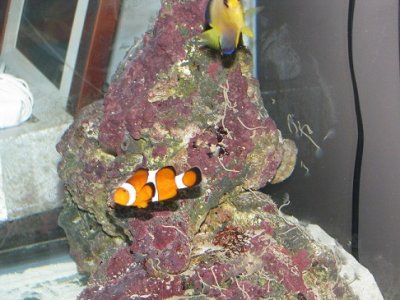
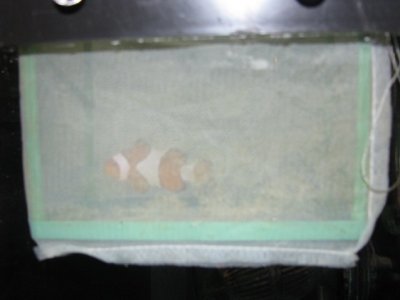
Ok here are pics of the clowns. The one in the cage is the one being the aggressor.

I think they were around the 1 inch to 1.25 inch mark when I got them a year ago. I'm guessing they're a little over 2 inches now...but it's hard for me to tell.
 

Attachments

  • IMG_0675.JPG
    IMG_0675.JPG
    98.4 KB · Views: 1
  • IMG_0677.JPG
    IMG_0677.JPG
    42.8 KB · Views: 2
If they've basically doubled in size in a year, they are still young. At this size, it sounds like they're about 1-1/2yo. This is the reason the aggression started since they are at breeding age. It's a bit surprising, since they are the only two in the tank and there was an established pecking order for so long.

It may help to rearrange the rock structures if you're going to re-introduce the clown that's in the breeder net. This way, there will be no established territory to defend for either of them. Make sure there are plenty of hiding places for them. Duncaholic has a very good suggestion to feed them well before putting them together. That would make one less thing to fight about: Food.

You're going to have to watch them, so do this on a day that you can spend a few hours with your nose to the glass. If either of these fish appears to be in trouble, you need to rescue it and put it back in the breeder net. It would be better if you could set up a divider in the tank so the one is not boxed in, but I realize you can't do that with a 47 column. If you had that, you could see how they react to each other from opposite sides of the panel. This would give you an excellent clue as to whether or not these two fish can be paired or must be separated permanently.
 
It's a bit obvious, especially since you've had them a long time and know how they act under normal conditions. Healthy aggression would be a little more than just "rough play" with charging and some nipping. There will be tail smacks and a lot of displays of prowess, very much like a bunch of kids at the playground.

When one of them goes after the other like a junkyard dog, that's a bad sign. You would see one corner the other and charge/attack it repeatedly. Even if the second fish concedes defeat and tries to get away, the first may try to hunt it down. If you see this happening, you must rescue that fish and accept that these two cannot be together now. It may help to keep them separated, with the one in a breeder net, or it may not. I have seen rare cases where they just don't get along.
 
Back
Top