
You are using an out of date browser. It may not display this or other websites correctly.
You should upgrade or use an alternative browser.
You should upgrade or use an alternative browser.
Wasting water, the RO/DI problem!
- Thread starter herostar
- Start date
LPS_Blasto
New member
I have a storage tank under the garage floor. I wash the cars and water the lawn with it.


windlasher
New member
"I use a water de-ionizer with carbon. I get 0 TDS with NO wastewater."
Please Explain This?
Please Explain This?

Plankt0s
Premium Member
I have gotten quite a few PM's asking about my DI unit so I will just elaborate here. I lease a water DI unit from culligan. I dont want to get into cost but you can call your local culligan. The DI unit that I use has one cubic foot of carbon then goes through a cubic foot of a mixed bed DI resin ( both the cation and anion ) once it leaves the first mixed bed there is a TDS meter. The water then goes through another mixed bed with a second TDS meter. As soon as my first TDS meter starts reading 1-2 PPM I take my first chamber back to culligan and they recharge the resin, and I put the new chamber last in series and enjoy a constant supply of 0 TDS water as fast as I want it. I will say that the cost is probably too much for the "average" hobbiest but I would not ever go back to a RO unit again.
One last thing I lived in Virginia beach for a few years and I had a DI unit that I leased from "Hydro-logix" and I only paid $0.135 (thirteen and a half cents) per gallon.
 NOT MY PIC
One last thing I lived in Virginia beach for a few years and I had a DI unit that I leased from "Hydro-logix" and I only paid $0.135 (thirteen and a half cents) per gallon.
TheLivingReefFL
New member
I'm shocked to find out you can get city water at 170 or 40, Mine comes in between 340 to 360, so the 4 gallons I dump has got to be dirtier then my septic.
I'm a laundry wastewater chick...
We had a setup with 2 brute buckets with float switches, one for fresh and one for saltwater RODI...
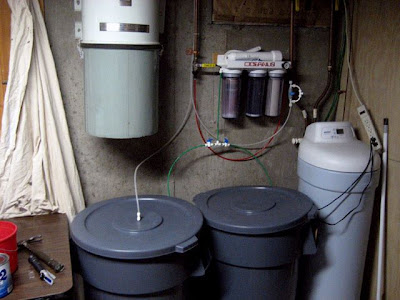
The wastewater went into a third bucket with a float switch, and I dumped it into my washer whenever doing the laundry. We set it up so that once the laundry bucket filled, the rest of the water drained outside into a rain barrel (and then onto our lawn).
good times!
We had a setup with 2 brute buckets with float switches, one for fresh and one for saltwater RODI...
The wastewater went into a third bucket with a float switch, and I dumped it into my washer whenever doing the laundry. We set it up so that once the laundry bucket filled, the rest of the water drained outside into a rain barrel (and then onto our lawn).
good times!
TampaSnooker
Active member
1/4" drip tubing from Wally World keeps my gardens happy in the drier months. T's and valves are very inexpensive and repairs are easy when you forget where you buried the line. There are surely plants that don't like the higher TDS water but I haven't found mine to be anything less than grateful for the extra drink and nutrients.
windlasher
New member
For drinking water I believe that culligan uses high capacity RO units and ozone.

Thats a little much... lol - Air, Water, ICE, has one that produced 20 gals per min, 1000 gals per day for about $2500.

socalmiket
New member
I use my RO waste water in two ways:
- As water change and top-off for my water barrel ponds
- As irrigation water for plants
As stated, Southern California is in a drought, so not wasting the "waste" water is a good idea. Since the waste water already went through a fiber filter and two blocks of carbon its far better than the tap for these uses.
- MikeT
- As water change and top-off for my water barrel ponds
- As irrigation water for plants
As stated, Southern California is in a drought, so not wasting the "waste" water is a good idea. Since the waste water already went through a fiber filter and two blocks of carbon its far better than the tap for these uses.
- MikeT
I see both sides of this argument, but I think the solution is more about what we DO with the waste water vs. trying to stop any waste water.
Filling your washing machine with waste water from your RO/DI unit is a great first step, and the craze towards front loading washers makes this choice a rapidly diminishing option.
Watering your lawn/garden/plants with your waste water is a good option too. I personally run my waste water hose out onto the grass in my yard instead of watering parts of my lawn. This past summer in southern Texas was one of the hottest on record - 60 days + of 100 degree heat with very minimal rain. Cities started wide watering bans and the only parts of my yard that are still alive are the parts in the shade, or the parts that my RO/DI waste water hose reached.
Could I remove the grass and stop the need for watering? Yes, I could, but I'm not. I'll just keep watering my grass with my RO/DI waste water and let the dead stuff grow back next spring when it rains again.
I think more complicated systems such as collecting all the waste water, then pumping to your showers or feeding into sprinkler systems is a nice idea, but until the governments of the world require that we take such steps, most people will chose more corals/gear for the tanks vs. spending lots of money on saving waste water.
Waste reducing methods such as the double membrane that Bulk Reef Supply sells are great steps, but water is still so cheap as a commodity that I personally can't justify it. I've run through 400 gallons of RO/DI in the month of September and I didn't notice it on my monthly water bill. The time to recoup your investment on a double membrane unit is too long for me. Probably by the time I get my money back, I'll need a new $50 RO membrane.
Every reefer must decide where they stand on the subject and design their systems accordingly but I don't think this issue is a problem, its merely something to make work for your benefit.
Filling your washing machine with waste water from your RO/DI unit is a great first step, and the craze towards front loading washers makes this choice a rapidly diminishing option.
Watering your lawn/garden/plants with your waste water is a good option too. I personally run my waste water hose out onto the grass in my yard instead of watering parts of my lawn. This past summer in southern Texas was one of the hottest on record - 60 days + of 100 degree heat with very minimal rain. Cities started wide watering bans and the only parts of my yard that are still alive are the parts in the shade, or the parts that my RO/DI waste water hose reached.
Could I remove the grass and stop the need for watering? Yes, I could, but I'm not. I'll just keep watering my grass with my RO/DI waste water and let the dead stuff grow back next spring when it rains again.
I think more complicated systems such as collecting all the waste water, then pumping to your showers or feeding into sprinkler systems is a nice idea, but until the governments of the world require that we take such steps, most people will chose more corals/gear for the tanks vs. spending lots of money on saving waste water.
Waste reducing methods such as the double membrane that Bulk Reef Supply sells are great steps, but water is still so cheap as a commodity that I personally can't justify it. I've run through 400 gallons of RO/DI in the month of September and I didn't notice it on my monthly water bill. The time to recoup your investment on a double membrane unit is too long for me. Probably by the time I get my money back, I'll need a new $50 RO membrane.
Every reefer must decide where they stand on the subject and design their systems accordingly but I don't think this issue is a problem, its merely something to make work for your benefit.

Neptangelo
In Memoriam
I was not sure if I should tell this but I what the heck. I use a system that I built seven years ago after talking to a biologist friend of mine... It is just four .5 micron carbon block filters in series. No waste water and my local water has a KH of 9 and CA is 440+ all I have to do is add salt. Going strong for the last seven years with no problems. No waste water. But a friend of mine uses his RO waste to help keep his swimming pool topped off.
Ok, I am looking into ways to both reduce my waste water and how to reuse my waste water. I am planning on buying a high effeciency unit to reduce the waste water from a 4:1 ratio to a 1:2 ratio. However on average I use anywhere from 55g to 80g a week depending on the temp, plus another 55g ever 2 weeks for water changes. So that is still 25 to 70 gals of waste water a week. So now how to use that water. I can't use it for washing since I have a front loader, my pond is on the opposite side of the house from my RO/DI unit, so the only option I can think of would be to use it to water the lawn and plants. So my question is, what are some methods of going about this? Are you deverting it into a holding tank and then pumping it elsewhere or diverting it into a drip system of some sort? Any sites that my show examples of going about this that I could take a look at?

It is just four .5 micron carbon block filters in series. No waste water and my local water has a KH of 9 and CA is 440+ all I have to do is add salt.
Salt? What kind of salt? Surely not an artificial seawater salt?
Salt? What kind of salt? Surely not an artificial seawater salt?
As pointed out earlier in the thread, a carbon block plus a Di can work well.
It has two drawbacks. The first is that it does not remove neutral organics (or inorganics), such as pesticides, if that is a possibility in your water. Along the same lines, it may not remove fine particulates which could include undesirable metals in them.
The second is that the DI is used about ten fold faster (or more) than when using Ro/Di. That has a substantial dollar cost that is likely prohibitive for many unless you recharge your own DI resins (which is a bit chemically intense).
But, in terms of social responsibility, one would want to consider whether the HCl and NaOH used to recharge (or make) the resins themselves require substantial energy and/or water to manufacture. I do not know the quantitative answer to that question.
It has two drawbacks. The first is that it does not remove neutral organics (or inorganics), such as pesticides, if that is a possibility in your water. Along the same lines, it may not remove fine particulates which could include undesirable metals in them.
The second is that the DI is used about ten fold faster (or more) than when using Ro/Di. That has a substantial dollar cost that is likely prohibitive for many unless you recharge your own DI resins (which is a bit chemically intense).
But, in terms of social responsibility, one would want to consider whether the HCl and NaOH used to recharge (or make) the resins themselves require substantial energy and/or water to manufacture. I do not know the quantitative answer to that question.
Purplerock SD
New member
I use a water de-ionizer with carbon. I get 0 TDS with NO wastewater.
You don't get wastewater, but the amount of water used to re-charge the DI resin is incredible. Just because you don't see the waste water doesn't mean you aren't causing any. It's built into the price you pay for the unit, but trust me, you are still causing significant waste water from this unit.
Similar threads


- Replies
- 20
- Views
- 496

- Replies
- 1
- Views
- 477

