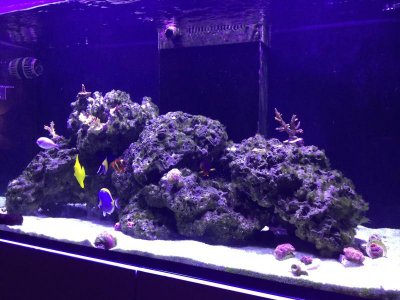
Why no corraline algae

Could anyone advise why my tank would be shy of creating corraline algae?

I have found that it only seems to form in tiny spots on my weir or on the plastic bits of powerheads etc..

The tanks been running for since January 2017..

Cal 430, mag 1400 dkh 9.8
Nitrate 5 po4 0.04.

It doesn't seem to form on my rocks, any ideas..
 
coralline generally is a medium to low light growth, tends to grow slowly in more intense light, phosphates inhibit coralline growth as well. DKH is decent but bringing it up closer to 11 DKH might help because without the carbonates coraline has a harder time calcifying.
same with calcium it's good within reef parameters but pushing that up just a bit to 450 may help.
Too scraping coraline into a high flow area to seed the tank helps a lot. and depending on what species you have in the tank already, it has to come from somewhere. so you need a source if your rocks have zero the only source you have is whatever is on frag plugs etc, so it's best to get a rock from some one that has a lot and frequently scrub the rock to speed seed the tank.
 
7D647F25-AABD-40B5-B6DD-6EB351DA49F9.jpg

Here is my tank, there is corraline algae that grows on my weir inlet and return outlet, I have some on the right hand corner of the weir. And some on my power heads...

Rock completely clear
 
well the algae growth on the rocks sugest that they are still holding a lot of phosphate (rock has an extremely high CEC capacity) so the coralline is growing on surfaces that aren't leaching phosphates back out. even if your phos is 0.04 in the water column it's much higher in the rock as exhibited by the algal growth.
 
eventually the rock will reach an equilibrium with the water as long as you maintain good quality and the phosphate concentrations in the rock will drop over time then the coraline will start to develop on the rock.
 
coralline generally is a medium to low light growth, tends to grow slowly in more intense light, phosphates inhibit coralline growth as well. DKH is decent but bringing it up closer to 11 DKH might help because without the carbonates coraline has a harder time calcifying.
same with calcium it's good within reef parameters but pushing that up just a bit to 450 may help.
Too scraping coraline into a high flow area to seed the tank helps a lot. and depending on what species you have in the tank already, it has to come from somewhere. so you need a source if your rocks have zero the only source you have is whatever is on frag plugs etc, so it's best to get a rock from some one that has a lot and frequently scrub the rock to speed seed the tank.

Somethings conflicting here, I'm having trouble with sps corals because they always die due to high alk and associated tip burn..
Some people are saying it's ok to have dkh into 9's and 10's..so I cant quite fathom what's going on..

If corraline algae grows at the height of the numbers quoted above, why can't I prevent my sps dying in the same environment.

I guess the way I'm going I'm trying to presume a correlation between corraline algae growing, and also associating it to do with poor success with my hard corals.
 
"Tip burn" is a poorly understood problem, and we don't know what actually might be happening. Most tanks can run at 9-10 dKH without problems, but some people seem to see issues if the dKH gets much over 8 dKH or so. You could try running at that level, but there are no guarantees about what might happen. I doubt that the problem will get worse, though, as long as your test kits are reasonably accurate.

Coralline algae seems to come in various strains. I had a tank that lost all its coralline when I went to brighter lighting, for example. From what I can see, there's a fair amount of purple in the bright areas. You might need to add some other strain that will grow well in the lower light area, or some other issue might need some help.

Corals can require different conditions than coralline. SPS do seem to be more touchy. They might be more sensitive to water conditions, for example, including organics and trace metals, but we don't have the tools to be sure about that. The hair algae on the rock might indicate some sort of nutrient issue, and that could limit the growth of corals and even coralline.

Are the SPS having problems other than tip burn? I might try some GFO to work on the phosphate level a bit, although .04 ppm is fairly low.

 
If corraline algae grows at the height of the numbers quoted above, why can't I prevent my sps dying in the same environment.

coralline and sps are totally different creatures, ones ideal conditions are not absolutely the others. you cant really compare the two, I would focus on the SPS, and seed as many different strains of coralline into the tank and you will eventually wind up with a type that likes your SPS's conditions.
 
"Tip burn" is a poorly understood problem, and we don't know what actually might be happening. Most tanks can run at 9-10 dKH without problems, but some people seem to see issues if the dKH gets much over 8 dKH or so. You could try running at that level, but there are no guarantees about what might happen. I doubt that the problem will get worse, though, as long as your test kits are reasonably accurate.

Coralline algae seems to come in various strains. I had a tank that lost all its coralline when I went to brighter lighting, for example. From what I can see, there's a fair amount of purple in the bright areas. You might need to add some other strain that will grow well in the lower light area, or some other issue might need some help.

Corals can require different conditions than coralline. SPS do seem to be more touchy. They might be more sensitive to water conditions, for example, including organics and trace metals, but we don't have the tools to be sure about that. The hair algae on the rock might indicate some sort of nutrient issue, and that could limit the growth of corals and even coralline.

Are the SPS having problems other than tip burn? I might try some GFO to work on the phosphate level a bit, although .04 ppm is fairly low.

I visited a reefer today who set his tank up 12 months ago ( same time as me ) using the same pukani rock, he's tank is fully covered in corraline algae and mine isn't.??

I went a different way to him in preparing my rock, he used bleach and a good soak in RO water to oxidise any unwanted organics..

I used a brick acid product from the local builders merchants which may have contained a cleaning agent..one thing I've picked up on since reflecting back to my previous posts Bertoni where you advised me of muriatic acid was that hydrochloric acid in pure form was around 35% the product I was using was 10%.. so makes me wonder what exactly else was in it..
now referring to the cleaning agent (if that was the cause of my problems) would you say that would degrade, or become diluted to insignificant levels over time?

My rock was completely bone white when I added it, it's now like a dark grey..

I've had ICP tests done and all results on paper would suggest nothing was wrong.

Where would phosphate that fuels algae come from, or is it something to do with the products I've prepared it with...

Magnesium levels are possibly too low. S/b around 1300-1350.

My mag is at 1400 it does seem to have expedited its growth rate everywhere else but not on my rock.
 
Although the rock you used was from the same source, the animals and hitchhikers that came with them might be different. Coralline require some source to get going, unfortunately.

I am not sure what was in the acid product that you used, but I'd guess that it was okay, although I can't be sure. There's no particular reason to use both bleach and acid since the acid will remove organics by dissolving the rock to which they're attached, and organics decay and are gone after some period of time, in any case.

If the acid treatment worked, either the phosphate is coming from food added to the system, or the rock you got was contaminated to a fairly deep level. What was the water:acid ratio for your dip, and how long was the rock in it?
 
When I prepared my rock the acid was used neat I used roughly 10 litres.

Whilst the rock was in the bucket there was a mass of foam and it turned the rock back to white bone in about 20 mins.

The contents of the acid afterwards was filthy brown and from what I recall it had a slimey feel to it.

I jetwashed it all off in fresh water to ensure any bits were completely removed

The corraline algae that’s formed so far has probably come from snail shells I have a fair few that seem to be covered in it, since there is nothing I’ve added that contains it.

I used the Red Sea corraline algae grow every now and then but it never seems to do much.
 
That procedure should be fine for cleaning any surface contamination off the rock. If there's any phosphate, then the rock was contaminate to a fairly deep layer. That's fixable, in any case. There's no need to bleach rock after a treatment like that.

The products for coralline growth basically aren't going to do much for most people. At best, they have a bit of calcium in them. You might need to seed your tank with some different strains of coralline. That's what I would have had to do in my tank that got a metal halide lighting upgrade. I was tired of coralline at that point, though. :)

You could consider working on the algal growth to reduce it, but I am not convinced that it'll make a difference for the coralline.
 
Sounds like you need more strains. My dominant strains were never high light rock growers either, but I have seen some tanks with dozens of seemingly high light stains.

Just be careful what you wish for, cleaning walls and equipment can be a PITA if you get an aggressive one....
 
The sps I see in that pic look like they are suffering from STN from the base up. Every time I have had that happen it has been because of a swing in alk. I think your levels are fine, but you need to keep them rock steady. Products like purple up are a waste, but there is a product out now that contains live coralline algae. It is called arc reef coralline in a bottle. I've never used it but have heard good things. It has active coralline spores and has a 14 day shelf life.
 
Yes they did start stn, that was after about three weeks, but to be fair the tips all begun eroding away one by one first from alk burn.
My dkh was like 9 dkh when I added them and 11 dkh after four days; since then it’s been a waiting game trying to get it to lower down..it’s still currently around 9.9dkh
I’ve got two frags left from nine that I put in which is a disaster..they were all growing well in a friends tank for 9 month prior to me taking them.

I’ve been scraping at areas near my weir, there is in places what looks like algae or something green couloured that’s overtaking it, the purple is underneath..
 
coralline generally is a medium to low light growth, tends to grow slowly in more intense light, phosphates inhibit coralline growth as well. DKH is decent but bringing it up closer to 11 DKH might help because without the carbonates coraline has a harder time calcifying.

I strongly disagree with this. The current thinking is NSW levels when it comes to Alk. If you head to the sps forum, you will find this quite a bit. 7-8 dKh is a very common target. Successful sps tanks generally have quite explosive coralline growth. Its usually a sign of stability. While higher levels can be ok in high light/high nutrient level systems, the general trend is for very low nutrients, so lower alk is usually appropriate. Ultimately, stability is more important than actual levels, but you must be within acceptable levels for your tank conditions for that to be true.

In general I would recommend letting alk come down and keeping it between 7-8. Keep it stable, match new salt water to those parameters on water changes so you don't swing it. This could help your sps and your coralline. Typically veteran sps folks will say once you see coralline doing well, you are ready for sps.
 
Also, it could just be the color cast from your lights, but it looks like you have coralline on your rocks. I'm betting you have more then you realize. It takes a while to really coat the rocks like you see in some tanks.
 
Back
Top