Wrasse Wars

rjallen

New member
Need some advice. I purchased 2 juvenile Hoeven' Wrasse (Halichoeres Melanurus) 4 months ago. Healthy and active, they have been great additions to my mixed reef 120. At the time of purchase, both were in juvenile colors, neither showed black spots. One was about 30% larger than the other at about 2 inches. Kept in a QT tank for 6 weeks, they got along with each other and with a small tang. In fact, the wrasses still appear to have a bond with the tang in the display tank. In QT the larger wrasse did establish it's dominance but everything was peaceful. Both ate frozen mysis shrimp and learned to nibble at flake. Neither was interested in frozen brine. The smaller wrasse seemed to be the better eater.
In the DT tank both seemed to adjust well with their tank mates and environment. Happily hunting pods worms, pods & small brittle stars both have shown some growth; the smaller faster growth and has almost caught up with the larger. The smaller wrasse has developed atypical black spots in the tail area and just behind the gills, not on the dorsal fins as most photos show. It's still in it's juvenile colors.
The larger wrasse has not developed the characteristic spots but has just started to change to adult male colors. This seems to be the source of the trouble.
The larger wrasse has sometimes been slow to exit the sand in the morning and did go missing for a day a few weeks ago for a day but showed up the next, acting normally. While on a business trip my wife called me saying the larger wrasse was missing again. Upon my return it was still missing. The next morning, still awol. Several hours later, the larger guy suddenly appeared trying to eat. I noticed his adult colors had become brighter BUT the now slightly smaller wrasse began attacking the bigger guy. It was fast and vicious as typical with wraases. The bigger fish is now again under the sand. I don't think he was injured but there is definitely a new sheriff in town.
I know all fish are different but EVERY thing I have read about this genus is they are very tolerant of each other. Any advice? Should I try to trap one? Will this be over? Anyone have this same experience? I was hoping to end up with a mated pair as I thought the smaller would stay a female.
Thanks in advance for any help.

RJ
 
2 males of the same species are NOT tolerant of each other, and that sounds exactly like what you're experiencing. A photo of each would help, but based off the description, you started with two sub-males. You need to remove one, unfortunately.
 
Yep, rarely will 2 male Halichoeres wrasses tolerate each other. It sounds like the few days the dominant wrassse was under the sand was all it took for the smaller one to transition to inital phase male.
 
Thanks for the response everyone. I was told it was impossible to sex juveniles. I wasn't too worried since I ordered a medium & small sizes. Thought the smaller guy would turn or stay a sub adult. I can't believe over sleeping would result in the little guy turning zombie!
 
Not really, but yes. Wrasses are protogynous hermaphrodites. Meaning they start life as a juvenile, turn female, than end up as a male.
 
That was my understanding as well. Vivid (source of these 2) lists the small one as female and a medium wrasse as male. That's what I purchased. In conversation today they said it was easy to sex the subadults and they were good with it. They too want phptographs. They have been very good in the past...we will see.

RJ
 
It sounds like you got two sub males and nothing good can come from that, one will assert dominance and eventually kill the other. Separate them and work with Vivid. They have been very understanding and accommodating in my experience.
 
Ive mixed haliochores a few times including adding a few with a very large male melanarus. As long as I use an acclimation 'box there have been no big issues but defiantly some squabbles. Males of the same species though sounds like a recipe for disaster.
 
I would remove the smaller aggressive male and keep the mellow big guy. Chances are the smaller wrasse will not tolerate other wrasse added to the tank later as well. The big guy has a better personality being that it didn't pick on the smaller guy at the beginning when he was much bigger in size.
 
That was my understanding as well. Vivid (source of these 2) lists the small one as female and a medium wrasse as male. That's what I purchased. In conversation today they said it was easy to sex the subadults and they were good with it. They too want phptographs. They have been very good in the past...we will see.

RJ

The coloring between male and female is very clear. The problem is when it transitions into male the change can occur first in internal anatomy and attitude and later the external characteristics are revealed.
 
He she or it?

He she or it?

2 males of the same species are NOT tolerant of each other, and that sounds exactly like what you're experiencing. A photo of each would help, but based off the description, you started with two sub-males. You need to remove one, unfortunately.


Going to try to upload photos from photo bucket.... first time. Must taken 50 shots with my camera phone- takes ok pictures. These are the best. Thank goodness for digital photography!

OK, I need help. I cropped the files. Uploaded to photo bucket. Tried to use the IMG path choice and it appears it doubled the url address. Using this choice, I got bad- invalid file message. I split it apart to what I think is a valid path and then got "file too large". I thought photo bucket allowed a work around to this. Besides cropping the original file, I don't know how to lower the size so RC is happy. If I lower resolution, you guys will not be able to help.
 
If they're already on photobucket, you can just paste the IMG code inline in your post; no need to upload anything here.

Click on the IMG code to copy it on photobucket, than simply paste that into a new post here.
 
If they're already on photobucket, you can just paste the IMG code inline in your post; no need to upload anything here.

Click on the IMG code to copy it on photobucket, than simply paste that into a new post here.

Thanks evolved

here are the links as email back to me by photobucket

http://s1335.photobucket.com/albums/w672/rjallenxxx/?action=view&current=wraase1_zpsa6e68f6c.jpg

http://s1335.photobucket.com/albums/w672/rjallenxxx/?action=view&current=wraase2_zps53dd3fe5.jpg

http://s1335.photobucket.com/albums/w672/rjallenxxx/?action=view&current=wraase3a_zpscf3c36ad.jpg

http://s1335.photobucket.com/albums/w672/rjallenxxx/?action=view&current=wraase4_zpsb44da1c6.jpg

The above links do work. Sorry I could not post the photos directly here.

Love to know your opinion on sex of this fish. It is the smaller wraase that was supposed to be a female. I have no photos of the larger male as he is under the sand.

RJ
 
^ Yup...

And the caudal eyespot is clearly fading; not much of it is left.

You'd also expect a prominent dorsal eyespot on a juvi/female.
 
Thanks guys.

I thought the spot was just atypical. I am familiar, least I used to be, with the Atlantic wrasses, Blue Head, Slippery Dick, Spanish and Cuban. Used to commercially collect them many, many years ago.[it was legal with proper permits then] In those days it was just being understood about wrasse sexuality. We used to use the term "Super Male" with the Blue Heads as to opposed to the regular males. The Pacific fish are very new to me.

Collecting them was so easy. A tight mesh net on the sand besides a reef. A couple of smashed up urchins in the center of the net= 10 to 20 fish every time. Unfortunately the Blue Heads make lousy aquarium fish.

Question: the larger male never exhibited ANY black spots. The smaller one only developed them after he/she was in my QT for several weeks.

Anyone want a very nice MALE Hoven's Wrasse? Free if there is anyone near by or for the expense of shipping....that is if I can get him out of the DT.

RJ
 
So to dive a bit deeper in the eyespot discussion:

Most Halichoeres species have them as juveniles. Some species have the two, others have three (along the dorsal fin).

As the juvi's mature into adults, those which remain female retain the dorsal eye spot, but those which transition into male typically lose the dorsal eye spot first, then the caudal last. A terminal males loses all of them.

As for it "reappearing" in QT, that's indicative of a submale which reverted a bit. And this takes us into another relam on the protogynous hermaphrodites; in a transitional male state, a reversal back to female is technically possible - but not the norm. It's not until a terminal male state that a male is just that; terminal.

And now for a visual sake of clarity. These are not my photos; just grabbing them off of Google images.

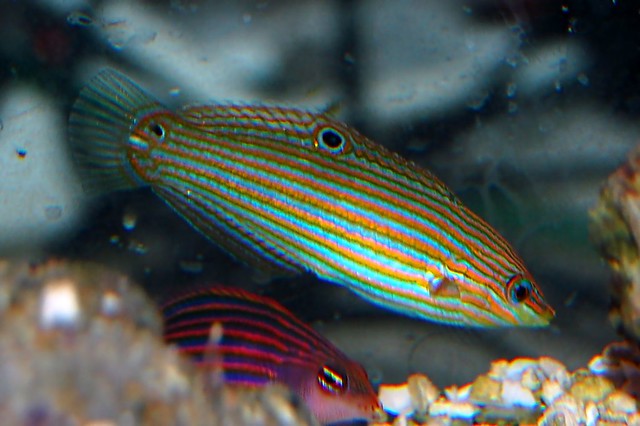
Here's what a female melanurus looks like. Note the eyespots and the overall coloration.

halichoeres_melanurus_initial.jpg


2334284446_b11599b12d_z.jpg


3335632.jpg


And here's an example of a submale (transitional male). Note the changes in coloration and the recession of the dorsal eye spot:
1336877.jpg
 
Back
Top