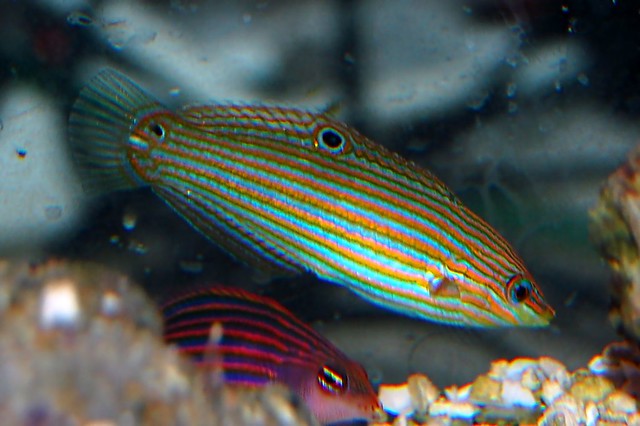
Need some advice. I purchased 2 juvenile Hoeven' Wrasse (Halichoeres Melanurus) 4 months ago. Healthy and active, they have been great additions to my mixed reef 120. At the time of purchase, both were in juvenile colors, neither showed black spots. One was about 30% larger than the other at about 2 inches. Kept in a QT tank for 6 weeks, they got along with each other and with a small tang. In fact, the wrasses still appear to have a bond with the tang in the display tank. In QT the larger wrasse did establish it's dominance but everything was peaceful. Both ate frozen mysis shrimp and learned to nibble at flake. Neither was interested in frozen brine. The smaller wrasse seemed to be the better eater.
In the DT tank both seemed to adjust well with their tank mates and environment. Happily hunting pods worms, pods & small brittle stars both have shown some growth; the smaller faster growth and has almost caught up with the larger. The smaller wrasse has developed atypical black spots in the tail area and just behind the gills, not on the dorsal fins as most photos show. It's still in it's juvenile colors.
The larger wrasse has not developed the characteristic spots but has just started to change to adult male colors. This seems to be the source of the trouble.
The larger wrasse has sometimes been slow to exit the sand in the morning and did go missing for a day a few weeks ago for a day but showed up the next, acting normally. While on a business trip my wife called me saying the larger wrasse was missing again. Upon my return it was still missing. The next morning, still awol. Several hours later, the larger guy suddenly appeared trying to eat. I noticed his adult colors had become brighter BUT the now slightly smaller wrasse began attacking the bigger guy. It was fast and vicious as typical with wraases. The bigger fish is now again under the sand. I don't think he was injured but there is definitely a new sheriff in town.
I know all fish are different but EVERY thing I have read about this genus is they are very tolerant of each other. Any advice? Should I try to trap one? Will this be over? Anyone have this same experience? I was hoping to end up with a mated pair as I thought the smaller would stay a female.
Thanks in advance for any help.
RJ
In the DT tank both seemed to adjust well with their tank mates and environment. Happily hunting pods worms, pods & small brittle stars both have shown some growth; the smaller faster growth and has almost caught up with the larger. The smaller wrasse has developed atypical black spots in the tail area and just behind the gills, not on the dorsal fins as most photos show. It's still in it's juvenile colors.
The larger wrasse has not developed the characteristic spots but has just started to change to adult male colors. This seems to be the source of the trouble.
The larger wrasse has sometimes been slow to exit the sand in the morning and did go missing for a day a few weeks ago for a day but showed up the next, acting normally. While on a business trip my wife called me saying the larger wrasse was missing again. Upon my return it was still missing. The next morning, still awol. Several hours later, the larger guy suddenly appeared trying to eat. I noticed his adult colors had become brighter BUT the now slightly smaller wrasse began attacking the bigger guy. It was fast and vicious as typical with wraases. The bigger fish is now again under the sand. I don't think he was injured but there is definitely a new sheriff in town.
I know all fish are different but EVERY thing I have read about this genus is they are very tolerant of each other. Any advice? Should I try to trap one? Will this be over? Anyone have this same experience? I was hoping to end up with a mated pair as I thought the smaller would stay a female.
Thanks in advance for any help.
RJ