Man, i disagree with so much advice here. If your only looking for actinic supplimentation, it is very hard to beat T12s. They might not be good for much else, but they excel at making smurf pee. The halide will provide all the grow you need. So far the only thing for supplimentation that I've seen better is LEDs.

You are using an out of date browser. It may not display this or other websites correctly.
You should upgrade or use an alternative browser.
You should upgrade or use an alternative browser.
Actinic Lighting for Anemone Tank?
- Thread starter cgauer5
- Start date

MelloW33
Member
Man, i disagree with so much advice here. If your only looking for actinic supplimentation, it is very hard to beat T12s. They might not be good for much else, but they excel at making smurf pee. The halide will provide all the grow you need. So far the only thing for supplimentation that I've seen better is LEDs.
So what are you disagreeing with? Because I've been saying LED for the supplementation for the entire length of the thread.

Samcro
New member
i wouls skip the halide. the quad T% will add enough light for any nem you want to add. i have seen gig, and bubble tips live in harmony and touching each without any ill effects to either nem. i think the halide will made your tank to hot and white.
i have kept many bubble tips in my nano under a 150mh and my bulb was always a 20k to get the blue so any type of light bulbs will help your nem. if you are dead set on the MH, i would do a 150 instead of a 175.
i have kept many bubble tips in my nano under a 150mh and my bulb was always a 20k to get the blue so any type of light bulbs will help your nem. if you are dead set on the MH, i would do a 150 instead of a 175.
MelloW33
Member
i wouls skip the halide. the quad T% will add enough light for any nem you want to add. i have seen gig, and bubble tips live in harmony and touching each without any ill effects to either nem. i think the halide will made your tank to hot and white.
i have kept many bubble tips in my nano under a 150mh and my bulb was always a 20k to get the blue so any type of light bulbs will help your nem. if you are dead set on the MH, i would do a 150 instead of a 175.
I would have to disagree with you about skipping the MH. For 1, he already has the halide. 2, I don't think 4x24w T5 is nearly enough for what he is trying to accomplish but it is enough to give the tank a nice blue look when paired with a 10k MH bulb. Heat isn't the issue as he already has a chiller in his system.

cgauer5
New member
I don't want to use a 20k Bulb. As far as a 150 instead of a 175, 25W more in a 45 Gallon tank translates to an increase of .55W Gallon, I don't think 3.8W per gallon vs. 3.3 WPG is that big of a difference or even a bad thing at all and I already have a 175W Ice Cap ballast. Using only the T5 would result in 95W on the tank which isn't enough IMO. However, they will be great for running 453nm bulbs for supplementation.
I am curious however to see how the Ecoxotic Stunner Strips will look. It would be great due to the lower cost of running and not having to replace the bulbs every 6-8 months. I think that it will be more than worth it if they pan out.
I am curious however to see how the Ecoxotic Stunner Strips will look. It would be great due to the lower cost of running and not having to replace the bulbs every 6-8 months. I think that it will be more than worth it if they pan out.
cgauer5
New member
That should be possible, I have a 24" canopy. The halide reflector is 6" so that leaves 18" for the rest. The T5 bulbs should only need 2" each so as long as the stunners are less than 5" a piece it will work fine. I think that I should have ample space in between and that it will make an awesome light.
So what are you disagreeing with? Because I've been saying LED for the supplementation for the entire length of the thread.
Obviously I'm not disagreeing with LED supplementation, hence the "LED is better" part of my quote. But for those who would pit T5 supplementation over T12, I disagree. However, the point may be moot because I don't think you can buy T12's for that short of a tank. He's already gotten his t5's anyway. Anyone know the answer to this? How short of t12's can you get?

BonsaiNut
Premium Member
Just talking to the guys at my local fish store as well as extensive online reading. It seems to be a consensus that they do best under that spectrum range, although I definitely will add light in the blue range as well in order to bring out the color. Do you not agree with this? I was trying to confirm what I had been told which is why I started the thread.
Hey Chip; first let me say that a 175 MH supplemented with 4 VHO's in the configuration you are suggesting should be fine for BTA's and a haddoni.
My comment about your color temperature was really just an attempt to understand who is giving you advice
 The truth is, while a 10K color temp MIGHT be ok for your anemones, just saying 10K color temp is no GUARANTEE it is ok for your anemones. The problem is, you can create 10K color temp an infinite number of ways be blending an infinite combination of lights. If your 10K "solution" includes a lot of blue and red, it is good. If your 10K solution contains a lot of yellow and green - it is not so good.
Remember that the primary purpose for lighting in a reef aquarium is to provide the proper bandwidths of light necessary for zooxanthellae to grow and thrive (the energy engines for corals and other photosynthetic organisms). Chlorophyll uses light that peaks in two specific spectra: blue/violet light of approx 440 nm wavelength, and orange/red light of approx 680 nm wavelength (see this chart).

The bottom line - you want lights that maximize the amount of spectral intensity that falls in these two bands. People use the term "PAR" to describe this light - it stands for "Photosynthetically Available Radiation". If you have a 10K light that is really bright, but has low PAR, your anemones will not do as well as a dimmer light that has a higher percentage of light as PAR.
Make sense?
Some people may prefer "whiter" or "yellower" lights because the human eye is more sensitive to light in this spectrum. But do not confuse what looks best to our eyes with what is best for our critters
All reef lighting should have spectral intensity charts and/or PAR information for you to review. The "art" of lighting comes from how you blend the lighting to provide the most benefit to your creatures while still providing enough yellow and green to be pleasing to the human eye. For THAT you will find a billion opinions. Some people just say "screw it" and buy a PAR light meter so they can compare how different configurations match up in the reality of their tank environment.
One last thing - lights high in PAR may still not provide the proper spectral intensities necessary for corals and other inverts to "color up" with dark pigmentation. This is why some people are struggling with current LED technology; the lights are narrow spectrum and provide a lot of PAR, but do not provide enough broad intensity (particularly in UV) for critters to darken up as much as you would like. Not as much is understood about this - but as LEDs become more mainstream, and cheaper, more efficient, and more intense, I expect they will resolve all of these issues.
Last edited:
cgauer5
New member
Bonsai, thank you for the information. This is much more of what I was looking for when I started the thread. I am just going to use the LEDs as more of an experiment while using the T5s for the main supplementation of the Aqualine Buske 10k. I found this chart for the MHs spectrum.

If I am reading it correctly it seems that I should be good for around the 440nm spectrum with the MH and the 2 T5 UVL Super Actinic. But, if I am to take advantage of the orange/red spectrum I could use 2 of the T5 UVL Red Sun Bulbs.
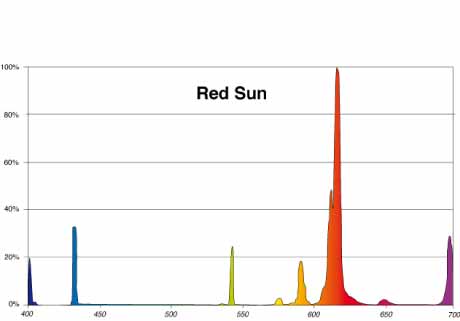
Does this seem like a good choice to you?
If I am reading it correctly it seems that I should be good for around the 440nm spectrum with the MH and the 2 T5 UVL Super Actinic. But, if I am to take advantage of the orange/red spectrum I could use 2 of the T5 UVL Red Sun Bulbs.
Does this seem like a good choice to you?
cgauer5
New member
How short of t12's can you get?
You can get VHOs as short as 24", the bulbs actually measure about 22". The ballast that I have will push either T5s or VHOs, it just depends on which endcaps I use. The VHOs run around 24W I believe and so do the T5HOs so it is basically a push there. I currently have endcaps for T5s but wouldn't be opposed to VHOs if I could get some sort of reason as to why they are better or worse. However, the size of the T5s is beneficial to what I am doing because they can be fit into a smaller area and allow for a cleaner install in my hood.
BonsaiNut
Premium Member
Bonsai...that might be one of the most informative posts I've ever seen! Well done.
Hey thanks!
BonsaiNut
Premium Member
By the way, just to slay another mixed-use term, people seem to be confused about what "T5" means.
T5 is simply a measure of the diameter of a flourescent bulb, not any fancy "new" technology. To find the diameter of your fluorescent bulb, simply take the bulb description and multiply it by 1/8". T5 bulbs are 5/8" diameter. T8 bulbs are 8/8" or 1". T12 bulbs are 12/8" or 1 1/2". That is all.
The primary advantage of T5 bulbs is that their size allows you to place more of them in a small space, thereby increased light intensity by increasing the NUMBER of lights. Additionally, their smaller size makes it easier to use optics to focus and direct the light. They are not inherently more intense or efficient (all things considered equal) than T8 or T12 bulbs.
BIG CAVEAT - that many T5 bulbs used in reef setups are HO bulbs - which stand for "High Output". There are also HO (and even VHO) bulbs in both T8 and T12 configurations as well. Bottom line - T5 doesn't necessarily mean brighter or more efficient or "better" for your reef tank. It just means smaller tube It is more important (when discussing reef lighting) to talk about what TYPE of T5 bulb you are using, than just use the blanket phrase "I am using T5 bulbs so I know it will be bright enough for my tank..." If you are using the more commonly available "HE" T5 bulbs, you will not be happy with the intensity. The "HE" stands for "High Efficiency" and HE bulbs are far more commonly available (in regular stores) than HO bulbs.
T5 is simply a measure of the diameter of a flourescent bulb, not any fancy "new" technology. To find the diameter of your fluorescent bulb, simply take the bulb description and multiply it by 1/8". T5 bulbs are 5/8" diameter. T8 bulbs are 8/8" or 1". T12 bulbs are 12/8" or 1 1/2". That is all.
The primary advantage of T5 bulbs is that their size allows you to place more of them in a small space, thereby increased light intensity by increasing the NUMBER of lights. Additionally, their smaller size makes it easier to use optics to focus and direct the light. They are not inherently more intense or efficient (all things considered equal) than T8 or T12 bulbs.
BIG CAVEAT - that many T5 bulbs used in reef setups are HO bulbs - which stand for "High Output". There are also HO (and even VHO) bulbs in both T8 and T12 configurations as well. Bottom line - T5 doesn't necessarily mean brighter or more efficient or "better" for your reef tank. It just means smaller tube
It is more important (when discussing reef lighting) to talk about what TYPE of T5 bulb you are using, than just use the blanket phrase "I am using T5 bulbs so I know it will be bright enough for my tank..." If you are using the more commonly available "HE" T5 bulbs, you will not be happy with the intensity. The "HE" stands for "High Efficiency" and HE bulbs are far more commonly available (in regular stores) than HO bulbs.
Last edited:
BonsaiNut
Premium Member
I think it would be good. The reason why I responded to the beginning of this thread about your bulb selection and said that you should be fine is that I have used EXACTLY that bulb selection in the past. It comes off a little blue to the eye, but the anemones loved it. I kept this monster gigantea under that exact lighting setup:

So as much as I try to pretend that I know what I'm talking about the lighting setup you are suggesting should be awesome - the extra red should help balance the blue and give some extra colors that will otherwise be lacking in an actinic / actinic white setup (with the MH as the main).
So as much as I try to pretend that I know what I'm talking about
the lighting setup you are suggesting should be awesome - the extra red should help balance the blue and give some extra colors that will otherwise be lacking in an actinic / actinic white setup (with the MH as the main).
DeathWish302
Clown Hoarder
BonsaiaNut what 400 watt mh bulb would you recomend using
10k
12k
20k
Also what temp are you running tanks at
Thanks
IME....
400W Radium is by far the best color and growth bulb I have found. But you have to like the blue. It's not as blue as Megachrome, but quite blue compared to my LED setup.
My BTA tank has had the best growth and splits from a 78F(winter)-81F(summer) consistent temp.
Similar threads
- Replies
- 28
- Views
- 2K


- Replies
- 7
- Views
- 2K


