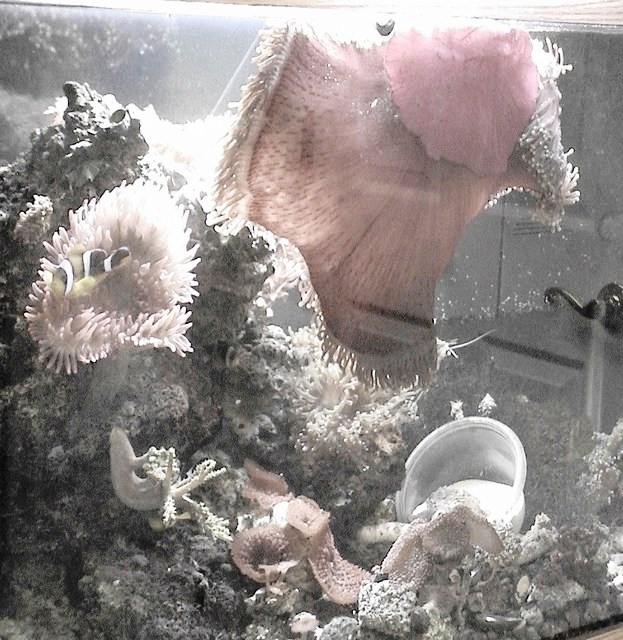
Anemone ID please.

<a href=showthread.php?s=&postid=13004188#post13004188 target=_blank>Originally posted</a> by traveller7
fwiw: I would consider the ID a guess until it settles in a bit. Many of my H. magnifica did not exhibit verrucae for quite a few months. Many of my new E. quads don't act more BTA until they settle in as well.

Incorrect, they arrive frequently and die very quickly.

Incorrect. They have much less capability of stinging, catching and eating tank mates then hosting Stichodactlyla species and many of the other non hosting anemone species.

Care to share the source of your opinions?

Dude, you are quite simply a JERK! There are 100 different ways you could have responded to and/or disagreed with my post. Now I know why I don't post on this forum. No-one is entitled to disagree with you or they are simply "incorrect"?

http://www.peteducation.com/article.cfm?cls=16&cat=1897&articleid=2153
 
<a href=showthread.php?s=&postid=13009760#post13009760 target=_blank>Originally posted</a> by Wrob
Dude, you are quite simply a JERK! There are 100 different ways you could have responded to and/or disagreed with my post. Now I know why I don't post on this forum. No-one is entitled to disagree with you or they are simply "incorrect"?

http://www.peteducation.com/article.cfm?cls=16&cat=1897&articleid=2153
Wrob you were making some bold statements that needed to be substantiated, pet education is not the last word in anemone identification and facts you know.

you are entitled to disagree just be prepared for others to comment, its a forum.
 
<a href=showthread.php?s=&postid=13009760#post13009760 target=_blank>Originally posted</a> by Wrob
Dude, you are quite simply a JERK! There are 100 different ways you could have responded to and/or disagreed with my post. Now I know why I don't post on this forum. No-one is entitled to disagree with you or they are simply "incorrect"?

http://www.peteducation.com/article.cfm?cls=16&cat=1897&articleid=2153
Yes, I am. The facts are still the facts, regardless of the out of character and abrasive delivery. Disagree would imply there was a doubt, unfortunately that is not the case and easily confirmed by a conversation with someone with wholesale access.

Your post indicated a lack of long term personal experience with either species. My apologies for calling you out on the matter in a manner which offended you.

If you are interested in H. magnifica in captivity, you'll find a great deal of first hand information and documentation in this forum. This would be a good place to start:
http://www.carlosreef.com/AnemoneFAQ.pdf
 
<a href=showthread.php?s=&postid=13009760#post13009760 target=_blank>Originally posted</a> by Wrob
Dude, you are quite simply a JERK! ....
I am sure we all can determine who is the jerk here.
Wrong information is just wrong. When you posted something wrong just accept that people will correct you.
I have had a few BTA myself but never seen any of my BTA with split tentacles. I just state that I have not seen one but other people (experience reefers) have. So I am wrong there and I just accept that I am wrong without getting mad and consider people atttacking me personally.
 
<a href=showthread.php?s=&postid=13009760#post13009760 target=_blank>Originally posted</a> by Wrob
Dude, you are quite simply a JERK! There are 100 different ways you could have responded to and/or disagreed with my post. Now I know why I don't post on this forum. No-one is entitled to disagree with you or they are simply "incorrect"?

http://www.peteducation.com/article.cfm?cls=16&cat=1897&articleid=2153

Wow. We don't allow name-calling here, even when the recipient is a member of the staff. :rolleyes:

And before you make authoritative statements about marine animals and then start calling names, you might want to check your source material. The link you gave supports exactly zero of the claims you made that were challenged by traveller7.

Kevin
 
At a minimum, it is best to stay away from the most difficult anemones in the list above until you are very experienced. These anemones have specialized care requirements, or get very large, or are generally “fickle” in their acceptance of captive environments.

Maximum size: 3 feet in diameter or larger. The 2nd largest of all clown anemones.

Additional info: If unhappy, will move around a lot, climbing up the glass and bothering other sessile invertebrates. Often locates as high in the water column as possible to get bright lighting and high flow. If you don’t have bright enough lighting, it will often climb the tank glass to the surface. Grows fast under good conditions, can triple in size in one year.

All from the resource you gave me. It supports everything I have said. But I doubt that either the severity of its sting or why it is generally not kept in captivity (assuming I were wrong) would result in improper care of this beautiful animal. I did not see you disagree with any of my other points, more relevant to its care. The fact is, its tentacles are tapered, not bulbous. And the tips of its tentacles are bulbous, not tapered. Therefore it is a Magnificent Anemone. Thanks for the apology. Sorry I called you a jerk. I just didn't expect this kind of a response to my 6th post.

To Orion- Thanks for your valued contribution to this thread that will obviously have a significant impact on the care of this anemone. It is not a matter of admitting I am wrong. It is a matter of knowing I am NOT wrong. If you'll notice, I have been a member for many months, but have not posted. I frequent this forum, but generally the few questions I do know the answer to have already been answered better than I could answer. I have been very careful to ensure I am giving other aquariasts accurate and helpful information. I noticed that this thread was misleading it's original poster. My intention was only to help him and his anemone. I wish them the best!

 
The problem is that the descriptions of these anemones, even those present in books authored by well respected anemone experts, are wrong. Identification in person, let alone over the internet, can be very challenging. I don't think that anyone can give a positive ID with the data presented to be quite honest.
 
Agree....this one is simply too close to call at this point.

I've seen a few anemones on this forum that were dead ringers for every text book picture and description of H. Magnifica I'd ever seen come up with huge bubbly tentacles within a few weeks of getting settled in.

You've been here for a couple of months lurking before you started posting, that's awesome. Soak it all in, these people are some of the most valuable resources you'll ever find in the hobby.

That said, most publications and websites I've seen regarding H. Magnifica's care are questionable in their accuracy. Here's why your statements about the Magnifica are not supported so well by the quote you gave:
1. All species of hosting anemones get quite large. Even BTA's have been known to reach two feet in diameter.
2. Again, all species of hosting anemone will move a lot if unhappy. BTAs are also known to wander and climb up the glass if they can't find a suitable spot.

As for tentacle shape, with these two species it's almost never a good indicator of which is which, especially when stressed. The best way to know for sure is to give this creature time to acclimate and see what it looks like after it's settled in.

I also have to agree with Scott (traveller7), H. magnifica is not rare in the hobby, they come in often and die soon after. Healthy specimens are very hard to find, however, and if this is a Magnifica, it looks like it's off to a great start.
 
Minh -- get ready to call me a jerk. ;)

Many of my BTAs had split tentacles ( I no longer keep BTAs ) but, one thing I noticed was that it seemed to only happen when there was "rough" clowns in them. The BTAs that I had with my GSM had several split tentacles, and when I had a Cinnamon clown. Clones of the same anemone kept with true percs didn't have any. Now, this wasn't any experiment that I did, just something I noticed.

As for the anemone in question, right now I am leaning towards BTA, something about how the foot looks -- while moving.
 
The problem I see in this forum lately is people coming out and making positive ID or judgement from a picture. All we can do with many pictures is make educated guesses. Or help out with suggestions and advice. Way too much judgemental advice and even poorer opinions around here lately. My .02..Sorry for the small rant there.

Wrob with all due respect Traveller's analysis of your initial post was accurate in every way minus delivery.

After saying that I must say I agree with you on the ID :). Sorry minh!

The only description or ID tool we have that mentions Bifurcated tentacles points to Magnifica. I dug out Fauntin and Allens book for grins and it contains the same description.

When you guys say split, are you referring to an entire tentacle or just the tip? The ID tools specify tip which is seen in picture three. I must say I've never seen this in my quads but I wouldn't swear to that.

Best of Luck with your Nem btw!
 
<a href=showthread.php?s=&postid=13011235#post13011235 target=_blank>Originally posted</a> by kris4647
.......

When you guys say split, are you referring to an entire tentacle or just the tip? The ID tools specify tip which is seen in picture three. I must say I've never seen this in my quads but I wouldn't swear to that.
.......

It was the tips in the cases that I had. Maybe only half an inch of the end. I looked though my old pictures, but couldn't find any.
 
Kris, You are going to make me get out my camera aren't you? :)

I would not buy the ID within even the more respected books in respect to tentacle, shape, etc.....when we are discussing captive specimens. So many things change the way our critters look over time.

fwiw: I did pull up some older pictures, tentacles split at different points, i.e. base, mid, tip. Some more then once. They are in an anemone forest, so it is tough to get a clear shot. I'll have to see what I can snap when the lights come back on tomorrow.

PS: Nobody asked for a shot of the oral disk yet to see if it has a puckered mouth? We are slacking ;>)
 
Heteractis magnifica and Entacmaea certainly do not share the same foot, visible verrucae would be nice. Unfortunately, many H. magnifica do not exhibit them until they are settled in and healthy :(

This one was not shy about it:
14159mini-Mooning_Magnificas_Batman.JPG
 
Thanks for all the info guys, I appreciate it. I know a lot of marine ID's are a difficult, if possible at all, but some guidance for us less experienced reefers is allways handy and goes a long way to helping us maintain our animals to their best.

The anemone has moved a little today, not much, maybe 3-4 inches. It is in slightly more light where it is now, but most of it is still under the rock as per the last lot of photos. Some of the tentacles are starting to become more bulbous, not right at the tip, but maybe 10mm back from the tip. The lights are out now and probably will be before I get a chance to take pics tomorrow night, so I'll try to get a couple of new pics up on Saturday. I'll also try to get a pic of it's mouth, if the female clown will stay out of the way long enough.

Thanks again for all your help, all seems well so far.

Dave.
 
<a href=showthread.php?s=&postid=13011775#post13011775 target=_blank>Originally posted</a> by davez104
.... Some of the tentacles are starting to become more bulbous, not right at the tip, but maybe 10mm back from the tip. ....

Dave.
That, IMHO, is a very good indication that it is a BTA. You can see that in the 3 picture of the thread.
If there are any bulbs, the bulbs of H. magnifica are at the very tip of the tentacles while the E. quadricolor bulbs are near the tip. I still think I am right that it is an BTA. This is not certain but IMO, it is much more likely to be BTA (at least 90% certain)
I read way back sometime that H. magnifica often have split tentacles while E. quad does not. This is consistent with my experiences in keeping these two species. That was why I mention this earlier.
 
<a href=showthread.php?s=&postid=13011304#post13011304 target=_blank>Originally posted</a> by traveller7
........

PS: Nobody asked for a shot of the oral disk yet to see if it has a puckered mouth? We are slacking ;>)
This does not help me at all. I see both species with puckered mouth before.
 
My E. quads have split tentacles. The splits seem to be toward the end of tentacle, maybe an inch in from the tip. And I'm with Ad and Orion, I think this anemone is a BTA.
 
Back
Top