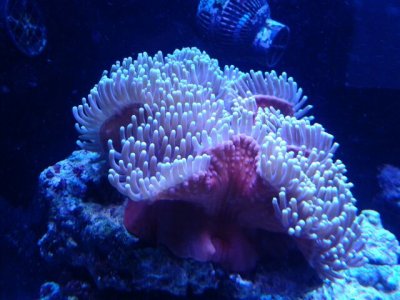
Antibiotic treatment for a sick H. magnifica

Med other than Cipro?

Med other than Cipro?

I hope I found this thread in time.

I picked up a red base Mag on Saturday and just today he started downhill fast. He was doing great, fully inflated, and eating bits of shrimp until today. Even though refrigerated, it may be the shrimp has gone bad. I have Furan 2, Maracyn, and Maracyn 2 on hand. Would any of these be an acceptable alternative to Cipro, or helpful until I can find some?

I will move him to a treatment tank, but he is in a 150 reef, with good flow, on top of the rocks, under AI LED.

Thanks for the help!!

Mark
 
Maracyn is Minocycline, very similar to Doxycyline. I would use this at the same dose, 10 mg per gallon. I would consider use Cipro. You can get ciprofloxacin on line at Drs. Foster and Smith, no prescription needed.
 
Thanks very much for the help Minh.

The anemone is supposedly from Africa (red base) and came into a LFS last week. It appeared healthy and I picked it up on Saturday (along with the rock it was attached to) and acclimated him into my DT. I kept an H. magnifica years ago, actually a clone from Minh, that did very well. I put this one on a rock pinnacle, right under AI LED's, with very good random flow.

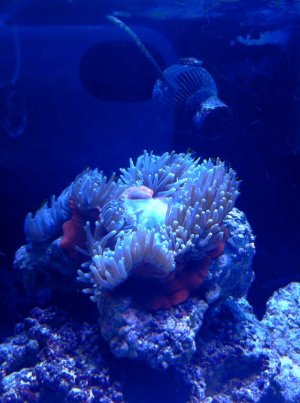
He did well at first. Never moved, the mouth was tight, opened fully, and ate a little raw shrimp on Sunday, Monday and Tuesday. Yesterday, my wife sent me the attached picture. The mouth was beginning to loosen. When I got home, it was substantially deflated, and the mouth gaping a little. Still firmly attached, but the top half of the column was completely deflated, as were the tentacles.

I think I may have caused the problem as I was still feeding pieces off the same raw shrimp (refrigerated) but it was getting a strong odor. It had probably spoiled. I would not have cooked and eaten it, for sure.

I moved the anemone to a 20 gallon (long) treatment tank filled with water from my DT (maybe 18 gallons), added a heater and powerhead, and placed a 4 bulb T-5 fixture over it. I added Maracyn 2 at 10 mg per gallon.

This morning, he was in the same place and fully inflated, but I could not see the mouth well. Hopefully this was a good response to the antibiotic and not just a cycle of inflate/deflate. I can't tell how it is doing from work. I am picking up Ciprofloxacin and will begin to use that this evening as per Minh's treatment (50% water change daily, replacing Maracyn 2 with Ciprofloxacin in new water).

Hopefully this will work. Please feel free to offer any suggestions.

Thanks,
Mark
 

Attachments

  • H. magnifica - 10_31_12.jpg
    H. magnifica - 10_31_12.jpg
    83.1 KB · Views: 23
Anyone using antibiotics, please research how to dispose of the water responsibly. There is a huge problem with antibiotic resistance, in part because of inappropriate disposal of these medications.
 
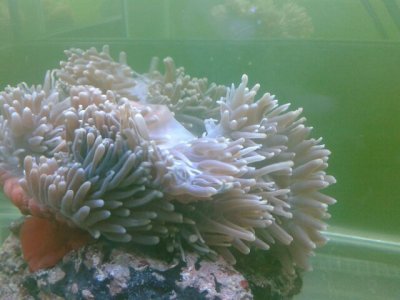
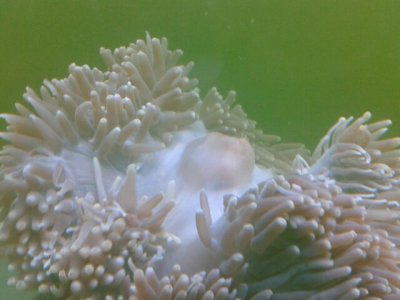
The Mag doesn't look any worse tonight. Much more inflated than yesterday at this time. The mouth though, is enlarged and elongated. Not really gaping, but larger than it should be. Hard to see in the photos. Overall, I think it is better than yesterday.

Switching to Cipro tonight.

Thanks.
 

Attachments

  • H. magnifica (1) 11_01_12.jpg
    H. magnifica (1) 11_01_12.jpg
    42.7 KB · Views: 19
  • H. magnifica (2) 11_01_12.jpg
    H. magnifica (2) 11_01_12.jpg
    35.7 KB · Views: 18
After a couple of days of looking anywhere from sickly to just ok, it looks better this morning. This is the first time since moving it to the treatment tank that I would say it looks vibrant and healthy. Hopefully, I wont see the inflate/deflate swing today. My experience has been that when Mags get sick, they tend to continually degrade, so perhaps this is a good sign the treatment is working.

Thanks

Mark
 

Attachments

  • H. magnifica - 11_4_12.jpg
    H. magnifica - 11_4_12.jpg
    60.2 KB · Views: 26
Anyone using antibiotics, please research how to dispose of the water responsibly. There is a huge problem with antibiotic resistance, in part because of inappropriate disposal of these medications.

The article I posted earlier in the thread is actually directly related to how the anti-biotics break down in the enviroment. I agree that the disposal can be important but more issues come from the disposal of the anti-biotics when they go into sources of water.

You have to remember, even as humans once we take anti-biotics we dispose of it down the drain through our body, although by this point our kidneys have normally broken it down most of the way I would guess.

I wouldn't think that a few people treating in small amounts would be to much of an issue on groundwater supplies and creating anti-biotic resistant strains of bacteria, but definately something to consider.
 
Mark,
It looks a lot better in the last picture. Your observation is certainly most reliable. Good luck with him.
 
The article I posted earlier in the thread is actually directly related to how the anti-biotics break down in the enviroment. I agree that the disposal can be important but more issues come from the disposal of the anti-biotics when they go into sources of water.

You have to remember, even as humans once we take anti-biotics we dispose of it down the drain through our body, although by this point our kidneys have normally broken it down most of the way I would guess.

I wouldn't think that a few people treating in small amounts would be to much of an issue on groundwater supplies and creating anti-biotic resistant strains of bacteria, but definately something to consider.


Something to consider for sure. From my understanding, most species of bacteria have varying degrees of resistance, and several species have resistance to most, if not all antibiotics available. What doesn't kill them makes them stronger. Any exposure at all to an antibiotic that does not kill the bacteria allows it to create future generations that are resistant to that particular antibiotic. As much as we would like to think that treating a fish tank isn't going to lead to antibiotic resistance, I don't believe that is consistent with the evidence.
 
Gary,
Medication that we tank some excreted unchanged from our body or can be metabolized prior to elimination. Some cleared more than one way. The kidney and the liver is the two organs that clear medication from our body and it go out either though the Urine or feces or both.
Of the medication we discussed here, Tetracycline, Minocycline and Doxycycline get eliminated through the liver while Cipro got eliminated un-change in the urine.

I think source of the problem for the environment, as eluded in the articles are really industrial use of antibiotic. For example, put Cipro in feed of chicken so that they can be raise in close quarter and not get wipe out by disease. Minor usage like us or people taken antibiotic should not cause any significant problem.

Other problem in pathogen in our body is due to sick patient who have had recurrent infection and on multiple antibiotic. The pathogen in these patient tend to get trained (or selected) to be resistant to various antibiotic then pass it on to care provider and other patients.

There are many mechanism for bacterial to become resistant to antibiotic, depends on the antibiotic, so there are very few generalization. However, most resistant mechanism are energy intensive. There is a energy cost for the bacterial to carry and keep resistance, so after a time of non antibiotic exposure, the registrant strains tend to died out in favor of the non resistance strains due to been out competed. 'they only have advantage when antibiotic is there while in the face of non antibiotic they will loose out. The competition in the microorganism world tend to be intense and fierce.
 
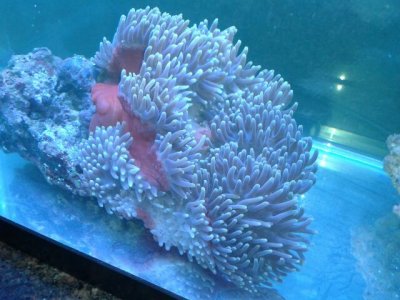
My H. magnifica looked great this morning and has stayed that way all day. The treatment with Cipro has worked well and I am convinced it saved this anemone. I will continue treatment for another 5-7 days to be sure it has completely recovered.

Thanks for the help.

Mark
 
Thanks Minh for the explanation. The information I've read about people disposing of expired antibiotics by flushing or pouring down the drain, strongly discourages that method. So, that said, do you know the most responsible way to dispose of antibiotic treatment water for those who are conscientious/concerned about the environmental impact? I recall someone discussing the use of bleach, but I don't remember any of the specifics.
 
Thanks Minh for the explanation. The information I've read about people disposing of expired antibiotics by flushing or pouring down the drain, strongly discourages that method. So, that said, do you know the most responsible way to dispose of antibiotic treatment water for those who are conscientious/concerned about the environmental impact? I recall someone discussing the use of bleach, but I don't remember any of the specifics.


I don't think that we need to treat antibiotic with anything to destroy it prior to flush it down the toilet. As stated earlier, many antibiotic get eliminated un-change in our feces and in our urine. Some medication , included antibiotic get alter before elimination, other does not.
Small dose that we use occasionally should not cause significant harm to the environment. It is the chronic large dose given to large amount of animals that cause change in the environment. Imagine the many kg of Cipro in chicken feed that is given to chicken daily, everyday for many years. The run off from this waste is what will cause problem.
 
I see. I can imagine kgs of broad spectrum antibiotics like cipro going into the water would be a much bigger issue than the amounts aquarists are adding to the environment. All of it sounds ominous to me.
 
Not to hijack the thread, but thought this may be of use.

I just bought some Cipro to treat a dying Magnifica. It turned out to be too little too late, but anyway... I couldn't find anyone who would give me a prescription, so I ordered "aquatic ciprofloxacin" as the label says, distributed by Aquatic Pharmacy. I got the 250mg tablets.

1. The label recommends a dosage of 250mg (one tablet) PER GALLON. That's 10x what I have been reading in this thread, correct? Any thoughts?

2. The instructions say to add this dosage to the water for a 1 hour "immersion bath", then change the water. It does not give any recommendation for proper disposal.
 
Bradley,

Currently I recommend dose of 25 mg/gal add to treatment tank daily, with or without water change.

Dosage for 1 hr dip is quite different from dose of continue 24/7 treatment. Also treatment of fish and treatment of anemones is most likely different.

Cipro 250mg per gal is way too high of a dose for continuous treatment for anemones where I think antibiotic is freely diffuse into the anemone. This is my assumption not back by any study of research.

Treatment of sick fish is different that that of anemones. It is possible that high concentration of antibiotic in water outside the fish is needed to get adequate level of antibiotic in the tissue of the fish which is needed for effective treatment.

We also know that Cipro is photo degrade so antibiotic need to be added regardless of water change. Under normal light condition, I would recommend to add 250 mg per 10 gal per day. This is a guess on my part, not back up by any drug concentration study.

I hope this help and clear up any confusion on dosage of Cipro for anemone treatment.
 
Just to finalize the treatment history on my Mag, it has fully recovered after the treatment with Cipro. This is the first time I have ever had an anemone recover after starting to slide. Thanks for testing this idea first Minh!

Mark

PS - No more feeding smelly shrimp.
 

Attachments

  • H. magnifica - 11_11_12.jpg
    H. magnifica - 11_11_12.jpg
    54.5 KB · Views: 21
Minh,I put the mag in the treatment tank last night,This morning the skin is comeing apart,it was just to far gone when I got it.The lfs has 2 more comeing in this morning.Would it be best to go ahead and place it in the qt tank and dose cipro even if it looks healthy.
 
Back
Top