

der_wille_zur_macht
Team RC
DWZM, could you explain a little bit how that works?
Sure.
The rectangular blocs near the sides of the schematic are "standard" shield headers. The text next to each pin is essentially the "arduino" name for that pin.
On the left side, you see a 3-pin IC with four caps. The IC is a VLDO (very low dropout) voltage regulator. The caps are there to filter it's input and output. Together, those 5 components create a regulated 10v power supply.
In the middle, there's a 6 x 2 pin header. This provides six spots to connect a 2-wire harness. There's six because that's how many PWM pins we have on an Arduino. Each set of pins is a "channel" of control for dimming ELNs.
The left side of each pin pair is connected to the 10v power supply on the left side of the schematic. This provides +10v to the ELNs. The right side of each pair of pins is where we are controlling things.
Now, look at the right side of the schematic. There's the two tall rectangles which represent the digital I/O pins from the Arduino - 6 of these are the PWM pins. A connection is made from each PWM pin to a resistor. The other side of the resistor is connected to the base of an NPN transistor. The resistor is there to regulate current. The transistor is there to provide our switching.
Now, look at one of the transistors. The base is connected to the Arduino PWM pin as described above. That means as the Arduino PWM pin switches on and off, the transistor will be switched on and off. The transistor is basically "inserted" between the header for the ELNs and GND. What this means is that when the transistor is off, the pins on the right side of the header will be floating (not connected to anything). In that state, there will be no current flowing on the circuit out to the ELNs, because there will be no ground. When the transistor switches on, it completes the circuit and electricity can flow, which means the ELNs will see 10v.
So, as the PWM signal from the Arduino switches on and off, it turns the transistor on and off. As the transistor turns on and off, it makes and breaks a ground connection for the ELN(s) connected to the header.
The "magic" is that the transistor is being switched by the Arduino's 5v signal, but we can have it switch anything we want - the voltage we use to turn it on and off are independent of what it happens to be switching, which we take advantage of here by letting it switch a 10v circuit, thus effectively translating the 5v PWM signal to 10v.
That's all in theory of course, I've never actually done this for this specific purpose. However, the general concept is extremely basic and fundamental to many electronics devices. Within the Arduino community, this approach is often used for doing things like turning a 12v DC relay on and off, for instance.


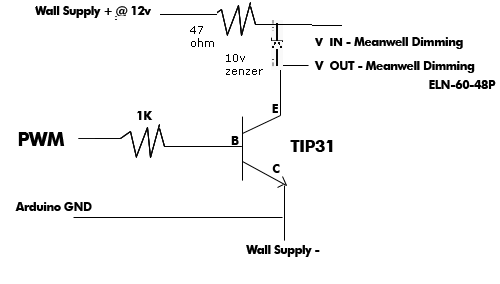
 I don't inherently see a problem - if the GND is broken, there will be no voltage or current in the circuit to the ELNs.


