Are Deep Sand Beds, DSBs, dangerous to use in a marine aquarium?

Pretty much ,yes. I used to think denitrifying bacteria were aerobic and needed to occur in areas where there was no free oxygen,only oxygen from nitrate ,and that these oxygen free areas only existed in areas of low flow of oxygenated water like in deep beds. I didn't think about the bacteria's needs for nutrients or how weak the forces to move those nutrients down into the bed are. I didn't realize that the same bacteria reduced the free oxygen and moved on to nitrate in localized shallow areas even where flow was moderately strong. Once I understood that just about as much denitrifying bacterial activity occured in a shallow bed since more of the nutrients the bacteria need are available in the upper layers exposed to flow and that the deeper parts of the bed were much less active ,I felt free to make a choice on the type of bed if any I would use based on other considerations for the animals and for aesthetics. Now, I prefer the beachy look but find clearing detritus easier on a bare bottom. On the other hand I do have burying wrasses in some tanks and it is difficult to keep zanthous and some other corals placed on a bare bottom free of detritus ; that's easier with some sand under them for the detritus to sink into a bit.
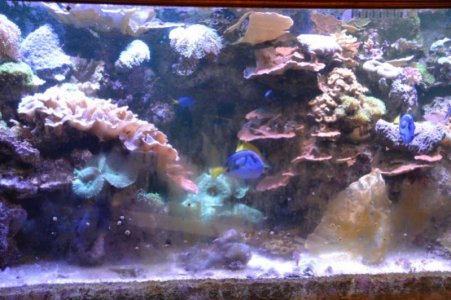
 
11 year old DSB

11 year old DSB

Anybody with a 10 year old DSB raise your hand..............higher
Anybody who ran a DSB for less time than 10 years and something happened to kill your fish, raise your hand. And if this is you, what happened to the inhabitants if anything.

I feel that even if a DSB does not add anything toxic to the tank, after so many years it just stops doing anything and may as well be concrete. But I don't know unless we hear from people who had problems and people who don't have problems, "in ten" years not 10 months.
Besides working, it should work for a substantial time as even a bare tank with nothing at all in it will support life for a while.

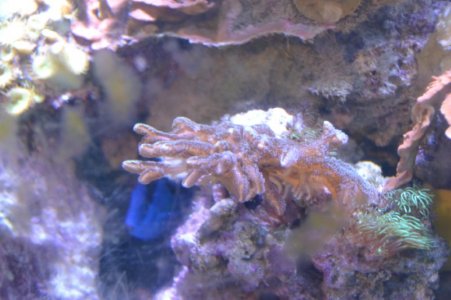
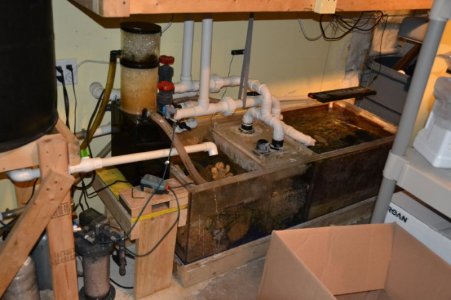
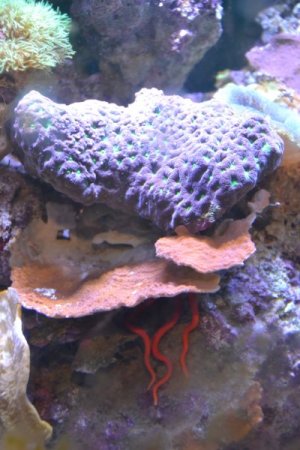
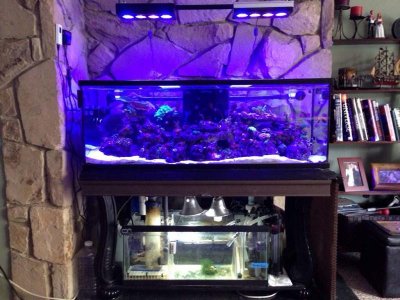
Mine has been in operation for 11 years... new to this forum but thought I would chime in. 180Gal, with 70 gal sump, last water change was over 24 months ago, I have coral and fish, and have not had a death in over 5 years or any diseases. I have to take my coral and sell it at least every 12 months as it takes over.

I replentish the DSB every 18 months to keep it at 5"-6". After reading some good infrormation from people who have run these, I have to admit that they were right. This hobby has alot of "experts" and I am not one of those, but with 15 years in the hobby and a stable once a week maintanence program (basically clean skimmer and display), I think I can speak intelligently to the DSB debate.

My system conists of 2 external pumps, 1 skimmer, and a reactor. I check the ALk once a week and as long as it is 11-12 no worries and my NO3 check once week as well and always 5 or less. And as you can see from my pics today I need to clean again....

If you search Jaubert you will find plenty of scientific testing that has been done, and his own personal success...
 

Attachments

  • Dec 2013 408.jpg
    Dec 2013 408.jpg
    73 KB · Views: 22
  • Dec 2013 409.jpg
    Dec 2013 409.jpg
    73.4 KB · Views: 21
  • Dec 2013 407.jpg
    Dec 2013 407.jpg
    74.6 KB · Views: 18
  • Dec 2013 410.jpg
    Dec 2013 410.jpg
    57.3 KB · Views: 21
Are Deep Sand Beds, DSBs, dangerous to use in a marine aquarium?

11 y/o DSB and a sweet tank.....................YES! :lol2:
 
24 months no water change.. can any BB owners make this claim here?

Nice tank. As mentioned before, if it is necessary to recharge dsbs with new infauna every so often, is there a limit to its success before having to replace the whole substrate due to lack of space?

Would avoiding additions to the tank after establishing and raising Infauna for a long enough time allow a sustainable population that would eliminate the need to replenish it periodically?
 
Are Deep Sand Beds, DSBs, dangerous to use in a marine aquarium? Reply to Thread

Are Deep Sand Beds, DSBs, dangerous to use in a marine aquarium? Reply to Thread

24 months no water change.. can any BB owners make this claim here?

Nice tank. As mentioned before, if it is necessary to recharge dsbs with new infauna every so often, is there a limit to its success before having to replace the whole substrate due to lack of space?

Would avoiding additions to the tank after establishing and raising Infauna for a long enough time allow a sustainable population that would eliminate the need to replenish it periodically?

My DT IS BB but, that does not mean i don't have a DSB. Mine is located in a 150 standard and is 6". I never have to worry about replenishing my Infauna because it takes care of itself. There are NO introduced Predators or sand sifters in the cryptic zone tank or refugium. EVERY time i look its crawling with life and it's all gravity fed to the DT. I know from what i see and from test results. You want to have success with a DSB? Then take the time to do it right from the start. Want to actually learn about DSBs? Be patient, do your HW. Read this nice little book called "Sand Bed Secrets". That's your DSB Bible. That's how i finally got mine to be what it is today. A thriving and healthy addition that's adds diversity to my system. I know the results because i actually SEE it with my own eyes. It is what it is. Where do you think i got the idea of a multi-tank system? Of exposed, semi-exposed, semi-cryptic and cryptic zones as well as a dsb? Aren't there areas like that in nature? It works pretty well there...RIGHT?
Why not in your system? You just have to take some extra steps because of the nature of the systems we keep. Get the right type of substrate to work with in the first place. Put it in an area where it's not going to be messed with..and keep ya paws out of it! :spin2:
 
Are Deep Sand Beds, DSBs, dangerous to use in a marine aquarium?

I'm sure the book on,dsb is thrilling lol, but If u read the book could u answer my second question, given it is in the DT?

...and like i said, start off using the right substrate in the first place, .. use common sense husbandry. You can have a DSB in your main display but, in order for it to work properly your going to have to exclude the sand sifters....and resist the urge to mess with it all the time. Unless you just want to maintain 1" in the DT.
 
Yes you can have one if you want one for certain critters that need it and if you like the aesthetics. It's not "dangerous" if you maintain it t oprevent anoxia in it but it won't do much more than a shallow bed or other alternative surface areas for biofiltration.
 
Here is the question:

Are Deep Sand Beds dangerous to use in a marine aquarium and if so why?


So who wants to get the ball rolling :spin1:


Joe :beer:


Mine has been in operation for 11 years... new to this forum but thought I would chime in. 180Gal, with 70 gal sump, last water change was over 24 months ago, I have coral and fish, and have not had a death in over 5 years or any diseases. I have to take my coral and sell it at least every 12 months as it takes over.

I replentish the DSB every 18 months to keep it at 5"-6". After reading some good infrormation from people who have run these, I have to admit that they were right. This hobby has alot of "experts" and I am not one of those, but with 15 years in the hobby and a stable once a week maintanence program (basically clean skimmer and display), I think I can speak intelligently to the DSB debate.

My system conists of 2 external pumps, 1 skimmer, and a reactor. I check the ALk once a week and as long as it is 11-12 no worries and my NO3 check once week as well and always 5 or less. And as you can see from my pics today I need to clean again....

If you search Jaubert you will find plenty of scientific testing that has been done, and his own personal success...


Awesome discussion folks, but to me tcdog4 and his 11 year old s DSB is the answer to the original question . . . A DSB is just as viable as a Bare Bottom. It all depends on the husbandry.

SO . . . as this is a hobby, it comes down to aesthetics. If you like the look and options afforded by a DSB then don't be afraid to try one. If on the other hand you want absolute control of your nutrients then you need to choose a Bare Bottom or a Shallow Sand Bed.

Not that this will end the debate, but just wanted to put my "fine point" on the thread since I'm the OP :D
 
SO . . . as this is a hobby, it comes down to aesthetics. If you like the look and options afforded by a DSB then don't be afraid to try one. If on the other hand you want absolute control of your nutrients then you need to choose a Bare Bottom or a Shallow Sand Bed.


More or less depending on how you maintain whatever option you choose. However, I don't think you give up nutrient control with a well maintained deep sand bed;might even gain a little . I don't think you gain any significant advantage in nutrient control either way,though..
 
SO . . . as this is a hobby, it comes down to aesthetics. If you like the look and options afforded by a DSB then don't be afraid to try one. If on the other hand you want absolute control of your nutrients then you need to choose a Bare Bottom or a Shallow Sand Bed.


More or less depending on how you maintain whatever option you choose. However, I don't think you give up nutrient control with a well maintained deep sand bed;might even gain a little . I don't think you gain any significant advantage in nutrient control either way,though..
If I remember correctly, you've stated you have a remote DSB on your system. Can you explain the purpose it serves for your system? Also, how do you maintain it? Do you vacuum it or do you leave it undisturbed?
 
I put it in years ago(7 inches deep by 36 in x 24 inches to reduce NO3 ;it didn't make any perciptible differnece.
After months of waiting , ultimately, I used a sulfur denitrator to reduce them from the 50ppm to 80ppm range to near zero in two weeks .I took the denitrator off line when nitrate was dropped about 5 years ago and maintain low levels(0.2ppm or so) with organic carbon dosing.
I never removed the remote deep sand bed.
If nothing else it gives pods somewhere to hang out and provides extra surface area for bacteria to colonize at least in the top half inch or so . Extra live rock sits on top of it to aid advective flow into the sand a little It serves as an ambient light section of a cryptic refugium arrangement ,now; it's fed by a drain from a darkened section. If I were to redesign it, I'd put in a shallow bed with a longer footprint for water to flow over.

I also keep puddles of deeper sand( 3 to 4 inches ) in some of my display tanks for animals that need it mostly some of my wrasses.
As for maintenance I just puff up any detitus that builds on the surface every couple od months using a filter sock on the drain when doing so.
 
I remotely located my DSB mainly for these reasons:

I wanted to try and replicate a sand bed as it were on the bottom of a reef at depth.
I did not want direct light to shine on it or even a lot of ambient room light for that matter.
I had the room to do it.
I did not want anything in the DT to disturb it.
It would not be effected by direct feeding or uneaten food.

I chose the type of substrate because:

It's in a specific size range that is most beneficial to the life i wish to maintain in it.
It's got a grain texture that's more user friendly to that life.
The small grain size helps to prevent any large food particles from making it past the surface.
It's inert.

I have LR where the DSB is. A lot of it. It's suspended above the DSB in the form of an arch. The only food that i feed to the DT that makes it in there is basically what makes it past a 200 micron filter sock. Other than Detritus that floats down to the surface of the DSB, that's pretty much the ONLY food it gets and that NEVER accumulates on the surface. It's eaten by all the critters in the DSB. That i can witness. There are TONS of the things too. SO, maybe it's helping...maybe it's not. My test results are pretty spot on though. Works for me.
 
Last edited:
Just redid my sump / fuge. Debating on keeping it bb or doing a DSB. I dont use filter socks. Hate em!! Lol

Any suggestions?!

ImageUploadedByTapatalk1392503452.285039.jpg
 
Well, it involves a bit more husbandry but, you would be surprised at what a 200 micron filter sock can pull out. I would get at least a couple. Before i clean one i pick off as many scuds as i can see. Then i run the washing machine once to rinse it before i use it to wash the filter sock. It's not to bad really. It's that much stuff that will not end up rotting in my system.
 
I do not use filters socks either except when cleaning except for one sehorse tank where feeding is exceptionally heavy and there are no croals to benefit from the extra food . I prefer foods ,larvae,bacteria etc to ciruclate through the majority of the system . Socks do remove a lot of crap but also alot of useful things too. So I don't think it's a matter of extra husbandry but a choice about the food web you might want to encourage or limit in your system. As it all moves trough the system bacteria and the skimmer get most of it anyway. A little detritus siphoning from time to time keeps things quite neat.

If you are planing to use algae in the refugium I would go bare bootm. Agle over sand makes a mess. A deep sand bed won't do much in terms of nutrient control anyway.
 
Back
Top