
You are using an out of date browser. It may not display this or other websites correctly.
You should upgrade or use an alternative browser.
You should upgrade or use an alternative browser.
Are Deep Sand Beds, DSBs, dangerous to use in a marine aquarium?
- Thread starter JPMagyar
- Start date

Bilk
New member
<iframe width="420" height="315" src="http://www.youtube.com/embed/8NPzLBSBzPI" frameborder="0" allowfullscreen></iframe>
<iframe width="560" height="315" src="http://www.youtube.com/embed/7KPPCBe58zs" frameborder="0" allowfullscreen></iframe>
I meant to ask - is it your position that if you don't keep up with nutrient export in a DSB, you'll crash and burn? (illustrated via ILL clip) But a multi-pronged approach to get the job done will work? (illustrated via the MIB clip)?

why does everyone always try to make this hobby into an exact science?? its really not... and every last one of us know this... folks always demanding some sort of concrete research to "back this point" or "go against" someone else's...
Some of us are scientist and some artist, it takes all kinds to make the world go around. :wavehand:
Good info in here but this topic has no real concrete answer as of yet. I think those that have tried and had success w/ DSBs will continue to use them while other will not. I have personally had success in keeping my NO3 in check with my 3'' DSB
You can definitely attribute this directly to the sand bed? Or you're assuming that your sand bed is the mechanism that is keeping no3 low?

Snickerol. I did not realize my second video was in another language but it still works plus it was funny. Warning the two videos are much more entertaining than what I wrote below. It goes round and round but I do have a point to it.
Yes I suppose the two videos would represent multiple approaches at maintaining a balanced system but my intent was related specifically to the topic at hand: DSBs.
On the first page, Jim discussed WWTF (waste water treatment facilities) and I came across an article in the Feb. 2013 Water and Wastes Digest issue that is related to the discussion. I do not work in waste water but for some reason I get this at work and it has some interesting information. In 2009 the Frackville Area Municipal Authority (FAMA) disposed of 1,036 wet tons of solids in 2009 at a cost of $26,000. In 2011, FAMA disposed of 444 wet tons of solids at a cost o $11,000. What changed? They installed a new aerobic digestion system. Previously they used a floor mounted coarse-bubble differ system in uncovered aerobic digester tanks but now they used an Ovivo Airbeam cover aerobic digestion system that allow the diffusers to be submerged several feet above the bottom. This reduced the discharge pressure (energy savings) and with the better temperature control had reduced sludge disposal. Basically this system does the same process as before but it is more efficient. Normally in this hobby we discuss energy efficiency when discussing LEDs and MHs but this is as or more important.
This is an anthropogenic system example but who would be “more scientific” and more interested in efficiency in terms of energy costs and wastes? Us as reef hobbyists or a waste water treatment operator who has to process x amount of waste in y amount of time at a cost of z?
Last night I started thinking about what other systems deal with organic matter, can be supersaturated, has a substrate (soil), and can have aerobic and anaerobic conditions.
Wetlands. Paul already showed a picture on page 1 of a type. One of the greatest differences between a wetland and our reefs is flow though. Moving water has the ability to do work and is capable of transporting sediments and other materials (organics anyone?). In a wetland, you have flooding either daily as in tidal movements or it is episodic. After the flooding has stopped the area is inundated with sediments (sand, silt, clay) and organic material. If the microbes digest at a rate slower than what is available you get a build up of organic material within the soil (a horizon) or if the microbes digest quicker then you get a reduction in elevation. In Florida there is an area near the Everglades that had 20 feet of organics built up but now that the area has been dewatered the rate of microbial decomposition is greater than organic deposition and the land elevation is decreasing at a rate of one inch per year.
If you have read this much I appreciate your patience. I am almost finished with my rant (I think the current term is blog but since I don’t do that I could be wrong.) So what does this have to do with my two videos from yesterday? For this application, they both represent functioning DSBs. Do I think DSBs work? Yes I think they do. Personally that really should not be the question being asked. Instead the question(s) that should be asked is/are:
Why do DSBs stop working?
Is it possible to reverse an inefficient/slow functioning DSB? Organic accumulation?
Why can someone run a DSB for 13 years but someone else cannot run one for 2?
Is the answer that magic bullet that we all seek for that balanced system?
Another question I have with DSBs is what happens when all the pores become filled with organics? No system is 100% efficient and I do not see how a DSB can defy that principle. If someone knows please explain it to me. I have looked for the answer and asked the question but I have not seen anything to explain this aspect of these systems.
Remember I said that both of my videos represented working DSBs. The ILL one shows two slow workers who are missing pieces of candy (organics) and they are being transported somewhere such as the sandbed but the MIB postal worker is flying through the mail (organics) and he is capable of meeting the needs of the system. Lucy is still working and is working hard but she isn’t capable of doing it all. Eventually the build up of candy will be too great and there will be an issue. The other question that should be asked is: When? For her, it will probably be at 4:45 on a Friday afternoon when Ricky has tickets for a 6:00 show and she will have to stay and wrap instead. For us it will probably be day 3 of our two-week vacation.
For the MIB video, at some point the alien will probably take a smoke break, or do something else and then the mail will build up once again. Will he be able to work efficiently and catch up with the backed up mail? If he can, then the system should be able to handle the demands of the system. If not what then? Do we add additional methods to play catch up or do we continue with the status quo and hope for the best?
For those that have run successful DSBs for years do you run ferric oxide? Again this is one of those multiple approaches and could be one of the reasons why a DSB can run longer.
Seems like I have more questions than answers but I am fine with that and that is what makes discussions fun.
Yes I suppose the two videos would represent multiple approaches at maintaining a balanced system but my intent was related specifically to the topic at hand: DSBs.
On the first page, Jim discussed WWTF (waste water treatment facilities) and I came across an article in the Feb. 2013 Water and Wastes Digest issue that is related to the discussion. I do not work in waste water but for some reason I get this at work and it has some interesting information. In 2009 the Frackville Area Municipal Authority (FAMA) disposed of 1,036 wet tons of solids in 2009 at a cost of $26,000. In 2011, FAMA disposed of 444 wet tons of solids at a cost o $11,000. What changed? They installed a new aerobic digestion system. Previously they used a floor mounted coarse-bubble differ system in uncovered aerobic digester tanks but now they used an Ovivo Airbeam cover aerobic digestion system that allow the diffusers to be submerged several feet above the bottom. This reduced the discharge pressure (energy savings) and with the better temperature control had reduced sludge disposal. Basically this system does the same process as before but it is more efficient. Normally in this hobby we discuss energy efficiency when discussing LEDs and MHs but this is as or more important.
This is an anthropogenic system example but who would be “more scientific” and more interested in efficiency in terms of energy costs and wastes? Us as reef hobbyists or a waste water treatment operator who has to process x amount of waste in y amount of time at a cost of z?
Last night I started thinking about what other systems deal with organic matter, can be supersaturated, has a substrate (soil), and can have aerobic and anaerobic conditions.
Wetlands. Paul already showed a picture on page 1 of a type. One of the greatest differences between a wetland and our reefs is flow though. Moving water has the ability to do work and is capable of transporting sediments and other materials (organics anyone?). In a wetland, you have flooding either daily as in tidal movements or it is episodic. After the flooding has stopped the area is inundated with sediments (sand, silt, clay) and organic material. If the microbes digest at a rate slower than what is available you get a build up of organic material within the soil (a horizon) or if the microbes digest quicker then you get a reduction in elevation. In Florida there is an area near the Everglades that had 20 feet of organics built up but now that the area has been dewatered the rate of microbial decomposition is greater than organic deposition and the land elevation is decreasing at a rate of one inch per year.
If you have read this much I appreciate your patience. I am almost finished with my rant (I think the current term is blog but since I don’t do that I could be wrong.) So what does this have to do with my two videos from yesterday? For this application, they both represent functioning DSBs. Do I think DSBs work? Yes I think they do. Personally that really should not be the question being asked. Instead the question(s) that should be asked is/are:
Why do DSBs stop working?
Is it possible to reverse an inefficient/slow functioning DSB? Organic accumulation?
Why can someone run a DSB for 13 years but someone else cannot run one for 2?
Is the answer that magic bullet that we all seek for that balanced system?
Another question I have with DSBs is what happens when all the pores become filled with organics? No system is 100% efficient and I do not see how a DSB can defy that principle. If someone knows please explain it to me. I have looked for the answer and asked the question but I have not seen anything to explain this aspect of these systems.
Remember I said that both of my videos represented working DSBs. The ILL one shows two slow workers who are missing pieces of candy (organics) and they are being transported somewhere such as the sandbed but the MIB postal worker is flying through the mail (organics) and he is capable of meeting the needs of the system. Lucy is still working and is working hard but she isn’t capable of doing it all. Eventually the build up of candy will be too great and there will be an issue. The other question that should be asked is: When? For her, it will probably be at 4:45 on a Friday afternoon when Ricky has tickets for a 6:00 show and she will have to stay and wrap instead. For us it will probably be day 3 of our two-week vacation.
For the MIB video, at some point the alien will probably take a smoke break, or do something else and then the mail will build up once again. Will he be able to work efficiently and catch up with the backed up mail? If he can, then the system should be able to handle the demands of the system. If not what then? Do we add additional methods to play catch up or do we continue with the status quo and hope for the best?
For those that have run successful DSBs for years do you run ferric oxide? Again this is one of those multiple approaches and could be one of the reasons why a DSB can run longer.
Seems like I have more questions than answers but I am fine with that and that is what makes discussions fun.

Last DSB I had lasted 14 years with no problems. Only reason I took it down, I took down the tank to move 1400 miles south to Miami. IMO, good current inside the tank, routine water changes, protein skimming, a little bit of ozone, carbon, good bioturbation (including some human sand stirring on occasion) all help contribute to success. In other words, even a DSB set up tank needs maintenance 
jimmyj7090
aka John K
I always wondered if southdown had something to do with the ups and downs of sand beds. Back when they were more popular everyone was using superfine southdown which certainly has much less void space to fill than more course sand. IIRC DSBs went out of style not long after southdown stopped being available. Probably silly, but I do wonder if there might be any connection?
Personally the longest I've kept a DSB was a bit over 5 yrs before breaking that particular system down. When I did break it down the tank still mesured 0 nitrate, and the sand wasn't clumped or stinky, though inevitibly it must have had at least some accumulated detritis polluting the sand bed.
Lots' of ways to run a reef tank.......
Personally the longest I've kept a DSB was a bit over 5 yrs before breaking that particular system down. When I did break it down the tank still mesured 0 nitrate, and the sand wasn't clumped or stinky, though inevitibly it must have had at least some accumulated detritis polluting the sand bed.
Lots' of ways to run a reef tank.......


power boat jim
Well-known member
Kufuda,
Energy costs at WWTP is a huge expense. Millions of gallons of water hundreds of tons of sludge and more cubic feet of air being moved then you can count doesnt come cheap. Save a small amount on any of these and you see savings the way you did in your article. The whole point behind treatment is to seperate solids and bacteria from water. The next step is to do something with the solids that you now have. The problem is the sludge even after it comes out of a digester at 107 F is still 99% liquid. Up to this point there is nearly no reduction in mass from the beginning of treatment. It has though changed form somwhat from a noxious bad bacteria enfested form to a more metabolized slightly more "organic" substance due mainly to the anearobic digestion.
From this point it can go to a pellitizer where it is dried further-about 67% dry or shipped to drying bed where it sits for sometimes months to dry into muddy cake. At this point it has metabolized into a sustance that can be used as fertilizer, caps for land fills or other projects that need fill. This is the readers digest version but good enough for here.
Whats this got to do with a sand bed? If one notices at no point does this stuff decay into nothing and go away. If it is not constantly turned aerated and moved it will compress compact, nasty gasses and toxins build up. This is the best scientific evidence I can up with as to why even a DSB needs to be maintained. As long as material is removed and not allowed to reach an anaerobic state, the sand bed has a chance.
Energy costs at WWTP is a huge expense. Millions of gallons of water hundreds of tons of sludge and more cubic feet of air being moved then you can count doesnt come cheap. Save a small amount on any of these and you see savings the way you did in your article. The whole point behind treatment is to seperate solids and bacteria from water. The next step is to do something with the solids that you now have. The problem is the sludge even after it comes out of a digester at 107 F is still 99% liquid. Up to this point there is nearly no reduction in mass from the beginning of treatment. It has though changed form somwhat from a noxious bad bacteria enfested form to a more metabolized slightly more "organic" substance due mainly to the anearobic digestion.
From this point it can go to a pellitizer where it is dried further-about 67% dry or shipped to drying bed where it sits for sometimes months to dry into muddy cake. At this point it has metabolized into a sustance that can be used as fertilizer, caps for land fills or other projects that need fill. This is the readers digest version but good enough for here.
Whats this got to do with a sand bed? If one notices at no point does this stuff decay into nothing and go away. If it is not constantly turned aerated and moved it will compress compact, nasty gasses and toxins build up. This is the best scientific evidence I can up with as to why even a DSB needs to be maintained. As long as material is removed and not allowed to reach an anaerobic state, the sand bed has a chance.
Bill, you moved to Miami and moved back here? Why would you do that? Or are you still there?
Still in Miami and calling 60 something degree days cold


Paul B
Premium Member
Still in Miami and calling 60 something degree days cold
Wow, good for you, I was in the Keys 3 weeks ago and it was in the high 70s.
But it is raining/snowing/miserable/cold here so don't worry about it.

LouH
LouH
I was the guy who stsrted this thread and finally got to catch up on it while flying from Detroit to Salt Lake last night. There is a lot of good information in this thread. I feel at this time that I should give some history about my system, changes over time, and observations.
My tank became reef tank somewhere around 1996. At that yime I got most of my reading from Borenman's book and the Wet Web Media forum. I tried to engage Bob Fenner and Anthany Calfo in an effort to get my system set up right from the get-go. Both were proponents of DSBs, and they wer the ones who made comments about intermediate bed depth as being an issiue due to waste accumulaiton. The theory being that deep sand beds can carry the nitrogen cycle all the way through to nitrigen gas. Teerefore. I bought in and went this route early on. I fought algal blooms that lastet as long as 8 months. I went the route of pulling rocks out and scrubbing algae off of them as a means of exposting nutriendt. I dodn'y touch the sand bed at that time.
In 2007 I moved from So Cal to Tehachapi and took all of my livestick with me, including the DSB. Observation #1 was the fact that the 2" of water that remained at the bottom of the tank after emptying all livestock and sand was unbelievably filthy. I mean, it was dark brown.
When I set up the tank in its new home with the relocated livestock, I installed two remote deep sand bed vessels. One was a 25 gallon Brute garbage can filled with about 12" of oolitic aragonite. On top of this I placed egg crate elevated above the sand bed by about 3" and placed decent sized chunks of life rocks in there for refugium benefits that I was of the belief they would offer. I also made an acrylic tank of approximately 25 gallons that houses a DSB, and I also culture Chaeto in there on a reverse photo period. The way the system is plumbed, I use one overflow to a 400 um sock located in a sump. The next stage is an ASM G-3 skimmer which has been working beautifully. The skimmed water then goes through an Ehem 1260. A portion of this water goes to the acrylic refugium which drains into the Brute DSB, and ultimatley back into the sump under the tank. That tank was intermittently successful with LPS and Montipora, Seriatopotra and Pocillapora.
Then I had to move again. This time I decided to pull both DSB refugiums completely appart. What I found is that the 1st DSB's sand was mildly dirty when the sand was removed, and the Brute DSB sand looked spotless. There was no evidence of anarobic nutrient decomposition. I wrote about this in a thread elsewhere at one time and was told that no material/nutrients are making it to the Brute DSN because it drops out in the primary sump and then in the acrylic DSB upstream. That sounded reasonable, but I reinstalled both DSBs and went BB for the main display, OK, so what happened?
1. Nitrates have never been detectable in my system, ever. I use a Salifert Kit.
2. I do not measure Phosphate.
3. I've reconfigured my system and now use a LiterMeter to dose Ca Reactor effluent into the main display.
4. My Kalk has also been reconfigured to dose directly into the display.
5. I run GFO, and ROX in a reactor along with ozone dosing at 10 mg/hr. I now hit ORP values between 385 and 420.
6. I now run my system on an Apex controller.
7. As previously mentioned, I run a BB main display.
8. I'm gettng the fastest growth rates out of all SPS tank inhabitants than I've ever had, and their color is good. Not great, but good. I'll post a picture some time from now.
9. I vacuum the floor of the tank every weekend, and it takes 15 gallons of siphoning to clean a 120 gallon tank.
10. I decidede to go BB in the display this time because I observed very good SPS color and growth immediately after moving the tank each time. During the move I would rinse/wash all substrate material throughly with sew water before putting it back in the tank. Because I observed this several times, I decided to go with BB from the get-go after the last move.
11. I still have no measurable nitrate in my system.
12. I feed mmy fish heavily daily, and coral frenzy 2X per week.
That's pretty much where I'm at. I am getting better results than ever, but I think that the most significant component is that I can see the detritus on the tank floor and know that I get all of it out of the system at water change. Is this the best set-up/technique? I have no idea, but it works now. Over time I may take out one DSB and later the other to see how the system responds. Experimentation is essential in order to know what you can and cannot achieve with a particular approach to reef husbandry.
<ou
My tank became reef tank somewhere around 1996. At that yime I got most of my reading from Borenman's book and the Wet Web Media forum. I tried to engage Bob Fenner and Anthany Calfo in an effort to get my system set up right from the get-go. Both were proponents of DSBs, and they wer the ones who made comments about intermediate bed depth as being an issiue due to waste accumulaiton. The theory being that deep sand beds can carry the nitrogen cycle all the way through to nitrigen gas. Teerefore. I bought in and went this route early on. I fought algal blooms that lastet as long as 8 months. I went the route of pulling rocks out and scrubbing algae off of them as a means of exposting nutriendt. I dodn'y touch the sand bed at that time.
In 2007 I moved from So Cal to Tehachapi and took all of my livestick with me, including the DSB. Observation #1 was the fact that the 2" of water that remained at the bottom of the tank after emptying all livestock and sand was unbelievably filthy. I mean, it was dark brown.
When I set up the tank in its new home with the relocated livestock, I installed two remote deep sand bed vessels. One was a 25 gallon Brute garbage can filled with about 12" of oolitic aragonite. On top of this I placed egg crate elevated above the sand bed by about 3" and placed decent sized chunks of life rocks in there for refugium benefits that I was of the belief they would offer. I also made an acrylic tank of approximately 25 gallons that houses a DSB, and I also culture Chaeto in there on a reverse photo period. The way the system is plumbed, I use one overflow to a 400 um sock located in a sump. The next stage is an ASM G-3 skimmer which has been working beautifully. The skimmed water then goes through an Ehem 1260. A portion of this water goes to the acrylic refugium which drains into the Brute DSB, and ultimatley back into the sump under the tank. That tank was intermittently successful with LPS and Montipora, Seriatopotra and Pocillapora.
Then I had to move again. This time I decided to pull both DSB refugiums completely appart. What I found is that the 1st DSB's sand was mildly dirty when the sand was removed, and the Brute DSB sand looked spotless. There was no evidence of anarobic nutrient decomposition. I wrote about this in a thread elsewhere at one time and was told that no material/nutrients are making it to the Brute DSN because it drops out in the primary sump and then in the acrylic DSB upstream. That sounded reasonable, but I reinstalled both DSBs and went BB for the main display, OK, so what happened?
1. Nitrates have never been detectable in my system, ever. I use a Salifert Kit.
2. I do not measure Phosphate.
3. I've reconfigured my system and now use a LiterMeter to dose Ca Reactor effluent into the main display.
4. My Kalk has also been reconfigured to dose directly into the display.
5. I run GFO, and ROX in a reactor along with ozone dosing at 10 mg/hr. I now hit ORP values between 385 and 420.
6. I now run my system on an Apex controller.
7. As previously mentioned, I run a BB main display.
8. I'm gettng the fastest growth rates out of all SPS tank inhabitants than I've ever had, and their color is good. Not great, but good. I'll post a picture some time from now.
9. I vacuum the floor of the tank every weekend, and it takes 15 gallons of siphoning to clean a 120 gallon tank.
10. I decidede to go BB in the display this time because I observed very good SPS color and growth immediately after moving the tank each time. During the move I would rinse/wash all substrate material throughly with sew water before putting it back in the tank. Because I observed this several times, I decided to go with BB from the get-go after the last move.
11. I still have no measurable nitrate in my system.
12. I feed mmy fish heavily daily, and coral frenzy 2X per week.
That's pretty much where I'm at. I am getting better results than ever, but I think that the most significant component is that I can see the detritus on the tank floor and know that I get all of it out of the system at water change. Is this the best set-up/technique? I have no idea, but it works now. Over time I may take out one DSB and later the other to see how the system responds. Experimentation is essential in order to know what you can and cannot achieve with a particular approach to reef husbandry.
<ou

flyingpolarbear
New member
Great observations Lou. When I build a larger system I am thinking of running a remote DSB to continue the benefits of the DSB with less risk. Sometimes it's hard to keep track of large pieces of decaying organics that fall into the DSB and get buried.
Did your remote DSB collect a layer of fine sediment on top (or the brown calcified detritus that typically lines sumps)?
Did your remote DSB collect a layer of fine sediment on top (or the brown calcified detritus that typically lines sumps)?
Paul B
Premium Member
Yup. I was missing that while on a boat in Biscayne Bay
Yep, you missed this one Bill, but during the last one I was on a boat in the mangroves off Key Largo.

one clownfish
Member
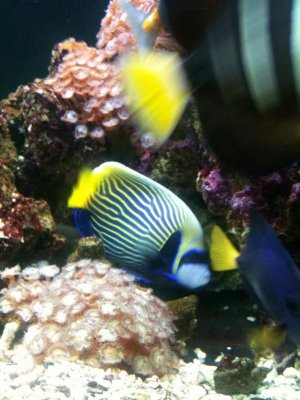
I ran a DSB for about 6yrs on my system before I took it down. I took it down because all the negative things that were being said about them being used after years of use. I used it on 3 different tanks 90, 180 & 220. The DSB was 36" long x 18" wide x 8" deep with 350gph of unfiltered water going over the top of it. All of my tanks are/were heavily stocked FOWLR. Removing the DSB was the worst thing I ever did to my system. It set things off I can't begin to explain. I'll be honest, I've only done 20% water changes/mth because its not necessary for a FOWLR system. I can't believe I'm going to post these pictures but here it goes. I'll post a before, after and now. I've finally got things back on track.
Attachments
Similar threads

- Replies
- 21
- Views
- 542
- Replies
- 3
- Views
- 632


- Replies
- 8
- Views
- 285
- Replies
- 9
- Views
- 2K