Automated NSW maker build

Yup... the easiest way is to mix to a stronger solution by 10% or so and then allow the controller to add water in cycles until the concentration is correct.

 
I'll be making about 25-30 gallons at a time. At a bit under 6g salt mix/gal that's about 150g per batch. I currently make a batch about once/month and my objective is for a 6 month supply in the hopper, so that means about 1kg of salt mix to have to keep stirred or dessicated.

Using the blast gate method, I really have no option but to overfill then dilute with RO/DI. Assuming accuracy of the conductivity probe, this will be easy to accomplish with a peristaltic pump. However, my alternative salt system will use the auger screw that is the meat grinder attachment to a KitchenAid mixer. This will allow very minor additions of salt so I'll be able overfill or underfill. I prefer this approach as it it closer to how the food and chemicals industry accomplishes automation, and I have the parts to set it up, but it is more expensive to build and I'm trying to keep the total cost of the final method affordable.
 
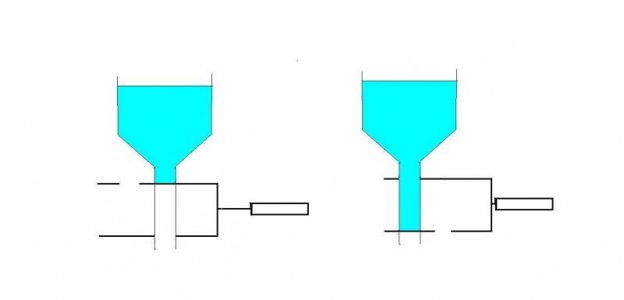
For accuracy I would be inclined to double up on your slides with a container made to accept 150g between them, stay with the actuator to move the two slides, first move would allow salt to drop into the container, the next move would drop the contents into the mixing bucket,while preventing any more salt from entering the container.
 
like this.
 

Attachments

  • shuttlemix.jpg
    shuttlemix.jpg
    12.1 KB · Views: 9
First of all Good luck!
I been thinking of doing this with salt water premixed and storeing it in 300 gal tanks and useing my AC3 pro and the conductivity probe to ajust the tank water with rodi top off back down to were i want it. So now you got me rethinking on my idea:fun4:
 
like this.

-That`s a nice solution to keep water splaches and other humid things from sneeking into the salt storage.

-One other thing that concerns me a little bit ,is the fairly flat angle that the bottom section of the container has , this could leed to bad salt transport and could even makes brigdges of salt .

-For my work we have to prepare sometimes a solution of 7000 G of methanol mixed with 1000 kg dry Naoh powder ,that we first dump in a big containment bin , the angle of this bin is a little bit sharper , and even then we sometimes experiencing brigdge formation (sometimes also due to methanol vapours entering the containment bin).


greetingzz tntneon :)
 
I visited your homepage Hawkdl2 , nice funiture you make :thumbsup:

In the future i was planning to make an wooden stand for my bigger tank , that also has to be estatical pleasing to look at , so somebody with great knowledge of funiture making could definitly give me some tips :D

greetingzz tntneon :D
 
Just an update that I've got the system ready to test but I'm having trouble figuring out how to get a triggering input to the Apex. I've been waiting for Neptune to release their new PM2 module so I can add a conductivity probe and the float switches. Right now I have no way to get a float switch input from my garage (where the system is being developed and the NSW tank lives) to the family room 90 feet away.

I'm thinking of faking it with a multi switchable power strip (e.g. a DJ power strip). The problem is I need to work out a way to trigger one outlet off the other (the way I wrote the Apex code).

Any ideas would be helpful.
 
Do you have a spare pair of wires in your phone lines? Most houses are wired with a few extra pairs. If so, and your phone wires originate from the garage or close to it, using a pair of phone wires would be an option provided you can get a wire from a phone outlet to your Apex.
 
Please do update on the humidity issue I've seen this bounce around a few times over the years but can't recall someone pulling it of? - (I really only check once in a blue moon though). I'm planning to automate the fill, thermal adjustment, mix, and final conductivity adjustment myself here shortly but was just going to add salt by hand once the mix station was initially filled and warmed up.
Subscribed...
 
Well, I calculated about how much salt I would need for one tank fill and loaded the hopper with about a 1kg of salt and plugged the system into my DJ outlet strip. It worked!!!

Using a mark on a bowl as a crude gauge I timed several fills and determined that with the size hole in my blast gate slide, it will take 25 sec or so to fill the tank.

Here it is in action:
saltflow2.jpg


Now for the glitches...

More salt than I hoped for was pushed out the ends of the blast gate by the slider (yellow arrows). After 2 or 3 runs there was enough salt around to inhibit the full opening of the blast gate (notice the salt stream not in the center) and by run 5 or so the gate wouldn't close - oops. A "few" grams of salt joined the wood dust on the floor. I had anticipated making a gasket out of an o-ring that would fit inside the blast gate on top of the slider. I guess I'll look into this next.

blastgateproblems.jpg


Also, you can see in the pic that the blast gate slider is not perfectly level (red arrows) - simply poor assembly. And this also caused some friction. I'll have to re-adjust it.

The current hopper looks like it will hold 3-4 tank fills, which isn't enough to meet my 6 month criteria so I'll have to plan to build a larger hopper. I'm also planning on making the hopper a round cylinder to allow for some sort of mixing.
 
I've had to wait for Neptune to release their long awaited conductivity expansion module for the Apex controller before progressing on the project, but the wait is over. I got the module a few days ago and spent the past few days figuring out how to program a triggered event that would initiate on a float switch event, but proceed with a cascade of timed events- not so straight forward. The module is the small black box with the green light above and to the left of the RO/DI system. The prototype hopper/gate is now mounted near the rest of the auto water system and hooked up to the controller.

The control system works perfectly. I can control precisely how long the gate will stay open after the low NSW float switch closes (currently mounted to the side of the hopper in the pic). I still have to fix the leaking salt issue I pointed out in an earlier post, but I have a plan and should have that problem fixed this week. Then it's figuring out how long the gate has to be open before begin the longer term assessment of the potential salt caking problem.

inplace.jpg
 
Last edited:
Clogging is always going to be an issue, gravity can be your friend and your enemy, instant gravity just like instant potatoes can be a disaster.

Do the shuttle and confirm fill,before dumping you will be able to sleep at night.
 
I have a second actuator on order that I will use to build an adjustable fill column version that will fill with a set amount before dumping.
 
I have a second actuator on order that I will use to build an adjustable fill column version that will fill with a set amount before dumping.

Perfect, now if you are going to run these on timers you can always mount a small electric motor to the side of the hopper, putting an eccentric wheel on it will cause it to vibrate and hopefully keep the salt from clogging.
 
Back
Top