Best Salinity Measurement Tool?

I have a conductivity probe that reports salinity very accurately, it needs calibration once in a while, but it is very good stuff!
 
I took Boomer's advice from many years ago and will be using the VeeGee STX-3 refractometer. There's a lot of research on here and in the archives regarding digital refractometers and their inaccuracies and lack of precision.

http://www.reefcentral.com/forums/showthread.php?t=1933819

I am confused now. According to Boomer, I have been doing it all wrong all these years. I thought by reading 36.5 ppt using my brine DD refractometer, I was getting 35 ppt. Have I read his remarks correctly?
 
A perfect brine refractometer will always read seawater to be higher in salinity than it actually is (misreporting an actual 33.3 ppt to be 35 ppt). It reads roughly 1.7 ppt too high.

BUT, if you read in specific gravity from that same refractometer, the error is much smaller. So a perfect brine refractometer, when perfectly calibrated to fresh water, will read the specific gravity of 35 ppt seawater to be a bit low, at 1.0261 instead of about 1.0264. That error (reading 0.0003 or so too low) is, however, probably less than most reef aquarists are concerned with.

I demonstrate those issues here:

Refractometers and Salinity Measurement
http://reefkeeping.com/issues/2006-12/rhf/index.php
 
A perfect brine refractometer will always read seawater to be higher in salinity than it actually is (misreporting an actual 33.3 ppt to be 35 ppt). It reads roughly 1.7 ppt too high.

BUT, if you read in specific gravity from that same refractometer, the error is much smaller. So a perfect brine refractometer, when perfectly calibrated to fresh water, will read the specific gravity of 35 ppt seawater to be a bit low, at 1.0261 instead of about 1.0264. That error (reading 0.0003 or so too low) is, however, probably less than most reef aquarists are concerned with.

I demonstrate those issues here:

Refractometers and Salinity Measurement
http://reefkeeping.com/issues/2006-12/rhf/index.php

Thank you Randy.
 
FWIW, I use the milwaukee digital refractometer. It's apleasure to read. It crosschecks well with a standard refractometer and ther pinpoint conductivity meter ,IME. While calibration is limited to 0 with distilled water; you can check it with other devices or a 53 ms solution .

Any variation in the scale on standard refractometer will be augmented further away from the calibration point, that's the reason for calibrating with 53ms solution for 35ppt rather than distilled water. The digital is different.
 
FWIW, I like to use conductivity for salinity measurement. Fast, accurate, easily checked in standards, and works for other things too, such as limewater potency.
Can you elaborate on a meter for this process? The hobbyist-level conductivity meters I've looked at don't appear to support a high enough range for saltwater aquarium salinity. It'd be nice to have a single conductivity/TDS meter that supports low range for confirming tapwater/RODI purity and high range for reasonably accurate saltwater salinity. I am most likely missing something as I've seen lots of people use them. TIA!
 
The PinPoint Salinity Monitor is designed for use in saltwater aquaria, and reads samples 53 mS/cm<sup>2</sup> nicely, IME. It was very stable in its calibration.
 
Can you elaborate on a meter for this process? The hobbyist-level conductivity meters I've looked at don't appear to support a high enough range for saltwater aquarium salinity. It'd be nice to have a single conductivity/TDS meter that supports low range for confirming tapwater/RODI purity and high range for reasonably accurate saltwater salinity. I am most likely missing something as I've seen lots of people use them. TIA!

The Pinpoint salinity meter can measure both limewater potency and tank water salinity, but is not suitable fore very low conductivity measurements such as an RO/DI. They sell a separate unit to get low enough (they call it their conductivity meter, even though both are such devices).

My Orion Model 128 can read from just a few microsiemens/cm (units are close to ppm TDS) to 199 mS/cm, so it spans the entire range that we encounter. But it is no longer made and was quite expensive.

Many other brands are present sold, but won't be cheap for the whole range. Check Cole Parmer:
http://www.coleparmer.com/Category/Conductivity_Resistivity_TDS_Meters_and_Testers/555

I discuss the method here:

Using Conductivity to Measure Salinity
http://www.aquariumfish.com/aquariumfish/detail.aspx?aid=1804
 
This is what I have.

If you want the best, this is it. Look at the zeros, so sexy.
Sexy is not cheap.

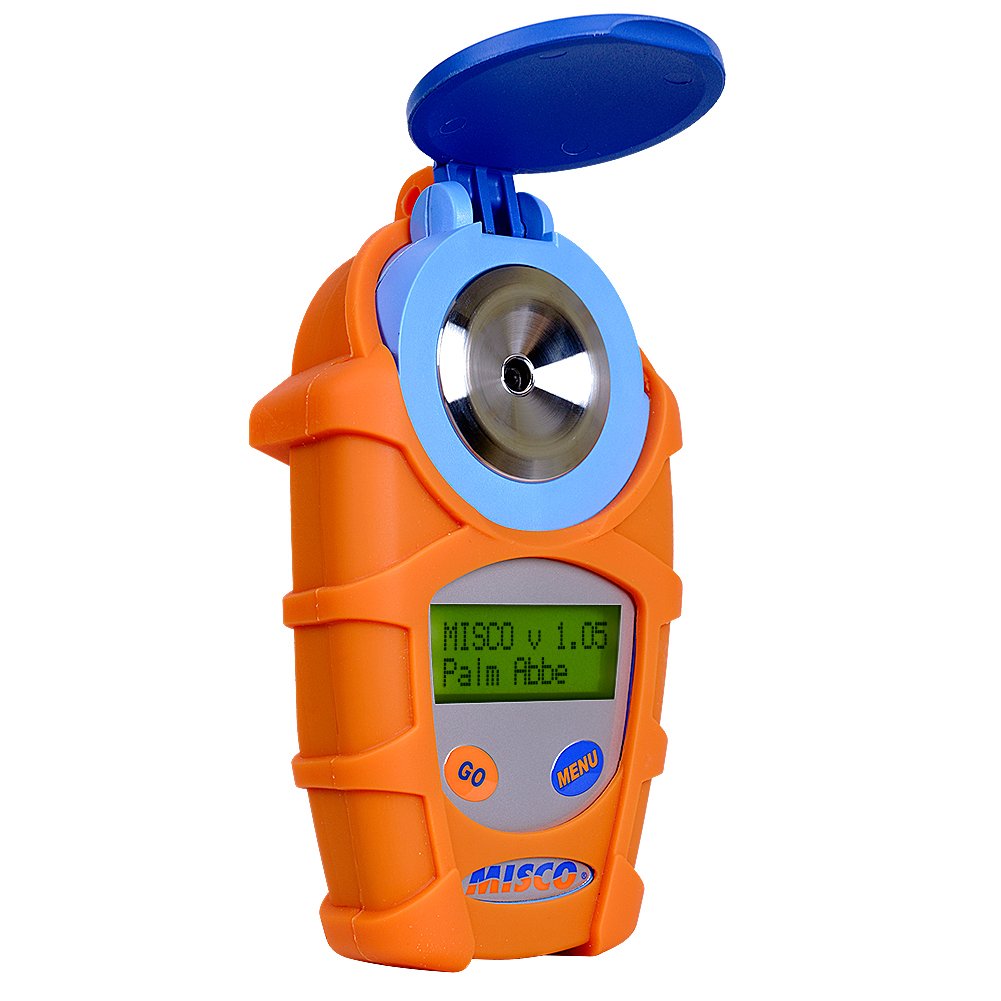
The Palm Abbe AQUAR H2O Digital Seawater Refractometer is a professional refractometer for testing seawater, salt water, and brackish ocean water for oceanography, aquaculture, aquariums, desalination plants, and ocean research.

Sea Water; Unit of Measure: Specific Gravity (D20/20); Range: 1.0000 to 1.1180 ; Resolution: 0.0001; Precision: +/-0.0005


61MJCuVn%2B4L._SL1500_.jpg
 
I received my new Tropic Marin High Precision Hydrometer. It's a big sucker!

One thing which is a little tricky when testing is that the temperature should be 77 degrees for optimal results. But once I matched the temp, I found it easy to use and read and very accurate. And the good news is that I found my Pinpoint Salinity Monitor to be dead on accurate and that can be used at any temperature.

I did my weekly testing yesterday and here's what I found:

Apex 37.6 ppt
Milwaukee 35 ppt
Pinpoint 51.6 / 34 ppt
Tropic Marin 1.0252 / 34 ppt

I calibrated the Milwaukee with distilled water this time, but the results are the same. It reads 1 ppt higher than true. I noticed the same during my last testing when I validated it with Pinpoint salinity solution. I had noticed that it read 36 ppt at the time. So two things I can conclude about the Milwaukee, it reads 1 ppt higher than true, and you can use either RODI or Distilled for zeroing with similar results.

I'm very happy I bought the Pinpoint salinity monitor, it's super easy to use and easily portable for water change mixing, etc. And now I know it's dead accurate.

As for my Apex, the salinity monitor is crap, but I think most people who have attempted to use it have found the same. So no big news here. What I'll probably do is dial my tank in at 35ppt, then adjust the temp offset to match and see if the monitor stays accurate that way. If it moves around, it was a huge waste of money...
 
I received my new Tropic Marin High Precision Hydrometer. It's a big sucker!

One thing which is a little tricky when testing is that the temperature should be 77 degrees for optimal results.

Thanks for the information. My question is that how do you ensure that your water temperature is 77F without calibrating your temperature monitor? Arrgh, my head hurts...
 
Thanks for the information. My question is that how do you ensure that your water temperature is 77F without calibrating your temperature monitor? Arrgh, my head hurts...

Good question. I run two temperature probes, one at the entry and one at the exit (heated) of my sump. I calibrate both once a month with a NIST traceable digital thermometer.
 
This is what I have.

If you want the best, this is it. Look at the zeros, so sexy.
Sexy is not cheap.

The Palm Abbe AQUAR H2O Digital Seawater Refractometer is a professional refractometer for testing seawater, salt water, and brackish ocean water for oceanography, aquaculture, aquariums, desalination plants, and ocean research.

Sea Water; Unit of Measure: Specific Gravity (D20/20); Range: 1.0000 to 1.1180 ; Resolution: 0.0001; Precision: +/-0.0005


61MJCuVn%2B4L._SL1500_.jpg

Wow!! I'll stick with Randy's article. Our hobby can get crazy...:eek1:
 
I received my new Tropic Marin High Precision Hydrometer. It's a big sucker!

One thing which is a little tricky when testing is that the temperature should be 77 degrees for optimal results. But once I matched the temp, I found it easy to use and read and very accurate. And the good news is that I found my Pinpoint Salinity Monitor to be dead on accurate and that can be used at any temperature.

I did my weekly testing yesterday and here's what I found:

Apex 37.6 ppt
Milwaukee 35 ppt
Pinpoint 51.6 / 34 ppt
Tropic Marin 1.0252 / 34 ppt

I calibrated the Milwaukee with distilled water this time, but the results are the same. It reads 1 ppt higher than true. I noticed the same during my last testing when I validated it with Pinpoint salinity solution. I had noticed that it read 36 ppt at the time. So two things I can conclude about the Milwaukee, it reads 1 ppt higher than true, and you can use either RODI or Distilled for zeroing with similar results.

I'm very happy I bought the Pinpoint salinity monitor, it's super easy to use and easily portable for water change mixing, etc. And now I know it's dead accurate.

As for my Apex, the salinity monitor is crap, but I think most people who have attempted to use it have found the same. So no big news here. What I'll probably do is dial my tank in at 35ppt, then adjust the temp offset to match and see if the monitor stays accurate that way. If it moves around, it was a huge waste of money...

Can you let us know how that adjustment made the apex probe respond? I got that spending itch and if its that far off I'll scratch else where.
 
Can you let us know how that adjustment made the apex probe respond? I got that spending itch and if its that far off I'll scratch else where.

Hey I'm sorry, I got busy with Christmas and all and haven't had a chance to test that theory. I should have some time after the holidays and I will definitely update this thread with the results.
 
FWIW, I like to use conductivity for salinity measurement. Fast, accurate, easily checked in standards, and works for other things too, such as limewater potency.


I had one and it was quite accurate. I reviewed it here:

http://www.advancedaquarist.com/2002/1/chemistry

Hi Randy,

I have decided to get a Pinpoint Salinity Monitor by American Marine with a bottle of their calibration fluid. I use limewater in addition to your recipe 2. So, as you said above, this monitor will also help me with limewater potency.

What I would like to know is how crucial it is to equilibrate the calibration solution's temperature with 25C. I can leave the calibration bottle in my tank's sump for for a while to raise its temperature. However, my problem is to ensure that the temperature of a solution is accurate. My ATC 300 temperature module's accuracy is ±1C. How would ppt/SG vary if I calibrate the monitor when the calibration solution's temperature is either 24C or 26C? Should I get a certified (traceable?) digital thermometer?

regards

Bulent
 
Back
Top