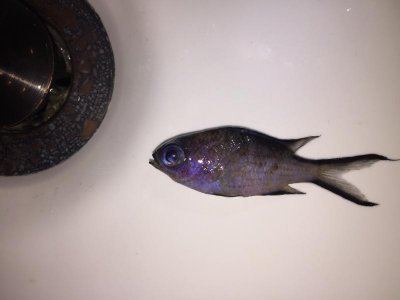
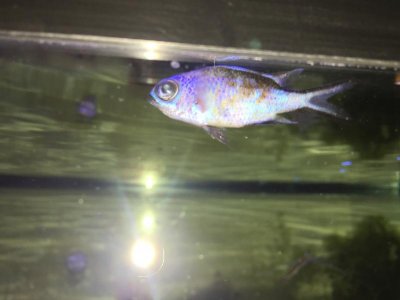
Can you indentify this disease?

dougdstecklein

New member
I recently received a copperband butterfly from live aquaria. I stuck it in my quarantine tank, but it wouldn't accept food for days so I decided to put it in my main tank which has 100s of aptasia for it to eat.
After a few days in the main tank it's fins started turning milky white, it's skin started sloughing off, and it's fins started falling apart.

Now my blue reef chromis are dying with similar symptoms.
1 chromis just died and the other isn't far behind.
Is this marine velvet?
Will it spread to my clowns and goby? They are showing no signs of sickness besides slight decrease in appetite.
 

Attachments

  • image.jpg
    image.jpg
    33.6 KB · Views: 8
The chromis has uronema marinum. Sounds like the CBB has velvet. Either can wipe out all fish in the tank.
 
Thanks Snorvich. I googled uronema marinum and found a well written post you wrote on RC about how to treat the disease.

It seems that I have now infected my quarantine tank and my display tank, so how do I proceed from here?
I'm guessing my quarantine tank should be drained and allowed to dry out at this point to start over?
I have 2 clowns and a goby still alive in my display tank. If they survive and remain in the tank, can it ever be considered "clean"?
 
Just because a Chromis is involved doesn't mean automatically Uronema.
The description (milky and fraying fins, "peeling" skin) actually sounds more like Brooklynella than either velvet or Uronema.
The key symptom for an advanced Uronema infection are usually ulcers with bloody borders.
Also, as I understand it, the Chromis were established fish and the only new fish who brought the disease in was the Chelmon, which would make two different diseases killing two different fish a lot less likely.
 
Sorry Throewer, I neglected to mention that I also ordered 2 blue reef chromis. They never accepted food either and died pretty quickly. I didn't notice any signs of disease though so I just assumed they died from the stress of transport.
 
If it is in your display you could always try pulling all fish out and trying s fallow period of a few months. There is no guarantee that it will work, but parasitic virulence should be knocked down considerably. I'm in a similar boat right now too.
 
Well, if the Chromis were new, Uronema is back in as an option - and if it's that it's bad because no fallow period will starve out Uronema.
The only way to clean a system of it is full tank sterilization.
 
Soooo... You're telling me there's a chance😜
Seriously though, this sucks👎🏽. And I know it's my own damn fault. I should have quarantined for longer than 2 days.

Sterilizing the tank is not an option, I have a lot of corals.
But I'm not ready to give up on keeping fish just yet.

I'm going to let my qt sit fallow for 10 weeks. At that point I will purchase a fish and leave it in the qt for 8 weeks. If it looks healthy I will introduce it to the DT.

If you have a better idea, please tell me what you would do instead.
 
ThRoewer,
I just looked up some pictures of fish with brooklynella and fish with uronema and I'm pretty sure they had brooklynella.
I never saw any of the lesions with bloody borders that fish with uronema exhibit.
I did see a lot of the milky white skin and sloughing or peeling skin that fish with brooklynella exhibit.
 
Microlady,
I have been following your fish disease thread as well:)
I emptied and dried my QT tank today and I plan on refilling it in a few days. After it cycles again I will purchase a fish and quarantine for 8 weeks.
That should give my display tank around 12 weeks to hopefully rid itself of the disease.
My only issue is I have 3 healthy fish in the display that I don't have the heart to remove. It won't be a true fallow period, but I'm hoping the disease population will drop enough that if I introduce a new healthy fish that it will not become sick.
 
ThRoewer,
I just looked up some pictures of fish with brooklynella and fish with uronema and I'm pretty sure they had brooklynella.
I never saw any of the lesions with bloody borders that fish with uronema exhibit.
I did see a lot of the milky white skin and sloughing or peeling skin that fish with brooklynella exhibit.

In that case you got kinda lucky.

Brook is easy to prevent via prophylactic formalin dips - all my fish go through that before they are even allowed into a QT. This also greatly reduces the risks of velvet and uronema and a whole host of other ecto parasites. It also kills all free stages (incl. ich) that may have hitched a ride in the transport water.
After that 8 weeks of observation. If you are concerned about ich and flukes you can include a round of TTM with PraziPro.
If you are extra paranoid about velvet you can either do more formalin dips when doing the tank transfers (only option for pipefish, seahorses and wrasses) or dose the TTM tank water with Chloroquine Phosphate (deadly for pipefish, seahorses and wrasses, but fine for all other fish).

As for the infected DT 6 weeks (better 8) fallow will starve brook out.
 
Hey ThRoether,
Thanks for the info. I like the sound of the formalin dip before entering the QT. Do you know of any good RC threads that go into greater detail on that topic?

Also, I'm really having a hard time accepting the fact that I will have to pull these 3 fish out of my DT. I honestly don't know if I can do it.
If I don't remove the DT fish and 12 weeks later I introduce a new healthy fish what Are the odds of it becoming sick?
 
Fish can acquire immunity to brook like to many other protozoan parasites, but one adverse event (failed heater, power outage,...) can compromise their immune system and cause an outbreak. I'm willing to take that chance with ich, but not with brook - it moves way too fast and you may start loosing fish within hours.
 
Thanks for the advice about quarantine steps. I'm going to do that same protocol from now on. I'll update after the fallow period. I may go 12 weeks this time. I'm pretty sure I had Brooklynella, but I'd like to wipe out any possibility of Crypto as well.
 
Back
Top