Clown fish ID

thedasher

Member
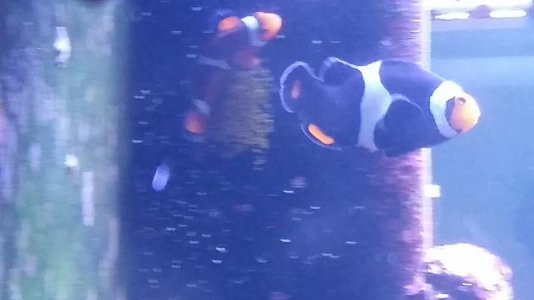
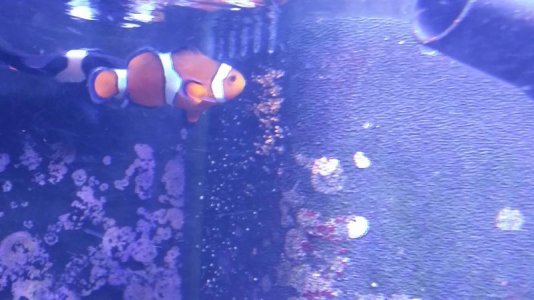
Hey guys I was wondering what kind of clown fish these are because I am raising the eggs laid by them and when I sell the babies I may need to know what type of clowns the parents are. Sorry for the bad pictures.
Thanks
 

Attachments

  • uploadfromtaptalk1428304122815.jpg
    uploadfromtaptalk1428304122815.jpg
    32.7 KB · Views: 1
  • uploadfromtaptalk1428304164207.jpg
    uploadfromtaptalk1428304164207.jpg
    50.7 KB · Views: 1
The orange one looks like a pure ocellaris (but how can you know these days for sure :angryfire:). The other looks like the Black Photon, an abominal cross of ocellaris and percula.

Please, I beg you not to pollute the clownfish gene pool any more with fish no one can trace back to anything by spreading these around - it's basically mish-mash garbage.
If you want to breed something you plan to sell get either a pair of true percula or pure ocellaris, anything that's traceable.
 
The orange one looks like a pure ocellaris (but how can you know these days for sure :angryfire:). The other looks like the Black Photon, an abominal cross of ocellaris and percula.

Please, I beg you not to pollute the clownfish gene pool any more with fish no one can trace back to anything by spreading these around - it's basically mish-mash garbage.
If you want to breed something you plan to sell get either a pair of true percula or pure ocellaris, anything that's traceable.
Thanks for the ID's. I didn't plan on breeding them. I got them from a friend who's tank broke and they just ended up laying eggs, so why not try out this challenge, right? [emoji1]
 
I also came across an onyx clown that looks similar to the female. What the difference between an onyx and a photon?
 
I believe your big mama is a misbarred onyx percula. The male is too hard to make out, but it does look to be a cross between percula and ocellaris. If you plan on trying to raise them it would be much easier if you can get them to lay on a tile. So it can be easily removed. With that said if you have never raised clownfish it is a time consuming and pricey endeavor. If it was me I would allow the clownfish eggs to hatch and feed your corals and fish:)
 
I believe your big mama is a misbarred onyx percula. The male is too hard to make out, but it does look to be a cross between percula and ocellaris. If you plan on trying to raise them it would be much easier if you can get them to lay on a tile. So it can be easily removed. With that said if you have never raised clownfish it is a time consuming and pricey endeavor. If it was me I would allow the clownfish eggs to hatch and feed your corals and fish:)
Thanks, and I already started raising them and it's pretty fun. I have about 50 that are 2 weeks old and about 70 that are 2 days old. Also the female doesn't look misbared to me, its stripes go all the way around, but the male has a misbared on the other side of its tail. I'll try to get a better picture.
 
Last edited:
The male (the orange one) looks like a pure ocellaris while the female is clearly a black photon and not an onyx percula - see here: http://www.seaandreef.com/marine-ornamental-fish/clownfish/black-photon

The problem with breeding these is not the breeding itself (they will make fine feeder fish for predators) but bringing them into circulation (=selling them for display or further breeding). These days you can't buy a clownfish without wondering if it is a pure bred or just a normal looking designer cast off. That's why I would now only buy wild caught clownfish or fish where I precisely know where they come from and that they are pure bred.
 
I believe your big mama is a misbarred onyx percula. The male is too hard to make out, but it does look to be a cross between percula and ocellaris. If you plan on trying to raise them it would be much easier if you can get them to lay on a tile. So it can be easily removed. With that said if you have never raised clownfish it is a time consuming and pricey endeavor. If it was me I would allow the clownfish eggs to hatch and feed your corals and fish:)
Yah I believe the female is a misbar since it's missing its third stripe
The male (the orange one) looks like a pure ocellaris while the female is clearly a black photon and not an onyx percula - see here: http://www.seaandreef.com/marine-ornamental-fish/clownfish/black-photon

The problem with breeding these is not the breeding itself (they will make fine feeder fish for predators) but bringing them into circulation (=selling them for display or further breeding). These days you can't buy a clownfish without wondering if it is a pure bred or just a normal looking designer cast off. That's why I would now only buy wild caught clownfish or fish where I precisely know where they come from and that they are pure bred.
What's the difference between a photon and an onyx?
 
Onyx is a true percula color form that can be found wild (like the ones in my avatar).
The Sea Quest Onyx percula line had been isolated from a handful of offspring of only two pairs. Those look a bit different than the wild caught onyx and are likely by now quite inbred.

The Photon is a crossbreed between a percula and an ocellaris - a hybrid. All the ones I have seen so far had some deformations, either from inbreeding or bad water quality during larva raising.
 
The male (the orange one) looks like a pure ocellaris while the female is clearly a black photon and not an onyx percula - see here: http://www.seaandreef.com/marine-ornamental-fish/clownfish/black-photon

The problem with breeding these is not the breeding itself (they will make fine feeder fish for predators) but bringing them into circulation (=selling them for display or further breeding). These days you can't buy a clownfish without wondering if it is a pure bred or just a normal looking designer cast off. That's why I would now only buy wild caught clownfish or fish where I precisely know where they come from and that they are pure bred.

Amen - the gene pool of CB clowns is getting so messed up, it's sad. Wild caught only for me.
 
Amen - the gene pool of CB clowns is getting so messed up, it's sad. Wild caught only for me.

I don't think we can blame a small gene pool. From what I've read it can take 7-10 generations before we see defects passed on.

I think it's more about people -- small time and large breeders alike -- not caring or understanding how hard it is to produce babies without defects. It can be done, just that folks aren't up to the task. Small breeders breed for pattern. Large breeders breed for quantity. I went to Petco the other day and peeked at the saltwater fish. I saw clowns with the worst gill flares I've ever seen. This is not to say that all breeders produce crappy clowns, as I've seen beautiful clowns from all different kinds of breeders, it's just that we as hobbiysts needs to make educated decisions when purchasing them.

Anyone can breed clowns, with minimal effort on their part. All they need are rotifers for the first week or so and the rest is easy.

What we should all keep in mind is that happy pairs of clowns will inevetibly breed. The question becomes not whether you can, but should you raise the babies.

To the OP... we're not trying to rain on your parade, just trying to level set. If you don't know what kind of clowns you have, no one can tell you what they are with 100% accuracy.
 
Onyx is a true percula color form that can be found wild (like the ones in my avatar).
The Sea Quest Onyx percula line had been isolated from a handful of offspring of only two pairs. Those look a bit different than the wild caught onyx and are likely by now quite inbred.

The Photon is a crossbreed between a percula and an ocellaris - a hybrid. All the ones I have seen so far had some deformations, either from inbreeding or bad water quality during larva raising.

FWIW, the company that produced Onyx clowns is actually called "C-Quest" and is no longer in existence, but many C-Quest Onyx clowns are alive and bred.

Also, it appears that we may see more aberrant clowns -- including wild onyx clowns (notice that I didn't capitalize the "O" on onyx) -- if PNG can get their act together:

http://www.reef2rainforest.com/2015/04/06/papua-new-guinea-gearing-up-for-aquarium-market-again/
 
Sorry - old Sci-Fi fan and C-Quest just sounds like SeaQuest :D
If I remember correctly their Onyx line went back to a hand full of very dark offspring from only two pairs. So the genetic pool is quite limited. Though I suspect it may have been a bit diluted by someone mixing in wild "onyx".

The issue with the deformations comes from lack of knowledge or economic pressure. I always did my best to breed perfect clownfish with no deformations and no misbars. But back then I didn't know that the slightly shorter upper lips were coming from high nutrient levels in the larva tank water (otherwise I would have done daily water changes - so much did it bug me). For the most part I had comparatively huge larva tanks (120 liter) to what most hobby breeders were using. But at the same time I was raising regularly 300 (ocellaris & percula) to 900 (clarkii) larva per clutch.

BTW which Petco in the Bay Area has saltwater fish? All I've been to so far only had freshwater fish.
 
Thanks for the information you guys. Man, I learned a lot. I thought misbars just came out with some extra pattern but it's really just a deformation. I never really paid attention to this stuff, seeing all these breeders trying to come up with new designs, I always thought it was something good, but I guess not. Thanks again
 
Back
Top