Completely Puzzled....?

I'm a believer and a user of Microbacter 7, if it doesn't work for nitrate reduction then so be it, It works awesome as coral food :thumbsup:

 
How long has this tank actually been set up? I just re-read the initial post and is seems like this is a fairly new setup. If so it is very possible that he is still getting die off. Even if he pulled live rock from an established tank in the same room there will be some die off from the short exposure to air. If the rock came from someplace else there will be even more die off over time. Sounds to me like his tank is simply not finished cycling. He probably has established enough bacteria to handle the ammonia and nitrite but the bioload will remain high until all of the die off is consumed. This combined with his initial overfeeding could be all that us wrong.

Sent from my PC36100 using Tapatalk 2
 
A few nuggets I like from that thread:


These are from Randy Holmes Farley and TMZ two of the names I respect most on Reef Central.

I'll take it one step further in regards to Mike's problem. Mike can't specifically test for the bacteria he is dosing via microbacter7 (assuming he doesn't have a lab grade 1000x microscope with the appropiate stains). Therefore he can't tell if this dose of bacteria is actually working or dying off by being out-competed by his already established bacteria. We all know that adding things to the tank where: you can't identify the ingredients and you cant test for it are bad husbandry practices.

If his dose is dying off those building blocks of the bacteria are getting consumed by other bacteria and getting broken down into the base building blocks - PO4 and N.

Water changes that mike is performing isn't really removing bacteria (it is - but most of the bacteria reside in the rocks and in the sand - its not really free-floating in the water).

And correct me if I'm wrong - but it looks like Mike isn't running biopellets. Isn't the only reason to dose bacteria after initial cycle is to maintain the biopellets functionality?

I'll concede that Microbacter7 helps the two following situations: Tank Turbidity/Clarity and phosphate reduction. I see no benefit in reducing nitrate to nitrogen though. I also see no benefit in using this to reduce ammonia to nitrate (his established tank bacteria is already doing that).

Ted like I said we have to agree to disagree on this one. Here is a little something on the topic as well.

"The general misconception is that bacterium is all powerful and never dies. It is only natural for us to assume that since whenever we are sick from bacterial infection, bacteria don't seem to go away until we use antibiotics on them. This is however far from the truth - bacterium is in fact a very fragile life form. According to scientists, most bacteria do not survive for more than 15 minutes outside laboratory conditions. And each time water circulation in your aquarium system stops for 30 minutes, as much as one third of the bacteria population can be wiped out. Bacteria can also die from diseases, poisoning and the lack of suitable food. So while the bacteria in your aquarium system are multiplying, they may also be dying at the same time. So if a large proportion of the bacteria population gets wiped off for whatever reasons, toxic ammonia and nitrate will build up very rapidly resulting in massive life-stock deaths. It is therefore wise to dose bacteria on a regular basis. This is to ensure there is always a sizeable bacteria culture in your aquarium system to get rid of toxic ammonia and nitrite. Besides, bacteria also helps to keep your aquarium water clear by feeding on un-consumed food and livestock waste. You can never over-dose bacteria."

Reefkeeping Online Magazine
August 2009
Volume 8, Issue 4
 
How long has this tank actually been set up? I just re-read the initial post and is seems like this is a fairly new setup. If so it is very possible that he is still getting die off. Even if he pulled live rock from an established tank in the same room there will be some die off from the short exposure to air. If the rock came from someplace else there will be even more die off over time. Sounds to me like his tank is simply not finished cycling. He probably has established enough bacteria to handle the ammonia and nitrite but the bioload will remain high until all of the die off is consumed. This combined with his initial overfeeding could be all that us wrong.

Sent from my PC36100 using Tapatalk 2

My first thoughts exactly.....In the end this may be the case but if do I dont understand why the nitrates keep going up after water changes but no ammonia or nitrites showing on tests unless those kits are bad as well.
 
My first thoughts exactly.....In the end this may be the case but if do I dont understand why the nitrates keep going up after water changes but no ammonia or nitrites showing on tests unless those kits are bad as well.

You won't see ammonia or nitrite because he has plenty of bacteria to keep them at zero but with rock still dining off the nitrates will keep climbing until all the die off is consumed.

My suggestion would be to use a turkey baster or powerhead and blow all the rocks off as well as possible and then vacume the sand while doing a water change. Then just let it go for another month or so with normal maintenance and watch the nitrate levels. At 4 months he definitely won't have enough anaerobic bacteria in the rocks to keep up with the nitrates. I would continue carbon dosing as well. Make sure he is skimming wet if he is carbon dosing.

Sent from my PC36100 using Tapatalk 2
 
Mike I thought it had been longer than that. I guess I was thinking about your 20L you had before. I think he is right you may be having another cycle on your hands. You need to get your ammonia and nitrites tested again with another test kit to see where they are at. Just stick with it man and keep doing your water changes you will have it right in no time.
 
Pretty sure it's ammonia>nitrite>nitrate

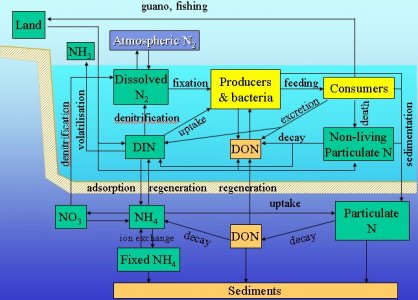
The Nitrogen cycle, really should be called web, is vastly more complex that and it is not a one-way street that is often diagrammed in hobby literature. The picture shows an estuary model but the same processes are present in our aquariums.


On the Microbacter topic. I'm sure Brightwell isn't going to tell us what exactly is in it but from the label; complex non-pathogenic aerobic and anaerobic microbes, natural enzymes. While bacteria are microbes so are fungi, archaea, protists and viruses. Enzymes are complex grouping of proteins that act as catalysts in chemical reactions. Most proteins are large organic molecules consisting of one or more chains of amino acids. Amino acids consist mainly of carbon, hydrogen, oxygen, and nitrogen. Brightwell goes out of their way to not include bacteria in the description. In my experience with the product, MB7 most positive effect is as a flocculating agent that enhances protein skimming.
 

Attachments

  • estuarinenit.jpg
    estuarinenit.jpg
    76.7 KB · Views: 6
Thanks for posting the diagram john never seen a breakdown like that. Always learing. What are your thoughts on adding microbactor to his tank at this stage?
 
^^^Definitely agreeing with that but under control circumstances, it's literally a one way street. Of course it's a moot point considering a reef tank has so many variables.

Not blasting mb7 because I used it to cycle my tank at the very beginning. Now it's mainly weekly water changes and kalk. To give you an idea of growth in my tank my 2p utter chaos that I bought less than 4 weeks ago has 4 babies blooming as of this morning. Don't know if I can contribute it to mb7 but I'll definitely start a cycle with mb7 if I ever decide to upgrade.
 
Ok - I'm looking for that original Pete. I also continue to try and convince you and mike that dosing bacteria to dose bacteria to put more money into Brightwell's pockets.

Reefkeeping Online Magazine
August 2009
Volume 8, Issue 4
The quote you reference appears to be a mistake in that the end of your quote in my searches also points to Paul_B's 40 year reef - not the "Dosing Bacteria - is it neccessary" article. I can't find the original for that.
A little detective work:
I would only like to know who the author is. It looks (through google searching) that this article you quoted doesn't have an original. It was posted to several forums under the name sam@a-reef and that user only has a single post in all of those forums.

Whoever this sam@a-reef is - it looks like he tacked on PaulB's explanation from the reefkeeping issue to back up his thoughts on bacteria dosing. Basically - I'm saying Sam@a-reef is suspect of commercial interests

PaulB's quote:
Paul Baldassano’s Reef - 40 Years in the Making
A Different Technique

There is one more non-typical thing that I do that some may consider either risky or just useless. I mentioned above that I add bacteria from the sea to my tank. I feel bacteria are the most overlooked aspect of this hobby, and are vital to a healthy, long-lived tank. Bacteria cover everything in our tanks, but are they the correct bacteria for our purposes? Probably not. Bacteria enter our tanks in a number of various ways. Every time we put our hands into the water, we add bacteria. When we add fish, corals, rock or food, we add bacteria. The bacteria on the rocks and fish were at one time in the sea and “some” of those bacteria are the correct bacteria for our needs. But eventually, that bacteria will stop reproducing and will be outnumbered or outcompeted by other bacteria that may not be dangerous but do not necessarily help complete the nitrogen cycle. Why do so many people change so much water and still have nitrates? If we had the correct numbers and types of bacteria, we would never have to change water just to lower nitrates; the bacteria do that for us for free. I have found that by adding bacteria from the sea a few times a year, my reef stays healthy. I have no scientific data on this theory, but I do have a 40-year-old tank with an undergravel filter and no nitrates.

Paul B does state that he doses bacteria by doing a water change with NSW. I respect alot of what PaulB says - along with those two pennsylvanians - SanJay and Mike Paletta. However, in my research - i specifically place them into a seperate bucket from people like Randy Holmes Farley. All three of these people have amazing tanks but employ techniques that the rest of the hobby debunk. Mike Paletta swears by Miracle Mud. PaulB has an undergravel filter. I suspect people with succesful tanks like this have karma or luck or something they keep to themselves. Then the marketing folks get ahold of something they are doing and start marketing some solution that is only part of their success.
 
Thanks for posting the diagram john never seen a breakdown like that. Always learing. What are your thoughts on adding microbactor to his tank at this stage?

I would discontinue the use of MB7 or anything else that is organic based. IMO, the tank already has an overabundance of Nitrogen compounds and the bacteria population response is being limited by the amount of organic carbon. For an additive, an organically clean carbon source would be my first choice.
 
Here's another quote by Elegance Coral - who also has some logical thoughts That I like to read:

I totally agree. IMHO. Not only are their numbers influenced by the availability of food, but the strains of microbes in a system will be determined by the environmental conditions of that particular system. Even after the initial cycle is over, most of us don't consider a system to be mature and stable for another 6 months to a year. This is due, in part, to the yoyoing microbial populations and the battle for dominance among the different strains. Eventually, those microbes that are best suited to the environmental conditions within a particular system will become dominant, and the others will see their numbers greatly reduced, or completely wiped out. Survival of the fittest. Once the microbes that are the most efficient at survival within the system become the dominant strains, the system becomes very stable. Throwing foreign microbes into a well established system, doesn't make it stronger. It temporarily reduces the number of efficient microbes, and starts the whole battle for dominance all over again, disrupting the stability of the whole system. Diversity is not always a good thing. Throwing African lions into the wilderness of Yellowstone would increase the diversity, but would upset the balance of nature. At least until the first winter when the lions died off and the established creatures began the long recovery process. This, IMHO, is what happens when you add an unknown bacteria culture to a healthy, well established system. Just let the wolfs do their job and the deer, and caribou herds will remains strong and healthy. Don't throw lions in there to kill the wolfs, steal their food, and disrupt the whole system.

Since Mike is dealing with a new system within the first 6 months - I would lean towards allowing the bacteria to fight it out naturally and have a more mature stable (can we call it a? ) ecosystem in the end than trying to unbalance the equilibrium by adding more bacteria from additional sources.

So again, I'm with Snake's previous posts - remove all of the bells and whistles, do water changes (and do test your water mixing station for nitrates before the water change).
 
^^^Definitely agreeing with that but under control circumstances, it's literally a one way street. Of course it's a moot point considering a reef tank has so many variables.

I'll say it again, the Nitrogen Cycle is not and never has been a one way street. It works the same way in our tanks as it does in nature with the exception of abyssal nutrient sinks. The processes are the same just on a smaller scale and therefor easier to overwhelm or disrupt.

This is a hoax.
NitrogenCycle.jpg
 
my bachelor in chemistry background from the University of Florida, plus a fellowship, states otherwise under a "controlled" environment. ;-)

2NH3 + 2.5O2 ---------> 2NO + 3H2O

this equation doesn't change under any circumstances without any plausible variable and that's what I was stating.
 
Good job Ichthyman, I argued with a fellow for a long time about the nitrogen cycle and he also tried to tell me it was a one way street since the arrow in the diagram only goes one way. All my classes have been the web based dynamic diagram.
 
Good job Ichthyman, I argued with a fellow for a long time about the nitrogen cycle and he also tried to tell me it was a one way street since the arrow in the diagram only goes one way. All my classes have been the web based dynamic diagram.

how else do you oxidize NH4 in a control environment? A tank cycle have multiple cycles within a cycle because the variables can all be affected by anything.

under laboratory control, the nitrification of ammonia is only way. guaranteed if you took CHEM 2046 and told Dr. Horvath, head of the Chemistry Department at UF that there's some other way he'll give you a quick "F"
 
Back
Top