aguila88psi
Zoa Addict
I'm a believer and a user of Microbacter 7, if it doesn't work for nitrate reduction then so be it, It works awesome as coral food :thumbsup:


A few nuggets I like from that thread:
These are from Randy Holmes Farley and TMZ two of the names I respect most on Reef Central.
I'll take it one step further in regards to Mike's problem. Mike can't specifically test for the bacteria he is dosing via microbacter7 (assuming he doesn't have a lab grade 1000x microscope with the appropiate stains). Therefore he can't tell if this dose of bacteria is actually working or dying off by being out-competed by his already established bacteria. We all know that adding things to the tank where: you can't identify the ingredients and you cant test for it are bad husbandry practices.
If his dose is dying off those building blocks of the bacteria are getting consumed by other bacteria and getting broken down into the base building blocks - PO4 and N.
Water changes that mike is performing isn't really removing bacteria (it is - but most of the bacteria reside in the rocks and in the sand - its not really free-floating in the water).
And correct me if I'm wrong - but it looks like Mike isn't running biopellets. Isn't the only reason to dose bacteria after initial cycle is to maintain the biopellets functionality?
I'll concede that Microbacter7 helps the two following situations: Tank Turbidity/Clarity and phosphate reduction. I see no benefit in reducing nitrate to nitrogen though. I also see no benefit in using this to reduce ammonia to nitrate (his established tank bacteria is already doing that).
How long has this tank actually been set up? I just re-read the initial post and is seems like this is a fairly new setup. If so it is very possible that he is still getting die off. Even if he pulled live rock from an established tank in the same room there will be some die off from the short exposure to air. If the rock came from someplace else there will be even more die off over time. Sounds to me like his tank is simply not finished cycling. He probably has established enough bacteria to handle the ammonia and nitrite but the bioload will remain high until all of the die off is consumed. This combined with his initial overfeeding could be all that us wrong.
Sent from my PC36100 using Tapatalk 2

The tank officially started cycling on January 29th of this year so just over 6 months.
My first thoughts exactly.....In the end this may be the case but if do I dont understand why the nitrates keep going up after water changes but no ammonia or nitrites showing on tests unless those kits are bad as well.

Pretty sure it's ammonia>nitrite>nitrate


The quote you reference appears to be a mistake in that the end of your quote in my searches also points to Paul_B's 40 year reef - not the "Dosing Bacteria - is it neccessary" article. I can't find the original for that.Reefkeeping Online Magazine
August 2009
Volume 8, Issue 4
Paul Baldassano’s Reef - 40 Years in the Making
A Different Technique
There is one more non-typical thing that I do that some may consider either risky or just useless. I mentioned above that I add bacteria from the sea to my tank. I feel bacteria are the most overlooked aspect of this hobby, and are vital to a healthy, long-lived tank. Bacteria cover everything in our tanks, but are they the correct bacteria for our purposes? Probably not. Bacteria enter our tanks in a number of various ways. Every time we put our hands into the water, we add bacteria. When we add fish, corals, rock or food, we add bacteria. The bacteria on the rocks and fish were at one time in the sea and “some” of those bacteria are the correct bacteria for our needs. But eventually, that bacteria will stop reproducing and will be outnumbered or outcompeted by other bacteria that may not be dangerous but do not necessarily help complete the nitrogen cycle. Why do so many people change so much water and still have nitrates? If we had the correct numbers and types of bacteria, we would never have to change water just to lower nitrates; the bacteria do that for us for free. I have found that by adding bacteria from the sea a few times a year, my reef stays healthy. I have no scientific data on this theory, but I do have a 40-year-old tank with an undergravel filter and no nitrates.
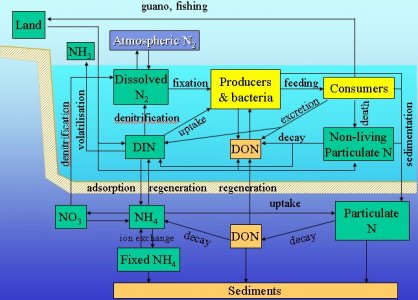
Thanks for posting the diagram john never seen a breakdown like that. Always learing. What are your thoughts on adding microbactor to his tank at this stage?
I totally agree. IMHO. Not only are their numbers influenced by the availability of food, but the strains of microbes in a system will be determined by the environmental conditions of that particular system. Even after the initial cycle is over, most of us don't consider a system to be mature and stable for another 6 months to a year. This is due, in part, to the yoyoing microbial populations and the battle for dominance among the different strains. Eventually, those microbes that are best suited to the environmental conditions within a particular system will become dominant, and the others will see their numbers greatly reduced, or completely wiped out. Survival of the fittest. Once the microbes that are the most efficient at survival within the system become the dominant strains, the system becomes very stable. Throwing foreign microbes into a well established system, doesn't make it stronger. It temporarily reduces the number of efficient microbes, and starts the whole battle for dominance all over again, disrupting the stability of the whole system. Diversity is not always a good thing. Throwing African lions into the wilderness of Yellowstone would increase the diversity, but would upset the balance of nature. At least until the first winter when the lions died off and the established creatures began the long recovery process. This, IMHO, is what happens when you add an unknown bacteria culture to a healthy, well established system. Just let the wolfs do their job and the deer, and caribou herds will remains strong and healthy. Don't throw lions in there to kill the wolfs, steal their food, and disrupt the whole system.
^^^Definitely agreeing with that but under control circumstances, it's literally a one way street. Of course it's a moot point considering a reef tank has so many variables.


Good job Ichthyman, I argued with a fellow for a long time about the nitrogen cycle and he also tried to tell me it was a one way street since the arrow in the diagram only goes one way. All my classes have been the web based dynamic diagram.