
You are using an out of date browser. It may not display this or other websites correctly.
You should upgrade or use an alternative browser.
You should upgrade or use an alternative browser.
Dinoflagellates.
- Thread starter DNA
- Start date
karimwassef said:UV kills dinos and bacteria in the water column.
The dinos are free floating in the dark, but set up farms in the light.
The nitrifying bacteria are predominately not free floating. They're resident in sand beds and inside rock structures.
Every night, the dinos float kills them. The skimmer and nitrifying bacteria export/consume their remains. This strengthens the good bacteria.
I agree that UVS can effectively control a dino population, but it doesn't wipe them out, and some fraction of the DOC released when a dino (or any microorganism) is killed by UVS may be absorbed by the dinos' food bacteria. And some of it will go to feed bacteria we consider beneficial, as well. And some of it will be captured by still other bacteria, of which there are a great many in reef tanks. No one group of bacteria will have a monopoly on the DOC released by a UVS.
For some insight into the microbiology of coral reefs, I urge any interested reefer to read the book Coral Reefs in the Microbial Seas by Forest Rohwer. It's accessible, engaging, and short, but it introduces readers to some hardcore science, and ULNS reefers may find some of what Dr. Rohwer has to say to be of particular relevance to their slant on the hobby.
karimwassef said:I wonder what adding a large volume of nitrifying bacteria would do. Something concentrated like TurboStart900 would create a significant rebalance of bacteria.
34cygni said:It looks to me like heterotrophic bacteria are the foundation on which ostis build. These bacteria are rich in phosphorous. Dinos are P-rich organisms, as well, but less so than the bacteria, so there's excess phosphorous in their diet. This waste phosphorous is used to recruit cyano, which is also P-rich, but less so than the dinos. And now the dinos have access to P from the bacteria and N and Fe from the cyano. Sky's the limit.
I thought Montireef outcompeted the ostis' bacteria by triggering a minicycle when he added LR. A cycling bacterial biofilter is basically a series of overlapping bacteria blooms, during which nutrient demand is very high.
I agree that our best bet to outcompete the ostis is to outcompete their food supply with, as you put it, "a significant rebalance of bacteria". I'm looking for a bigger gun than just the nitrogen cycle bacteria, though...
PorkchopExpress said:as soon as i saw them i sucked them up and immediately started feeding the tank like crazy to get NO3/PO4 up which has worked
Don't forget DNA's cautionary tale:
DNA said:I raise nitrates and it makes a considerable dent in the dinos.
Algae moves in and covers much of my rocks.
Dinos move back in and sit comfortably on top of the algae.
Cyano really gets going and covers the dinos.
You know, that's almost haiku...
I raise nitrates, it
makes a considerable
dent in the dinos.
Algae moves in
and covers much of my rocks.
Dinos move back in
Comfortably on
top. Cyano gets going,
covers the dinos.
So close! One line is a syllable short... Okay, so the bad news is that O. ovata is known to be epiphytic, which is Science for "it grows on algae". The point of that observation being that what you guys are seeing is normal behavior this organism exhibits in the wild, and it's another reason why ostis can never be outcompeted by algae.
PorkchopExpress said:...at least for me the UV approach is no longer working by itself, it requires me dirtying up my water as well...i believe my dinos will lay dormant for some time and bloom at opportune moments...i don't believe i'll ever get rid of them
Sorry the problem recurred in your new tank. Sorrier still to tell you that you're right: they will lay dormant for years, bloom at opportune moments, and you'll never be rid of them. Out in the real world, that's pretty much their job. Dinos are survivors. They have to be because they're a keystone of marine ecosystems, responsible for generating vast amounts of biomass, and an entire suite of organisms has evolved to take advantage of this food resource, and another to take advantage of the organisms taking advantage of it, and so on up the food chain.
Short of a miracle fix -- I like to imagine multiple high-speed micrographic video cameras at different angles localizing individual dinos, and a green laser blowing them apart (I bet dinos fluoresce at certain wavelengths, making them easy to see in the dark) -- all we can do is try to keep them in check.
PorkchopExpress said:the next time they decide to bloom, the UV and dirty water may no longer work...i might have to take a poop in my aquarium at that point
If "the clean method" really has stopped working for you and you're resorting to "the dirty method" with the UVS on, I can only guess that the UV is working against you by killing other protists and bacteria that circulate through the sterilizer. Perhaps that's why you have to let things go so far to make it work. Next time, consider taking the UV offline when you "go dirty", or perhaps turn the UV off during the "day" when the dinos are settled down to give other microorganisms a chance to move around. Be prepared for an explosion in the dino population -- this looks like it could be one of those "it's going to get worse before it gets better" situations. See if the dirty method works faster with UV only at night or with UV completely off. Then turn the UVS back on to slow the rebound of the dino population after you knock them back and tidy up. In theory, it's the best of both worlds. Food for thought, anyway.
Speaking of dinos developing resistance, though, it also crosses my mind that even if Montireef's probiotic power-up works, the dinos might be able to adapt to that, as well. The problem is that pretty much the same menagerie of microorganisms is going to be coming out of the skimmer every time, and the dinos may eventually find the right mix of toxins to repel them, or at least to repel the most rapacious species. But on the other hand, maybe some of the organisms in skimmate tea are heterotrophic dinoflagellates, and we're fighting fire with fire.
Quiet_Ivy said:I'm discouraged.
I don't know if you were actually born there, but you are a true Canadian. I would be waaaay beyond discouraged at this point if I were in your shoes.
Quiet_Ivy said:Where's the green algae? Diatoms?
Remember DNA's warning... You may be setting yourself up for disappointment if you dose nitrogen to grow green algae.
Quiet_Ivy said:Looking at my monthly tank shots I see that my sandbed is becoming less and less alive. There aren't any hair worms along the front at all anymore. No spaghetti worms in the sandbed. Pod population has come back to normal, and seems to hang out on the glass in the dinos. Sandbed is clumping into little hillocks, oddly.
Yes, your sand bed appears to be dying. My guess is that the clumps are made by bacterial biofilm goo gluing the sand grains together. Your sand bed "clogged", meaning there's no longer enough infauna to turn the sand and break up the biofilm goo, and it crusted over. The crust somehow got broken up a bit, and now you have clumps.
Dinos killing a sand bed is interesting... How was yours set up? Did you follow Shimek's list of "DSB safe" livestock when stocking your tank? If not, what were your livestock choices, in particular for your sand bed CUC and your CUC in general? How long was your sand bed in place before your dino outbreak? Did you have the usual very low or undetectable N and P at the time of your outbreak, and if so was that normal for your system? Have you ever seen offgassing from your sandbed? If so, have there been more bubbles or fewer bubbles over time? Thanks for any information you care to share, and if anybody else has dinos and dead or dying sand, same questions. Sand is on my mind ATM.
Quiet_Ivy, if you intend to try probiotic dosing and want to try to turn your tank around -- and I'm guessing you do, as you haven't torn it down and started over -- I suggest you consider collecting skimmate from other hobbyists, as yours is coming in slowly, and your tank's ecosystem seems to have slid so far that you may lack some of the microfauna you're trying to cultivate. An infusion of new life at the bottom of the food chain would probably do your tank some good. And the sooner, the better.
Quiet_Ivy said:I'd really like to know what was going on in Montireef's cultured skimmate. Were conditions anoxic/anaerobic?
No -- if you put it in a sealed container and it goes anaerobic, everything dies except anaerobic bacteria, which would then die in turn when dumped into oxygenated tank water. Not that you would be at all inclined to dump that reeking bottle of foulness into your tank...
12/31/2014, 03:13 PM #594
Montireef
Just place some GAC on your filter/mesh to remove the bad stuff and release the stinky waters back to the tank, I'm sure you will be surprised.
12/31/2014, 03:38 PM #597
Montireef
And this is the outcome:
https://www.youtube.com/watch?v=OeWIJrUzRoo&feature=youtu.be
No trace of ostreopsis ovata (probably the worst dinofalgellate I have ever come across) after a few days.
Which is not to say that it won't smell bad. I mean, y'know... Skimmate. Plus, a small anoxic zone will almost certainly develop among the larger bits of gunk that settle to the bottom, but this shouldn't be disturbed as a trickle of nutrients, in particular nitrogen, is coming out of it as the gunk decays, and this helps keep the system going as it "matures".
Quiet_Ivy said:Did the bottle contain the motherload of n-fixing bacteria? Or was it the protozoan predators?
Remember where we stole skimming technology from: the wastewater treatment industry (but fair's fair: they got the idea from us in the first place). Skimmers excel at removing colloidal organic carbon, a squishy, somewhat nebulous intermediate phase between dissolved organic carbon (individual molecules floating around in water) and solid matter. The reason the wastewater treatment people were interested in such a thing, and the reason the technology came full circle and returned to the aquarium hobby in new and improved form, is that there's quite a bit of colloidal organic carbon in poo.
Bacteria love colloidal organic carbon, the fresher the better. It's solid enough for them to colonize, but soft enough that the enzymes they release can get into it and break down the individual molecules -- fragments of old proteins -- that it's made of into smaller pieces that the bacteria can consume. And where there are bacteria (and oxygen) there are things that eat bacteria, some of them single-celled and some of them multicellular...
Basically, I theorize that Montireef's reported success was the result of millions of these microscopic rafts of colloidal organic carbon, all of them carrying bacteria and perhaps also other hungry things, sticking to the dino mucilage and contaminating it with exactly the sort of organisms the dinos are trying to exclude. If so, it would reasonably follow that DNA's reported failures happened because he left his skimmer on and removed the colloidal organic carbon before it could do any good.
So here's a fun science fact: dinos love sand.
Dinos are found in pretty much any sort of marine sediment, but sand is their favorite. I know people have tried removing sandbeds, and Squidmotron gave us this rather amazing report of his experience adding sand...
Has anyone tried rejiggering their system so that there's no sand anywhere except in a cryptic tank or a cryptic remote deep sand bed? I'm wondering what happens to mixotrophic dinos and their cysts when the only sand they have access to is dark and full of hungry heterotrophs... And filter feeders like cryptic zones. Having some of them around couldn't hurt.
Like I said, I've been thinking about sand.
Dinos are found in pretty much any sort of marine sediment, but sand is their favorite. I know people have tried removing sandbeds, and Squidmotron gave us this rather amazing report of his experience adding sand...
04/30/2014, 04:11 PM #206
Squidmotron
I just discovered something that is interesting. Since I have never heard this before in relation to dinos I thought I would pass it along.
Today I added about 15 lbs of pink somoa sand (not live) sand to my refugium. I was curious if there was any particular reason the dinos weren't growing much in my refugium and so thought to recreate the environment of the aquarium above. My refugium never had any substrate. Just caulerpa.
Within 4 hours, dino populations exploded. And I mean exploded. Dinos rose to much larger than normal heights in their usual spots and started covering all the rocks. The substrate began literally bubbling as new dinos formed (even in tank areas where I did not add sand).
(and yes, these are not diatoms -- as you might expect from the addition of sand -- although I wonder if there are both present)
Has anyone tried rejiggering their system so that there's no sand anywhere except in a cryptic tank or a cryptic remote deep sand bed? I'm wondering what happens to mixotrophic dinos and their cysts when the only sand they have access to is dark and full of hungry heterotrophs... And filter feeders like cryptic zones. Having some of them around couldn't hurt.
Like I said, I've been thinking about sand.
PorkchopExpress
New member
@karim - the bulb in my UV was replaced @6 months and thoroughly cleaned.
@34cygni - my UV is on a timer - it turns on at 10pm and are on until 6am...i really only care about killing the dinos while they are free floating...having the UV on all day long also raises my water temp up 2 degrees and i don't have a chiller
also it's true, dinos definitely love sand and is probably another reason why my UV is no longer working alone anymore...before when i had the smaller tank and got dinos, i had removed the sand bed prior to installing the UV and they vanished almost overnight...in the new tank i have a good 2-3 inches of sand again and they aren't quite as easy to beat
i actually just got another bloom yesterday and now it's become apparent that every time i've had a bloom, the only thing i did the night before was dose Acropower amino acids...this time was no exception, i dosed a half a cap of Acropower and sure enough the next day i had a bloom...i remember when i first got dinos in the old tank i was dosing vinegar, Acropower, using chemicals like chemiclean to get rid of cyano - a whole bunch of stuff...i stopped everything except Acropower which i dose seldomly and now it appears if i dose too much of it i get a bloom
@34cygni - my UV is on a timer - it turns on at 10pm and are on until 6am...i really only care about killing the dinos while they are free floating...having the UV on all day long also raises my water temp up 2 degrees and i don't have a chiller
also it's true, dinos definitely love sand and is probably another reason why my UV is no longer working alone anymore...before when i had the smaller tank and got dinos, i had removed the sand bed prior to installing the UV and they vanished almost overnight...in the new tank i have a good 2-3 inches of sand again and they aren't quite as easy to beat
i actually just got another bloom yesterday and now it's become apparent that every time i've had a bloom, the only thing i did the night before was dose Acropower amino acids...this time was no exception, i dosed a half a cap of Acropower and sure enough the next day i had a bloom...i remember when i first got dinos in the old tank i was dosing vinegar, Acropower, using chemicals like chemiclean to get rid of cyano - a whole bunch of stuff...i stopped everything except Acropower which i dose seldomly and now it appears if i dose too much of it i get a bloom
The skimmate I dumped in the system was the full content of the collection cup after a couple of weeks working. It was warm and not anoxic since it was on a working skimmer blowing humid air all the time.
I put a drop from the bottom of the cup under the microscope to find lots of nematodes, cilliates of diferentes kinds, heterotrophic dinoflagellates (oxyhrris marina) and tons of bacteria (spiros and cocos). There was a whole ecosystem teeming with life.
I put a drop from the bottom of the cup under the microscope to find lots of nematodes, cilliates of diferentes kinds, heterotrophic dinoflagellates (oxyhrris marina) and tons of bacteria (spiros and cocos). There was a whole ecosystem teeming with life.

Quiet_Ivy
New member
So close! One line is a syllable short... Okay, so the bad news is that O. ovata is known to be epiphytic, which is Science for "it grows on algae". The point of that observation being that what you guys are seeing is normal behavior this organism exhibits in the wild, and it's another reason why ostis can never be outcompeted by algae.
DNA has a very sparse, poetic prose style. Also is there anything dinos can't do? So you're theorizing that the 'dirty' method works not because the green algae outcompete dinos for nutrients, but because there's a concurrent bacterial or microfaunal bloom which outcompetes the farmed dino-bacteria for food?
I don't know if you were actually born there, but you are a true Canadian. I would be waaaay beyond discouraged at this point if I were in your shoes.
Remember DNA's warning... You may be setting yourself up for disappointment if you dose nitrogen to grow green algae.
Lol I suppose we're a bit tough, Canucks. I wanted to set up a more complex ecosystem than is possible in freshwater, and learn Stuff. It's definitely been a learning experience, though mostly not a positive one.
I think DNA may have the same situation I do; severe lack of biodiversity very low in the food chain. Perhaps lower than is usual with dinos? I look at a lot of algae posts on the newbie forum, and nobody with out of control algae seems to have dinos. (That said there was someone on Reef discussion today with suspicious dinos-or-cyano). Several people have had sucess adding pods, which may indicate that their infestation hasn't nuked all the organisms below pods. My pods are actually doing well, I saw some of those snowflake hydroids and a couple of flatworms this morning.
Dinos killing a sand bed is interesting... How was yours set up? Did you follow Shimek's list of "DSB safe" livestock when stocking your tank? If not, what were your livestock choices, in particular for your sand bed CUC and your CUC in general? How long was your sand bed in place before your dino outbreak? Did you have the usual very low or undetectable N and P at the time of your outbreak, and if so was that normal for your system? Have you ever seen offgassing from your sandbed? If so, have there been more bubbles or fewer bubbles over time? Thanks for any information you care to share, and if anybody else has dinos and dead or dying sand, same questions. Sand is on my mind ATM.
It's not a true DSB as my tank is an all in one about 40cm square. Shimek recommended not trying dsb without a square foot of unobstructed sand, so I went with about 3cm sugar-sized oolite. It was started with dead sand, when I started the tank (also with dead rock) but I got cups of sand from 3-4 people. Begged some spaghetti, hair, bristle worms too. CUC was bristleworms, nassarius, cerith, astrea snails, a serpent star (he's still in there!), 1 red reef hermit (still alive too), collonista snails, 3 sexy shrimp. No snails/shrimp have survived.
I don't have an exact date for the outbreak but I see I noted "diatoms are back? some kind of algae?" around 1.5 months after the cycle finished. I've never had measurable nitrate in this system. Phos was .03 right after the cycle, dropped to zero once the diatoms kicked in and has been undetectable since. Which is ironic as I intended this to be a lagoonal biotope. Max diversity of lower life forms as they're interesting and not seen as much as say, a fish.
Well that biofilm explanation sounds reasonable although that's a really bad sign. I had been blaming the wildly fluctuating alkalinity I had for almost a month during the worst of the outbreak. (I can tell I'm about to get a breakout of dinos just by watching my alk drop. Interestingly, coralline algae has receded dramatically despite normal Ca and Mg levels)
I've been turkey-bastering cyano/dinos out so I break up the surface. I took out a 10cm square section because it looked anoxic. I see more bubbles along the front glass than when I started. Do you suggest deliberately stirring it? I've been leaving it alone except for picking dino/cyano out in the hope that the worms will come back.
I suggest you consider collecting skimmate from other hobbyists,
Now this is an interesting idea! Local reefers already think I'm mental; this should confirm it without a doubt. *g*
Basically, I theorize that Montireef's reported success was the result of millions of these microscopic rafts of colloidal organic carbon, all of them carrying bacteria and perhaps also other hungry things, sticking to the dino mucilage and contaminating it with exactly the sort of organisms the dinos are trying to exclude. If so, it would reasonably follow that DNA's reported failures happened because he left his skimmer on and removed the colloidal organic carbon before it could do any good.
Hm. I don't have the reference to hand, but AA mag did a study on carbon dosing and bacteria. They found that skimmerless tanks had bacteria counts close to authentic reefs while tanks with skimmers had 1/10th or less. What they didn't do was identify the bacteria. Are aquaria a monoculture? It seems they should be, closed system.
I'm still going back and forth on shutting my skimmer down.
I've been drafted into running my relative's house-farm-garden-zoo for 10 days so my tank will be very neglected. At least they have internet.

definitely learning
ivy
PS look at this! http://biopop.com/products/dino-pet A bioluminescent, dinoflagellate dinosaur. Says they used Pyrocystis fusiformis. Who is brave enough to order this and dump it into their tank??
I bet if you put that under the microscope you would see 90% diatoms and 10% dinos, you are close, you are at the stage where I started dosing pods+ from the algae barn and fresh phyto, which was the final nail in the dino coffin for me.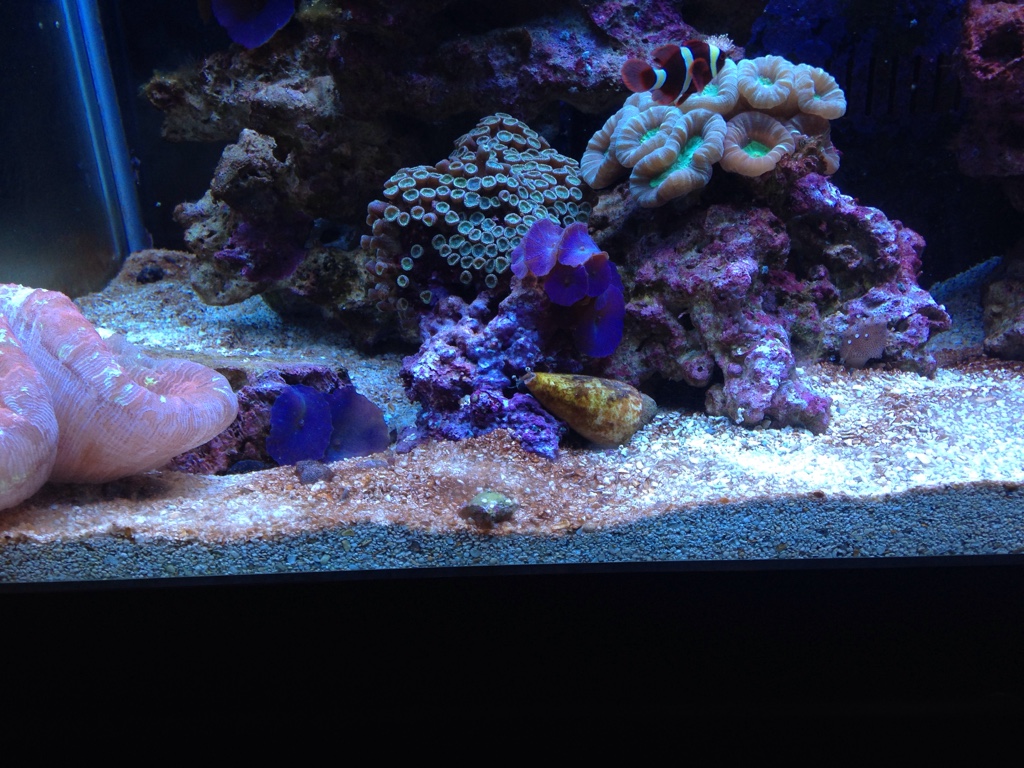
This is if I leave it for about a week
Adrnalnrsh
New member
The skimmate I dumped in the system was the full content of the collection cup after a couple of weeks working. It was warm and not anoxic since it was on a working skimmer blowing humid air all the time.
I put a drop from the bottom of the cup under the microscope to find lots of nematodes, cilliates of diferentes kinds, heterotrophic dinoflagellates (oxyhrris marina) and tons of bacteria (spiros and cocos). There was a whole ecosystem teeming with life.
I've had my skimmer cup full for a few weeks with the skimmer off. Wonder if I should give it a try?!?!?!

karimwassef
Active member
UV + skimming = removed DOCs. It doesn't have to be a bacteria pump.
Molecular data and the evolutionary history of dinoflagellates said:The importance of dinoflagellates in aquatic communities is hard to overestimate. They are ubiquitous in marine and freshwater environments, where they constitute a large percentage of both the phytoplankton and the microzooplankton, and in benthic communities as interstitial flora and fauna or as symbionts in reef-building corals, other invertebrates and unicellular organisms (Taylor, 1987).
Emphasis mine. Translated from Science, that means both mixotrophic ("flora") and heterotrophic ("fauna") dinos like to live in the little gaps between sand grains. In all likelihood, Shimek's identification of the optimal size of sand grains to maximize biodiversity in DSBs and the subsequent adoption of "sugar sand" as a standard in the hobby means many of us are setting up ideal habitats for benthic dinos in our tanks.
Growth said:4b. Trophic mode effect
The highest MGR [Maximum Growth Rate] of the HTDs [HeteroTrophic Dinoflagellates] is double the highest MGR of dinoflagellates growing autotrophically. Also, MGRs of small HTDs are much higher than those of similar sized ATDs [AutoTrophic Dinos]. Energy gain of small HTDs through feeding may be higher than that of small ATDs through photosynthesis. Also, enzymes involved in photosynthesis may lower MGRs of dinoflagellates and it is worthwhile exploring this topic. The range of MIRs [Maximum Ingestion Rates] of each HTD was 0.04-24.4 ng C per dinoflagellate per day, while that of each MTD [MixoTrophic Dinoflagellate] species was 0.03-7.0 ng C per dinoflagellate per day. Also, MIRs of HTDs were higher than those of similar sized MTDs (Fig. 5). Heterotrophic activity of HTDs (feeding and digestion) is likely to be higher than that of MTDs.
In other words, among planktonic species heterotrophic dinos eat more and grow faster than mixotrophic dinos. It's likely the same is true of benthic species. Perhaps we can recruit some to help us by providing them with a cryptic environment where they have the home court advantage.
Life cycle stages of the benthic palytoxin-producing dinoflagellate Ostreopsis cf. ovata (Dinophyceae) said:Several of the cells followed in this study were likely to have been cysts. The various forms included: 1) non-motile vegetative-like cells, also called thecate cysts; 2) ecdysal cells with the same shape as vegetative cells, known as pellicle cysts; and 3) round to elongated thin-walled cysts. All of these forms were detected inside threads of mucous and were viable for more than 6 months after their formation, consistent with the suggestion that those cysts could constitute an overwintering population responsible for bloom recurrence. Interestingly, only the mucilage-covered cysts survived in the samples, suggesting that the mucilaginous matrix acts as a protective coat
Emphasis mine. This suggests that an environment rich in heterotrophic bacteria and microfauna would reduce the reproductive success of ostis depositing cysts there, as the protective mucous layer would be eaten away and the cysts exposed.
For solaris11 and anyone else at your wits' end, it's a simple idea that wouldn't be too difficult to investigate: dinos love sand, so can we use that to lure them to their death?
Molecular data and the evolutionary history of dinoflagellates
http://www3.botany.ubc.ca/keeling/PDF/04dinosJS.pdf
Growth, Feeding and Ecological Roles of the Mixotrophic and Heterotrophic Dinoflagellates in Marine Planktonic Food Webs
http://hosting03.snu.ac.kr/~hjjeong/Publication/OSJ 45 65.pdf
Life cycle stages of the benthic palytoxin-producing dinoflagellate Ostreopsis cf. ovata (Dinophyceae)
http://digital.csic.es/bitstream/10261/56377/1/HarAlg18_24_34_post_print.pdf
PorkchopExpress said:i actually just got another bloom yesterday and now it's become apparent that every time i've had a bloom, the only thing i did the night before was dose Acropower amino acids...this time was no exception, i dosed a half a cap of Acropower and sure enough the next day i had a bloom...i remember when i first got dinos in the old tank i was dosing vinegar, Acropower, using chemicals like chemiclean to get rid of cyano - a whole bunch of stuff...i stopped everything except Acropower which i dose seldomly and now it appears if i dose too much of it i get a bloom
Of course, you're well aware that vinegar is organic carbon -- bacteria chow -- but most hobbyists probably think of amino acids as a nitrogen supplement... In fact, amino acids are almost as small and easy for bacteria to absorb as sugar or vodka or vinegar. The difference is that while those are, as I said, basically french fries (high energy, low nutrition) amino acids are very nutritious french fries. Think of them as combining the energy of sugar with the nutrition of nitrogen (the "amino" in amino acids is derived from the same root as "ammonia").
The mental model we have is that dinos start out eating P-rich bacteria and use surplus P to recruit cyano, which provides the dinos with N. If dinos can absorb amino acids, little wonder dosing too much would trigger a low-level infestation to bloom -- you're basically doing cyano's job and saving the dinos the time and trouble of growing their own.
But as I said, I don't know for sure that dinos can absorb DOC from the water. I think it's a safe bet that they can absorb small DOC molecules including acetic acid, ethanol, and amino acids, as heterotrophic dinos can do that, and mixotrophic dinos evolved from heterotrophic dinos, and some mixotrophic dinos have evolved back into full-on heterotrophs. Strong circumstantial evidence, and your observations certainly add to it, PorkchopExpress. Thank you.
Montireef said:The skimmate I dumped in the system was the full content of the collection cup after a couple of weeks working. It was warm and not anoxic since it was on a working skimmer blowing humid air all the time.
I put a drop from the bottom of the cup under the microscope to find lots of nematodes, cilliates of diferentes kinds, heterotrophic dinoflagellates (oxyhrris marina) and tons of bacteria (spiros and cocos). There was a whole ecosystem teeming with life.
Glad to see you, Montireef, and thanks for this ingenious recycling tip!
So you dosed with fresh skimmate? Interesting. Some details must've gotten lost in the shuffle when I read through the thread, and somehow I got the impression that you had left it sitting for a week or two.
Can you confirm that you kept your skimmer off after you dosed your system? I really hope you did, as I have constructed a fairly elaborate theoretical structure on a foundation of black snail poop...
Quiet_Ivy said:So you're theorizing that the 'dirty' method works not because the green algae outcompete dinos for nutrients, but because there's a concurrent bacterial or microfaunal bloom which outcompetes the farmed dino-bacteria for food?
I'm wondering if there's a synergy there that hobbyists can exploit. Ostis produce toxins to keep from getting eaten, and they ramp up their production of toxins to protect their bacteria farms as they begin to become victims of their own success and drown in the waste generated by their farms (many other dinos are sometimes toxic and sometimes not, so the idea that dinos modulate their toxin production to favor the growth and reproduction of their preferred food species might actually explain this strange variability seen in dino blooms both in the wild and in vitro). They're trying to hold off the effects of eutrophication, and the dirty method is all about eutrophy. Heavy feeding leads to the accumulation of decaying organic matter and rising nutrient levels -- that's almost a textbook definition of the phenomenon.
It's very tempting to make a connection between macro-scale eutrophication of an entire aquarium and the micro-scale eutrophication of dino mucilage. However, there's another dynamic at work here. Dinos evolved to have a competitive advantage in low nutrient conditions. Green algae evolved to have a competitive advantage when there's enough nitrogen available. That's why dosing inorganic nitrogen can tip a system from dinos to algae. The nitrogen generated by the dirty method should do the same thing.
And that's why I suggested to PorkchopExpress that he try the dirty method with his UVS off. If raising NO3 will tip a system from one type of primary production to another, will raising NO3 plus "dirt" (meaning organic detritus and all the associated microorganisms) tip it faster?
Quiet_Ivy said:I wanted to set up a more complex ecosystem than is possible in freshwater, and learn Stuff. It's definitely been a learning experience, though mostly not a positive one.
That describes my entry point into the hobby very accurately, as well, though my subsequent learning experience has been on the whole more positive than not.
Quiet_Ivy said:I think DNA may have the same situation I do; severe lack of biodiversity very low in the food chain. Perhaps lower than is usual with dinos? I look at a lot of algae posts on the newbie forum, and nobody with out of control algae seems to have dinos. (That said there was someone on Reef discussion today with suspicious dinos-or-cyano). Several people have had sucess adding pods, which may indicate that their infestation hasn't nuked all the organisms below pods.
Your intuition is correct, but to do that topic any sort of justice would require a long science lecture. Suffice to say that there's an unrecognized trophic level below the autotrophs -- the heterotrophic microbial detrivores -- that consists largely, though not entirely, of single-celled organisms that recycle nutrients from organic detritus. Without them, the photoautotrophs that we intuitively regard as the lowest level of the food chain would "starve to death" from lack of N, P, Fe, and other nutrients. This is why you sometimes hear organic gardeners talking about how they really grow soil, and the plants take care of themselves -- they're talking about feeding the detrivores in the soil that degrade organic materials and release nutrients for the plants.
The argument can be made that detritus is actually the very lowest trophic level on the food chain. Dead, inert organic matter from fish poo to driftwood. A certain fraction of biomass is made up of very large and complex proteins that resist degradation by enzymes -- which is basically how bacteria and fungi eat -- and this biomass is called "recalcitrant" organic carbon (...blackwater, and most minor discoloration of aquarium water in general, is recalcitrant organic carbon accumulating in the water, and at the opposite end of the spectrum are tiny, highly soluble, easily consumed molecules like sugars and amino acids that are called "labile" organic carbon). Dead biomass in general, and the recalcitrant fraction in particular, is generated faster than it can be recycled by the detrivores, with the excess being buried and processed geologically. This is the origin of fossil fuels, for example, and a 7000 year old deposit of "diatomaceous ooze" (mud consisting principally of the remains of dead diatoms) that accumulated at the bottom of an ancient freshwater lake in the Bodele Depression in Africa is the source of phosphorous-laden dust that sustains not only the Amazonian rainforest once thought to the be "the lungs of the world" before research showed that most of the oxygen the trees produce by day is consumed at night by decaying detritus on the forest floor, but also cyanobacteria in the Atlantic Ocean that are the actual lungs of the world.
Okay, sorry -- I'm slipping into science lecture mode. I'll try to rein myself in. I know my posts are ridiculously lengthy, but the problem with trying to explain this stuff is that everything is connected to everything else. I can't explain any one thing without talking about how it fits together with other things because the very fact that it does fit together with other things is the reason why the one thing is worth talking about in the first place, and pretty much the entire world is connected to the oceans in profound ways stretching back billions of years, literally to the dawn of life itself. Moving on...
There's an ecological rule of thumb that as you move up the food chain, each trophic level has about 1/10 of the biomass as the one below it. But the very lowest levels -- the reservoir of detritus and the microbial detrivores feeding on it -- are even bigger than that because the transfer of nutrients up to the next trophic level isn't as efficient. Thus, though individually tiny, collectively the heterotrophic microbial detrivores represent more than an order of magnitude more biomass than Earth's autotrophs, and I believe them to be severely underrepresented in a typical aquarium.
Quiet_Ivy said:My pods are actually doing well, I saw some of those snowflake hydroids and a couple of flatworms this morning.
Glad to hear your pods are hanging in there, but as I understand it, those snowflakes are actually part of the life cycle of small jellyfish -- I'm a pretend oceanographer, not a pretend marine biologist, so you'll have to ask somebody else for more information about them -- and of course flatworms are notorious pests in both FW and SW tanks. They're both indicators of a collapsed food web and a hypereutrophic environment. In other words, they're symptoms of how sick your tank is.
Quiet_Ivy said:It was started with dead sand, when I started the tank (also with dead rock) but I got cups of sand from 3-4 people. Begged some spaghetti, hair, bristle worms too. CUC was bristleworms, nassarius, cerith, astrea snails, a serpent star (he's still in there!), 1 red reef hermit (still alive too), collonista snails, 3 sexy shrimp. No snails/shrimp have survived.
This is good news. I would have been worried if your dinos had killed a highly biodiverse, Shimek-compliant sand bed.
Since you have an interest in fostering diversity at the bottom of the food chain, I must tell you that you adopted the wrong approach to reach this goal. A Shimek-style sand bed is all about tiny creatures living in the sand and coming out at night to feed your corals, but it's compatible with only a very limited set of livestock in a DT, as other species will eat the tiny creatures. In order to get around this limitation and put sand beds in display tanks, hobbyists have adopted a set of larger creatures that physically stir up the sand with their movement. This approach is incompatible with Dr. Shimek's original vision, as these creatures -- stars are particular offenders -- eat the tiny creatures in the sand and destroy the biodiversity that DSBs were conceived to foster. The absence of tiny creatures and the relatively rapid and effective burial of organic detritus by infauna drives these sand beds towards hypereutrophy and a very high population of heterotrophic bacteria. And since it seems that having a bunch of heterotrophic bacteria around is how dino blooms get started...
Trends in the hobby seem to have converged to create systems that are tailor-made for dinos: ULN is their preferred competitive environment, we're providing what is probably the ideal sort of sand for organisms that love sand, and then we fill the sand up with detritus and bacteria. If you build it, they will come.
Though as Dfee's experience shows, dinos can thrive in coarser substrates with larger interstitial spaces, as well.
Quiet_Ivy said:Do you suggest deliberately stirring it?
No. This is a bad idea in general -- it fixes nothing -- and you don't have a functioning CUC right now. Even skimmate dosing strikes me as potentially very risky with a tank as far gone as yours, but since the protists and nematodes in it are almost certainly bacteriovores and your sand is choked with bacteria and mucilage, it may be a risk worth taking. But remember what I said to DNA about the immune system of corals... The weaker your corals' symbiotes are, the weaker your corals' immune systems are.
If you wish to take action that's true to the original vision you had for your tank, consider converting to a Shimek-compliant sandbed. It could be your contribution to the thread: you've shown us dinos can kill a noncompliant shallow sand bed, but is the biodiversity of a proper Shimek sand bed a defense against them? Can you even get a diverse population of infauna established in a dino-infested tank with a sand bed that far gone? Those are interesting questions, and you can potentially answer both of them. Plus, it would be the perfect complement to what cal_stir is doing: he's working from the top down, trying to control dinos by increasing biodiversity in the water, while you'd be working from the bottom up, seeing if it's possible to control a dino outbreak from below with biodiversity in the sand.
Give it some thought.
Quiet_Ivy said:I'm still going back and forth on shutting my skimmer down.
It's a carbon sink, so probably best to leave it on. And if those little snowflakes really are jellyfish, for sure best to leave it on. In fact, the skimmate you've collected may be contaminated with their remains, in which case you should pour it down the drain.
Quiet_Ivy said:definitely learning
Me, too. That's largely the attraction the hobby holds for me -- I started out 5 or 6 years ago thinking DSBs and algae scrubbers were cool, and that was the beginning of a path that led me billions of years back in time. At this point, I even have a theory to explain the Ediacaran Fauna and the Cambrian Explosion.
That's not particularly relevant to reefing (except for this possible survivor of the Ediacaran biota) but here's something that refeers should probably be aware of given the bio-centric nature of the hobby.
Adrnalrsh said:I've had my skimmer cup full for a few weeks with the skimmer off. Wonder if I should give it a try?!?!?!
Montireef reported dosing 2 liters of skimmate into a 600 gallon system, one liter in the morning and the other at night. If my math is right, in imperial units that's the equivalent of 1 gallon of skimmate going into 1135.623 gallons of water, half a gallon in the morning and half a gallon in the evening, so call it a 1:1000 ratio and calculate your dosage accordingly. If you're uncertain, start with a smaller dose and see how everything reacts.
And everybody remember that we don't know if this works -- I may have constructed an elaborate, scientifically plausible theory to explain a one-off bit of random aquarium weirdness -- so if you try Montireef's probiotic anti-dino skimmate dosing, please report your results.
Adrnalnrsh
New member
Montireef reported dosing 2 liters of skimmate into a 600 gallon system, one liter in the morning and the other at night. If my math is right, in imperial units that's the equivalent of 1 gallon of skimmate going into 1135.623 gallons of water, half a gallon in the morning and half a gallon in the evening, so call it a 1:1000 ratio and calculate your dosage accordingly. If you're uncertain, start with a smaller dose and see how everything reacts.
And everybody remember that we don't know if this works -- I may have constructed an elaborate, scientifically plausible theory to explain a one-off bit of random aquarium weirdness -- so if you try Montireef's probiotic anti-dino skimmate dosing, please report your results.
I should point out that I have drained some of my skimmer cup into a 12 oz water bottle and have been pouring a little bit of it every few days.
I also added 3 new fish about two weeks ago to increase my bioload - so far so good with them.
Also I've rebuilt most of my cleanup crew and so far only one snail death.
I have what appears to be diatoms and early stages of green algae all over my glass, frag racks and skeletal remains of corals were tissue is missing. Even on corals that are still alive.
Last but not least, many of my corals have started coloring up.

DNA
New member
Dinos do like sand and you can use that to remove a lot of them.
The problem is that dinos will repopulate the sand in hours.
If you repeat this every day the end result will still always be as you did nothing at all.
I've taken cleaning to the edge twice and it will only add to the frustration.
Siphoning Ostreopsis out will not accomplish anything in the long term.
An exception could be with extreme blooms were dinos are smothering corals.
If you don't have any sandbed, dinos will simply settle on the rocks instead.
Don't forget that there are dinos in the water column as well.
It's just we see them so well on the sand and it's from there we estimate how they are doing.
Talking about illusions you can half or double you dinos by going from 5K>20K<5K Kelvin lights.
---
Here in Iceland are less than 50 reefers and I've heard none of them is able to keeps SPS healthy and they tend to end up dead.
From the photos they post it looks like almost all of them have dinos. The LFS included.
They are in denial or don't have a clue about what is going on. Same goes for the rest of the reefers in the world so it's normal.
There is only one exception, a reef on the opposite of the scale. An outgrown SPS tank where unicorns and rainbows live.
I imported seeded live rock from that tank earlier this year without success.
---
On saturday I'll give my skimmate another try.
I'll dump a week of collection back in over a few hours.
If the fish don't seem to mind I'll pour all of it in and keep the skimmer off.
More GAC will be used since I fear the toxic levels will raise.
The problem is that dinos will repopulate the sand in hours.
If you repeat this every day the end result will still always be as you did nothing at all.
I've taken cleaning to the edge twice and it will only add to the frustration.
Siphoning Ostreopsis out will not accomplish anything in the long term.
An exception could be with extreme blooms were dinos are smothering corals.
If you don't have any sandbed, dinos will simply settle on the rocks instead.
Don't forget that there are dinos in the water column as well.
It's just we see them so well on the sand and it's from there we estimate how they are doing.
Talking about illusions you can half or double you dinos by going from 5K>20K<5K Kelvin lights.
---
Here in Iceland are less than 50 reefers and I've heard none of them is able to keeps SPS healthy and they tend to end up dead.
From the photos they post it looks like almost all of them have dinos. The LFS included.
They are in denial or don't have a clue about what is going on. Same goes for the rest of the reefers in the world so it's normal.
There is only one exception, a reef on the opposite of the scale. An outgrown SPS tank where unicorns and rainbows live.
I imported seeded live rock from that tank earlier this year without success.
---
On saturday I'll give my skimmate another try.
I'll dump a week of collection back in over a few hours.
If the fish don't seem to mind I'll pour all of it in and keep the skimmer off.
More GAC will be used since I fear the toxic levels will raise.
karimwassef
Active member
Tell us about this rainbow and unicorn tank. What does he do differently from the rest of you?
Adrnalnrsh
New member
Dinos do like sand and you can use that to remove a lot of them.
The problem is that dinos will repopulate the sand in hours.
If you repeat this every day the end result will still always be as you did nothing at all.
I've taken cleaning to the edge twice and it will only add to the frustration.
Siphoning Ostreopsis out will not accomplish anything in the long term.
An exception could be with extreme blooms were dinos are smothering corals.
If you don't have any sandbed, dinos will simply settle on the rocks instead.
Don't forget that there are dinos in the water column as well.
It's just we see them so well on the sand and it's from there we estimate how they are doing.
Talking about illusions you can half or double you dinos by going from 5K>20K<5K Kelvin lights.
---
Here in Iceland are less than 50 reefers and I've heard none of them is able to keeps SPS healthy and they tend to end up dead.
From the photos they post it looks like almost all of them have dinos. The LFS included.
They are in denial or don't have a clue about what is going on. Same goes for the rest of the reefers in the world so it's normal.
There is only one exception, a reef on the opposite of the scale. An outgrown SPS tank where unicorns and rainbows live.
I imported seeded live rock from that tank earlier this year without success.
---
On saturday I'll give my skimmate another try.
I'll dump a week of collection back in over a few hours.
If the fish don't seem to mind I'll pour all of it in and keep the skimmer off.
More GAC will be used since I fear the toxic levels will raise.
GAC, Prodibio (bio-clean) were some of the things i were running before my dinos exploded.
Haven't put back or used since.
Adrnalnrsh
New member
Tell us about this rainbow and unicorn tank. What does he do differently from the rest of you?
I'd love to see pics too.....
karimwassef
Active member
I don't think GAC can contribute to the dino soup's health.
When I first got dinos, my LFS recommended I dump a couple of gallons of concentrated bacteria in there... I didn't take him seriously.
I figured he just wanted to sell me something.
When I first got dinos, my LFS recommended I dump a couple of gallons of concentrated bacteria in there... I didn't take him seriously.
I figured he just wanted to sell me something.
DNA
New member
What does he do differently from the rest of you?
No contact to local livestock.
I think that's it.
The rock he kept for me for two months that didn't help with my tank hints his tank does not have anything magical that controls dinos.
This has been tried already right?: if I move all livestock to another tank and get new live rock, sand, and water, will that work? And put all livestock back in?
I gave my anemone to my lfs cause he kept moving around when I got Dino's. I told him about my Dino problem but he wasn't concerned cause he said it's the systems problem and wouldn't spread to his. That was two months ago
But I seem to remember someone trying this and they came back
I gave my anemone to my lfs cause he kept moving around when I got Dino's. I told him about my Dino problem but he wasn't concerned cause he said it's the systems problem and wouldn't spread to his. That was two months ago
But I seem to remember someone trying this and they came back
Your results are very promising IMO, I believe the green algae actually out competes the dinos for space, my diatom bloom lasted about 5 weeks which was longer than when I originally cycled my tank.I should point out that I have drained some of my skimmer cup into a 12 oz water bottle and have been pouring a little bit of it every few days.
I also added 3 new fish about two weeks ago to increase my bioload - so far so good with them.
Also I've rebuilt most of my cleanup crew and so far only one snail death.
I have what appears to be diatoms and early stages of green algae all over my glass, frag racks and skeletal remains of corals were tissue is missing. Even on corals that are still alive.
Last but not least, many of my corals have started coloring up.
I am 10 weeks dino free, dirty method, Ostreopsis Ovata.
Adrnalnrsh
New member
I just basically refuse to do what I was doing before and GAC would be counter intuitive for me at this point for me.I don't think GAC can contribute to the dino soup's health.
When I first got dinos, my LFS recommended I dump a couple of gallons of concentrated bacteria in there... I didn't take him seriously.
I figured he just wanted to sell me something.
Similar threads

- Replies
- 74
- Views
- 846


