Dinoflagellates.

We can't expect out tanks to imitate a balanced ecosystem when it's missing many of the components. When it imitates the primordial conditions it's likely to attract the winners of that period. Cyanobacteria and Dinoflagellates.

Corals will also try to rule their environment with chemicals, but they will not thrive unless they have the support they need.
 
We can't expect out tanks to imitate a balanced ecosystem when it's missing many of the components. When it imitates the primordial conditions it's likely to attract the winners of that period. Cyanobacteria and Dinoflagellates.

Corals will also try to rule their environment with chemicals, but they will not thrive unless they have the support they need.

Excellent point. I was reluctant to add coral because I didn't want them to get choked out and killed, especially since i've never kept them before. Won't know till I try, I suppose.
 
There are some species of coral that are aggressive survivors and can help establish the chemical conditions in the tank. In my case, I used rhodactis (that have now become a plague). These corals are very aggressive and colonize every exposed and lit surface area by day, expanding to 10x their nocturnal state. Chemically, they're absolute tanks! I've found them to be indestructible under even the most horrid conditions. If there's a true match to dinos, these ugly beasts are it.

Once they have taken hold, they will chemically bias the water. The problem is then to keep them contained and remove them as you add more delicate coral.

You may find that a razor blade and metal scouring pad will actually be necessary.
 
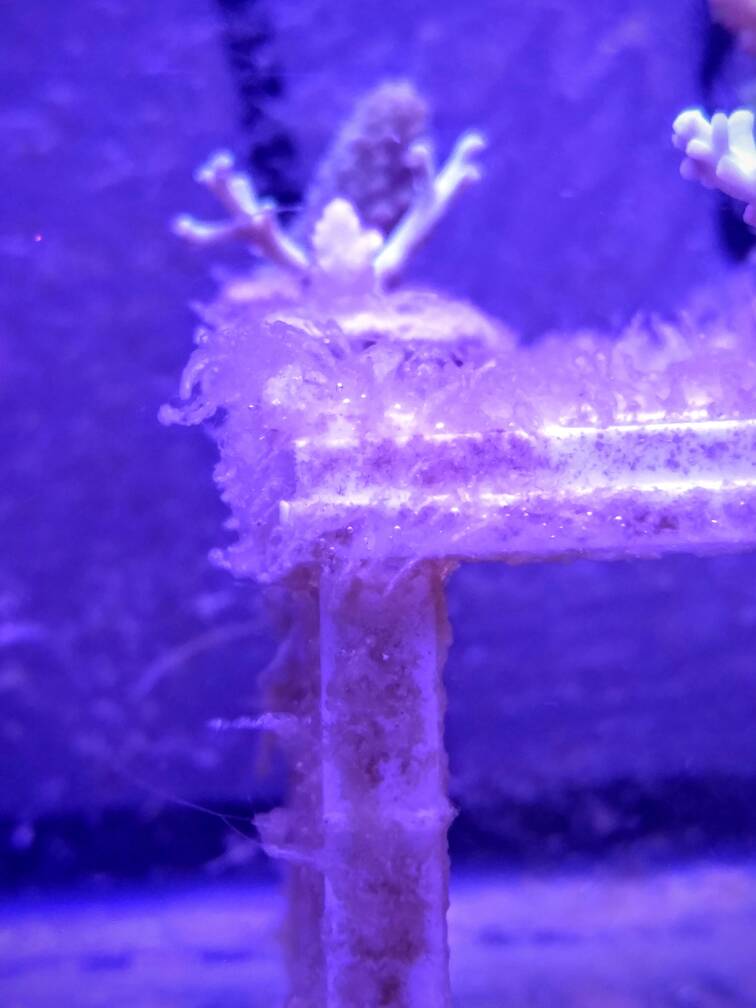
Been dealing with what I thought might be Dinos for the last month in a brand new BioCube 29. Tank is 2 months and 4 days old. Can someone confirm my fear?


EDIT: It might be hard to tell in the pic, but the Dinos eventually settled on the bottom and up the side of the glass. This happened again the second time, neither stayed suspended for long. Not sure if that says anything about Ostreopsis vs Amphidinium.

Definitely dinos, The amphidinium I've dealt with were more like dust on the sand and less mucous-y and stringy. Although their growing habit in the tank is a better indicator than in a cup, the quick clumping into mucous strings suggests not likely amphidinium.
 
There are some species of coral that are aggressive survivors and can help establish the chemical conditions in the tank. In my case, I used rhodactis (that have now become a plague). These corals are very aggressive and colonize every exposed and lit surface area by day, expanding to 10x their nocturnal state. Chemically, they're absolute tanks! I've found them to be indestructible under even the most horrid conditions. If there's a true match to dinos, these ugly beasts are it.

Once they have taken hold, they will chemically bias the water. The problem is then to keep them contained and remove them as you add more delicate coral.

You may find that a razor blade and metal scouring pad will actually be necessary.

That's a very good candidate. I was going to point out that a coral used to battle dinos should probably be one with a lot of mucous - one to keep the coral itself from getting colonized and overrun by dinos, and two because a coral's mucous seems to be its store for bacterial associates and allies. The more mucous - I would hypothesize - the bigger the pro-coral posse.
 
What's the consensus on turning off your skimmer to help win the battle? How many have tried and been successful with that?

Sent from my Nexus 6P using Tapatalk
 
That's a very good candidate. I was going to point out that a coral used to battle dinos should probably be one with a lot of mucous - one to keep the coral itself from getting colonized and overrun by dinos, and two because a coral's mucous seems to be its store for bacterial associates and allies. The more mucous - I would hypothesize - the bigger the pro-coral posse.

Very true. When I first put them in, there was a line... A perimeter around each disc where no dinos could live. The mucus and bacterial cover is part if it, but their sting kept everything else back too.

Another is the Hollywood stunner ... This is a painfully aggressive coral with copious mucus and a hyper aggressive nocturnal filament attack that decimates their perimeter. Even hair algae can't encroach these nasty polyps.

Again... Caution- these are very fast growing and very aggressive corals and can become nuisance (or killers) over time.
 
You know, the third coral I added was a green slimer... Again - very heavy mucus protection when irritated. I didn't intend on having so many slimy corals... just an coincidence.

Maybe there's a remedy here that comes from "milking" the mucus of slimy corals (like extracting venom from a cobra) and bottling it up as a cure for Dino-sick tanks? No idea how long coral slime can hold out of a living tank... Or the effect on bacterial colonies in it...

But it's a curious idea.
 
What's the consensus on turning off your skimmer to help win the battle? How many have tried and been successful with that?

Sent from my Nexus 6P using Tapatalk

Several people on this thread have done it. It's part of the "dirty method" and has the same effect as overfeeding.

I used the clean method and needed the skimmer post-UV to remove the waste from dead Dino bodies.
 
I either had my skimmer off or had it on and cultured the skimmate with light and air stone until it turned green before adding it back to the tank.

Kept up the routine of no nutrient export for weeks until my N and P stayed as high as I wanted them.

Sent from my SAMSUNG-SGH-I337 using Tapatalk
 
Any opinions? Is mine getting worse or better? Maybe this is the worse part of it has to get worse before it gets better?
e1f5035f7ccc235258643654e90faec3.jpg


08fc592bacf33be91d68452fa3225176.jpg


7ece283d66a09f65e44f4c492184c8e8.jpg


085acfe6ef53256557556c537fc412e2.jpg


cffcc33f1717e9734bb5cc5e3994f7f9.jpg
 
After overfeeding etc for weeks and still 0 nitrate I gave in and dosed some kno3. Dosed 2ppm over a few days, then tested and got merely .125 I think it was. First time I've had detectable nitrate though.

I'm currently overfeeding, dosing amino acids, phyto, oyster feast, running skimmer when lights are off, and contemplating continuing to dose no3 to keep it elevated....

Also thinking when I feel the time is right siphon everything I can and then do a lights out for 3 days but the sps e pretty beat up. The increased feedings, amino acids, and I think finally detectable no3 have them gaining a little color...
 
Any signs of some shift in growth in the tank?
Or are the dinos just getting good at eating what you are adding? I ask because I don't see signs of much else except dinos.

Sent from my SAMSUNG-SGH-I337 using Tapatalk
 
I plan on starting my 3 day blackout this weekend, but I have a few questions before I do so:

-Should I do a water change first, vacuuming out as much as I can and then doing the blackout? Or will this be counterproductive?

-Do I blackout the sides and the top or just the sides? I can leave the back chamber of my BioCube open for oxygen exchange if need be.

Starting last night, I am dosing 5mL of Microbacter7 every day for the next 2 weeks. The plan is to only run actinics on the first day back, with 1 hour of regular light added back each additional day there after.

Does this sound like a good plan? Am I missing anything?
 
Any signs of some shift in growth in the tank?
Or are the dinos just getting good at eating what you are adding? I ask because I don't see signs of much else except dinos.

Sent from my SAMSUNG-SGH-I337 using Tapatalk
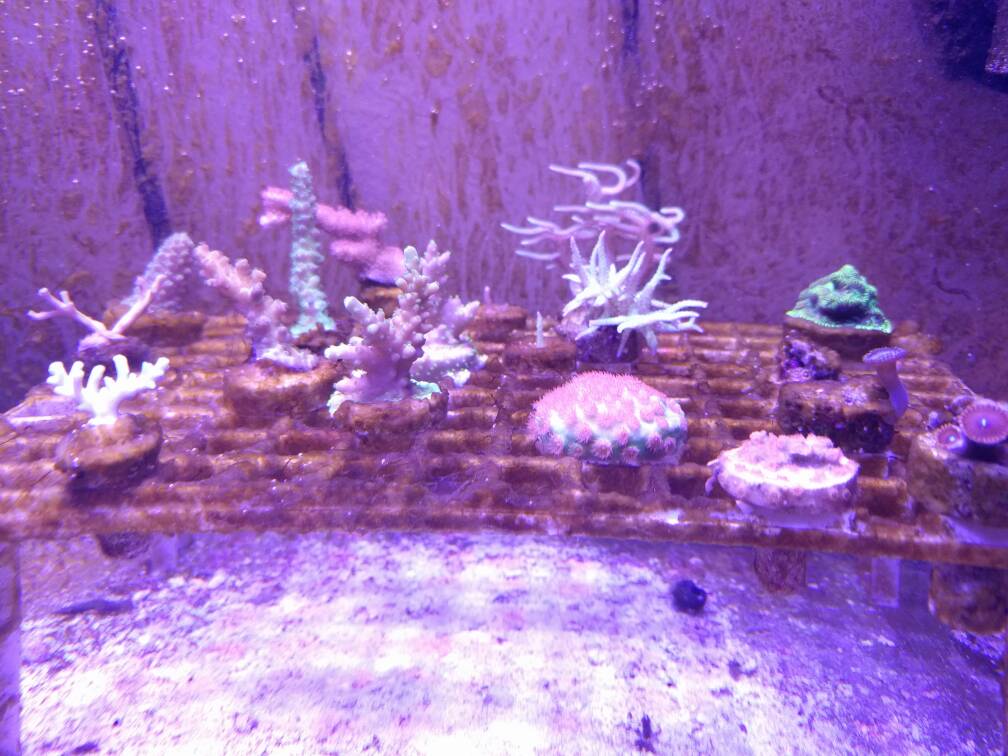
Not really. Maybe some coral growth and colors have gotten a little better. I have one mushroom in this tank that's over in the corner for lower light, I thought the lack of Dino's was from low light but maybe the shroom is fighting them. I'll move it onto the frag rack and see what happens.

I'm starting to think a rescue tank to hold and disinfect the corals is my only option. Then I can do a longer lights out etc. Any recommendations on how to get a rescue tank ready to eat Dino's?
 
I bought a high quality 80W Deltec UV and installed it two weeks ago.
It's treating around 200 g/hour (750 lilters/hour)

This has changed:
More algae on the glass.
Slight increase in dinoflagellates.
Big increase in cyanobacteria.
Miniscule increase in water clarity.

The reason I did not do this earlier is that I had no faith in it, but I had to try.
I'll run it for three months to be sure and then probably remove it.
 
Last edited:
That's unusual. How are you post processing the UV output? Remember that the dead dinos need to be removed or they become food for other things... Algae, dinos, cyano, etc...

Also, do it with the lights out to get them into the water column. That'll also keep the cyano away.
 
Not really. Maybe some coral growth and colors have gotten a little better. I have one mushroom in this tank that's over in the corner for lower light, I thought the lack of Dino's was from low light but maybe the shroom is fighting them. I'll move it onto the frag rack and see what happens.

I'm starting to think a rescue tank to hold and disinfect the corals is my only option. Then I can do a longer lights out etc. Any recommendations on how to get a rescue tank ready to eat Dino's?

Like a frag tank but let it cycle with live rock for a while... I would seed it with pods and give them enough food without predators so they can go wild. Maybe even push feeding just enough to get a green fuzz and then add snails and hermits.

That's the basics. Once you're there, you should be able to add the coral without infecting the new tank.

If you really want to dino-proof the rescue tank, run an ATS on it and feed it until you have a nice thick growth.
 
Ok, using established rock, new sand with a couple cups of established sand. Already have some diatoms, I'll wait for a hint of green. There is a tang in the tank for qt, hopefully he's not interested in pods. I think I'll make another pod hotel and put that in my display again.

I'm glad the Dino's aren't in my display, they are enough work in the little 20g jeesh.
 
I beat "whatever" it is I had - thanks to this thread

I beat "whatever" it is I had - thanks to this thread

TLDR: No skimming seems to be beating back whatever it is I have.

First - I have to say - this thread is wonderful! Love the discussions regarding the science behind Dinos. Thanks also to all the contributors who found methods to beat this.

Here

and Here

I feel compelled to share my results - but unfortunately I do not have any microscope shots of whatever this is.

Like most - my problems started because of a mis-assumption. Nearly everyone on here identifies Dino behavior as showing up on the sandbed and the mucus containing bubbles. I had neither of these - but did have a severe outbreak of brown slime. This lead me to the assumption that I was dealing with algae and a nutrient issue rather than a dinoflagellate outbreak. My troubles started soon after I had set-up the tank. I was probably running 3 months into a new setup. I skipped the diatom phase. I skipped the algae phase as well. I went straight to this brown slime showing up.

On the other hand, I did see other situations that made me think it might be some form of Dinoflagellate. Snails died (except for one turbo and one trochus), 1 out of 2 emerald crabs died. Nutrient reduction had no effect on whatever this stuff was.

2015-3-29: Startup Cycling.
2015_03_29_FTS.jpg


As you can see, it's a pretty sterile system. The purpose of the system initially is to be a quarantine while I build out my big tank. Down the road - it will be a frag tank / coral quarantine tank.

The plan I had for this tank was to let everything run it's course without the use of chemicals. If I had an Algae outbreak - I would try to deal with it naturally through aggressive skimming, increased water changes, etc. I do not test for Nitrates or Phosphates - instead I use the tank as my indicator for a problem. The greatest extent I have for chemicals is a KalkStirrer for my Auto top off. Cyano? Reduce feedings and aggressively export.

The main architecture of the tank is: 150 gallon Oceanic, dual overflows (Herbie style) - 2 x 10 Micron filter socks, Nyos Quantum 200 skimmer, DC 11000 return running at 75%. I also have a closed loop in the sump where I pass sump water through a 25 W Aqua UV and a 1/4 hp Chiller (water's returned to the filter sock) with a DC 4000 running at 100%. The internal circulation of the tank is handled with a maxspect gyre 150 running at 60%

Biological filtration is handled with two 4"x4"x8" CerMedia bioblocks. They were in the sump in the above picture but moved to the main display shortly after. Tank was seeded with rock rubble from a local LFS and with a pack of stuff from IPSF (Pods, worms, Actuator, sand starter).

Maintenance: every day I would empty the skimmer cup and every other day I change out the filter socks. I would change the water out once per week at around 25 gallons.

Feeding: I feed 1/2 block of Mysis PE in the morning and 1/2 block of Mysis in the evening. The autofeeder drops in about 20 baby Daichni pellets at 12:00 Noon.

Livestock: One Male Bangaii, 2 mating clownfish, one copperband (deceased), one Tomini Tang, 3 firefish, one neon goby, 4 blue leg hermits, one Turbo snail, One red-banded trochus snail, 2 skunk cleaner shrimp

As of 6/21/2015 - I had the tank stock starting to ramp up and took this video of some clownfish that I thought were aggressive (turns out it was only the bellus angel). The key here is you can see the brown slime algae starting on the frag plugs in the middle there.

<iframe width="560" height="315" src="https://www.youtube.com/embed/dmgpGt3SbSQ" frameborder="0" allowfullscreen></iframe>

I thought the frag plugs may be messing up the flow (assumption is I had Cyano) - so I removed the frag plugs to improve the flow characteristics. No effect.

Since I'm still on the assumption that I'm dealing with a nutrient problem (or maybe it was some type of Cyano - I tried an application of Boyd's Chemiclean (Feb 2016). I've worked with this before on a cyano outbreak in a separate tank a few years ago and know how it works. After 24 hours - the cyano should break up. This didn't occur. Applied a second treatment. Still no effect. What happened was - I did need to keep my skimmer off. It just overflowed and sent microbubbles to the display if I turned it on.

After the Chemiclean treatment - I changed out 100 gallons over three days. At this time, I was able to re-start the skimmer. Surprisingly, the brown slime receded but was not eliminated. This led me down the path of a "false positive" that it was a nutrient problem and water changes, aggressive wet skimming would help me.

Come to 4/28/2016 - this is what My tank looked like. It's looked like this for most of the year. Once a month I would get in there with a brush and export the brown slime to the filter socks and scrub everything down in an effort to export whatever this was.
2016_04_28_FTS.jpg


Off topic - but surprisingly, the clownfish continued to lay eggs throughout this entire ordeal. This was their second clutch that I actually got to see and take pictures of. They had a first clutch in March and a third clutch at the middle of May.
2016_04_28_Clown_Eggs_2.jpg


Again, I never saw any amount of brown slime on the sand bed. In this shot - with the assumption that I'm still dealing wit a nutrient problem - I was in the process of removing the last of the sand bed.

After speaking with the LFS (unfortuantly - they do not have a microscope - neither did any of my local reefkeepers): it was suggested this may be Dinoflagellate.

On 5/14/2016 - I started a 3 day blackout (to short of a time after reading this thread). I taped the entire tank and back window to eliminate 100% of the light from entering the tank. I turned off the LEDs and closed up the canopy.

On 5/15 after starting to read this thread, I thought I would also try the pH increase. Unfortunately, I discovered my pH probe was old and running out of life - so I'm unsure on how high my pH actually was. I increased the pH on my raising from 7.6 (at it's lowest) to 8.2 at it's highest.

I would peak into the tank from time to time. I exported alot of brown slime to the filter socks - changed out daily. But I would still see filaments growing on the frag racks.

After getting further into this thread - I found the ideas regarding a dirty tank (from Monti and Cygni). On Wednesday - I turned off my skimmer and UV to try to promote a dirtier tank and to allow the biodiversity to bounce back. I was thinking of ordering phyto and pods - but haven't done it yet. I'm still running and changing the filter socks daily throughout this time.

On 5/21/2016 - The copperband butterfly started having some problems (weak, getting nipped at by the Bangaii and Clowns, caught in the maxspect gyre). I re-started the skimmer in an effort to reduce the nutrient buildup but it had no effect. I lost him.

Coming out of blackout - 5/18/2016
2016_05_18_FTS.jpg


Lights on - 5/20/2016
2016_05_20_FTS.jpg


Today: 5/21/2016
2016_05_21_FTS.jpg


So every day I look at the tank - it continues to improve. I see a bit more green hair algae or green bubble algae and less brown in the tank.

 
Back
Top