DIY LED Build with a Ramp Timer Pro

sam.basye

New member
Anyone ever tried or know of anyone who has used a ramp timer pro from Current USA in a diy led build.

This is what I am wanting to do, except the two dimmers replaced with the ramp timer. One white and one blue string.


Ramp timer pro


There are three plugs that come out of the unit. One for the blue string, one for the white, and one for the power supply.

Can anyone explain how to wire it up or if it is even possible?
 
It sounds like this is basically a step down driver in a fancy package. Give it a PSU and hook up the strings and its like a LDD-1000H with the PWM programming/signal on board.

I don't think those brick drivers in the picture will like having this between them and the string though, as they are still constant current drivers themselves.
 
It sounds like this is basically a step down driver in a fancy package. Give it a PSU and hook up the strings and its like a LDD-1000H with the PWM programming/signal on board.

I don't think those brick drivers in the picture will like having this between them and the string though, as they are still constant current drivers themselves.
PWM chopper for the use w/ constant voltage LED strips.. Not really for constant current drivers...........

Widely compatible, the Ramp Timer Pro™ works with many 12-24VDC LED lights*
- Plug-and-play, uses your existing low voltage transformer

Model#1676
Voltage: 12-24VDC
Max.Wattage: 120 watts @ 24VDC / 60 watts @ 12VDC
Max.Watts per channel:60w@24VDC/30w@12VDC
Dimensions: 3.5” x 3.5” x 0.5”
Cable Length: 12”
Dimming Type: PWM

If you want to redesign your strings for constant voltage and 12 or 24V PS, discarding the drivers for resistors.. they are useable..

The 30W limit is fairly restrictive though..
 
Thanks for the replies!

So with a 30w limit per string, that's a max of (10) 3w led's per string. @12v 60w max
--- 60w (20) 3w @24v 120w max


If I got the 24v wall converter below as the power supply, how should I wire the strings from the ramp timer? And what type of resistors?


Thanks again for the help, I'm still new to all the electrical fun.

I have the complete orbit led setup. I mainly bought it for the features and settings, was somewhat disappointed with the output.
 
Thanks for the replies!

So with a 30w limit per string, that's a max of (10) 3w led's per string. @12v 60w max
--- 60w (20) 3w @24v 120w max


If I got the 24v wall converter below as the power supply, how should I wire the strings from the ramp timer? And what type of resistors?


Thanks again for the help, I'm still new to all the electrical fun.

I have the complete orbit led setup. I mainly bought it for the features and settings, was somewhat disappointed with the output.

First that wall wart isn't 1)constant voltage (need a switching power supply.. and 2)0.1A :eek: which is nothing really..

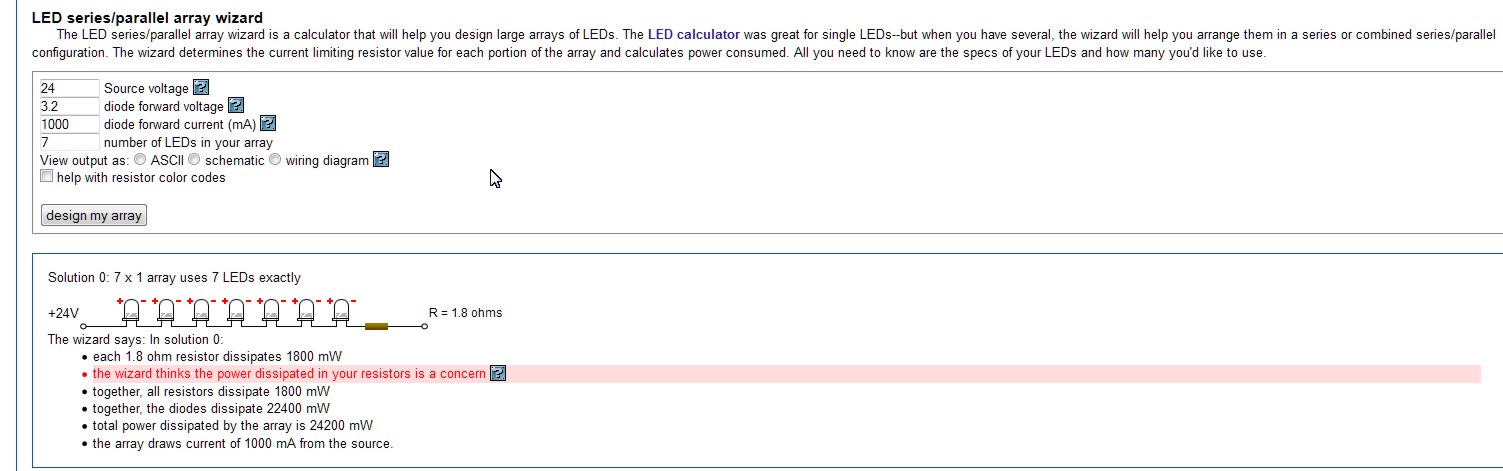
Best to play w/ this a bit:
http://led.linear1.org/led.wiz

you need the V(f) at the current you want to drive them at..

Example based on some average LED guessitmates
sample1.jpg


so each series string will need 1A of power .. 2 strings Max (14 LED's ) if you are using that dimmer...
Overkill but an example..
http://www.amazon.com/Mean-Well-Power-Supply-156W/dp/B004P48O96
 
Last edited:
What would I need if I were to have two strings of 12 wired in series. Or is this even possible with the ramp timer at 24v DC. Using 3w LED's.

String 1
(12) White 3.5V @700mA

String 2
(10) Blue 3.5V @700mA
(2) Violet 3.8V @700mA

W B W V W B W B W B W B
B W B W B W B W V W B W


I was exploring the link you posted, but still kind of struggling with the concept.
 
What would I need if I were to have two strings of 12 wired in series. Or is this even possible with the ramp timer at 24v DC. Using 3w LED's.

String 1
(12) White 3.5V @700mA

String 2
(10) Blue 3.5V @700mA
(2) Violet 3.8V @700mA

W B W V W B W B W B W B
B W B W B W B W V W B W


I was exploring the link you posted, but still kind of struggling with the concept.

Voltage adds in series.. so 12x3.5V =42V..
Amps add in parallel.. 2x.7= 1.4A PS

46V 2A ps is needed.. and you'd probably fry the dimmer..;)
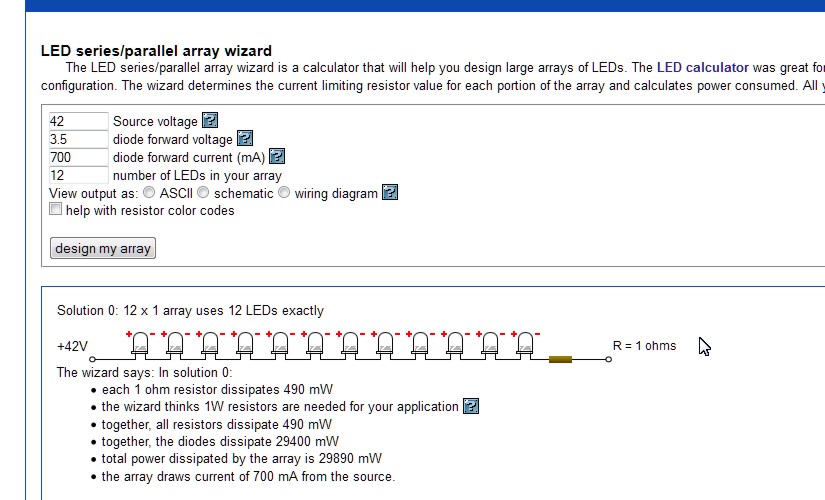
You would need a variable ps to adjust it down to 42V.. If left at say standard 46V your Resistor has to dissipate a LOT more power as heat.. OR add one more diode to make a string of 13....

Just plug the numbers in to the calculator..changing 42 to 46 and diode count from 12 to 13..
string2.jpg


so theoretical "ideal" is 13 LED's per string 1W 1Ohm terminating resistor and 2 strings, no dimming and a 48V (fairly standard) 2A ps trimmed down to 46V..

Use LDD-H drivers and a Typhon from Steves in place of the Current unit for full 2 channel dimming..is an easy out..and skip the resistors.. Or a Storm X for more "toys"...
Pricing between the 3 is not much cheaper .. The Current ramp timer isn't the cheapest tool in the shed..

you could (there are complications) .. run 7(series)x 2(parallel) X 2 channels for a total of 28 LED's and still stay within the parameters. The biggest complication would be to fuse each series string to protect the other one.. 4 1Amp fuses.

I am ignoring the voltage difference for the violets in this case..it does complicate the design w/ constant voltage a bit.. another reason to use constant current drivers.. Self correcting so to speak.
 
Last edited:
Oreo, you're now officially my electrician. ;)

4Hummer, thanks for the suggestion, but I already own the orbit led unit and was thinking of reusing the timer and selling the light..

For now I have decided, with your help, the ramp timer will not do what I want. Soo, gonna shop around for the 'right' setup for now. I definitely want it to have 2+ channels and dim-able. A programmable one is preferred, but not inherently necessary.
 
Back
Top