Do I have ich?

forcedfour

New member
I have a video showing my Blue Hippo Tang hitting the gravel and rocks. Only the tang has shown any signs, 8 days ago it was doing the same thing for a few minutes. Now today I see it again, but only for a few minutes. Could this be normal? I was watching for it all week and didn't see the tang do this once until today. All my normal water params look great. I have a QT that is not yet cycled, but is set up. All my fish eat like pigs! Should I be concerned?

VIDEO

Tank is a 125G and has been set up for a few months. I know I should not have put the anem in so early, though it is doing pretty good.

Shawn
 
You should always be concerned about a tang that has not been QT`d. But thats where we are at- so moving forward I would keep all yo parameters and feeding perfect- try to get the QT cycled and then if he shows spots get him into treatment. Its not the end of the world-keep your eyes on him- as well as the other fish.
 
I don't recommend cycling a qt at all, nor having any rock or sand in it, nor having any filter medium you do not toss daily: reason: ich goes to these places to reproduce and reinfest. Put all fish straight into the treatment tank, lower salinity to 1.009 over a 48 hour period, and observe. Once you are sure you have lost the last white spot, now begin a 4 week stay at this salinity---which must not vary in the least: any change in it will favor the parasite surviving this treatment. Once your fish has passed this last 4 weeks, raise the salinity again and quarantine for 4 more weeks at normal salinity. By this time your tank has had no fish for 8 weeks, which will, at normal temperatures, have starved out the parasite from your tank. You can then put the fish back in.
 
This is from the qt sticky at the top of the page- always the best place to start reading up.


What filtration do I need for my QT?
A: The more the better. A skimmer is beneficial and in some cases can be run with medication in the water. A HOB filter adds more surface for bacteria to colonize as well as a place to run filter pads and carbon. A ball of chaetomorpha is a good idea provided there is light available. There's no substitute for live rock but keep in mind that copper as well as other medications will contaminate the rock permanently (never use it with inverts). Bottom line; use water changes to maintain water quality regardless of the filtration methods in place.
 
Thanks for the tips. I can't see any spots on any fish, should I act now? I have Cupramine that I had planned to use in the QT. I have a cheap HOB filter and some PVC pipe in the tank, that's it. The QT was filled with water from the DT.

So you recommend using a power head only and removing the HOB filter? I know the bio media in the filter will be trash after the use of copper I assumed this would help minimize the spikes in Ammonia and help lower the WC frequency some.
 
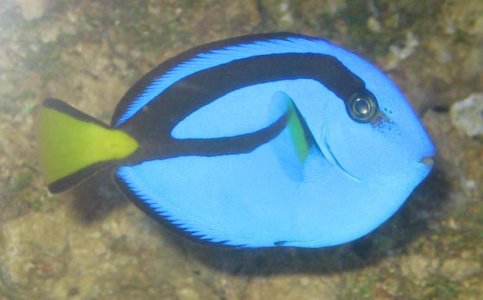
Here is a picture I just took of the Tang.
 

Attachments

  • BlueHippoTang_3_13_11.jpg
    BlueHippoTang_3_13_11.jpg
    40.3 KB · Views: 4
I don't recommend cycling a qt at all, nor having any rock or sand in it, nor having any filter medium you do not toss daily: reason: ich goes to these places to reproduce and reinfest. Put all fish straight into the treatment tank, lower salinity to 1.009 over a 48 hour period, and observe. Once you are sure you have lost the last white spot, now begin a 4 week stay at this salinity---which must not vary in the least: any change in it will favor the parasite surviving this treatment. Once your fish has passed this last 4 weeks, raise the salinity again and quarantine for 4 more weeks at normal salinity. By this time your tank has had no fish for 8 weeks, which will, at normal temperatures, have starved out the parasite from your tank. You can then put the fish back in.

This is what I advocate as well.
 
It is particularly tragic when someone delays treatment of a sick fish 'because I don't have a qt cycled'. A non-cycled qt does work, [with the exception of angels and mandarins] and recent information about encysted ich adhering to filter medium says you're actually better off tossing the medium daily, because once it drops off the fish, it's heading right for the sandbed [if you have one in your qt] any rock, and definitely the filters. Putting a filter sponge FROM the qt back into your tank sump is not a good practice, for that reason. Polyester pillow stuffing is way cheap at your hobby store, and it works just as well as regular filter floss.

At very least---discard such sponges and get a new one for the next event! The practice of re-using sponges is one possible reason for the occasional hobbyist who finds ich in his tank after a full qt procedure.

But at very minimum the practice of discarding all filter medium, and not forgetting a full-cleanout of the pump---is beyond a good idea. If you have ever looked inside your pump, you may discover a little reservoir of water that just should not be taken back into your system. This goes for nets, pipes, etc: just---if it's been in a tank with a problem, discard it or clean it before it goes anywhere near your DT system.
 
Last edited:
That Tang does NOT have ich. IMO, I would not be treating him with anything, just observe.

Good looking fish BTW.


I have been observing and noticed the tang scratching at the gravel more often. Not every day, but when I see her do it she will do it 10-20 times in a row. Still no sign of white spots, any ideas what this could be? Or could it normal behavior?
 
Sometimes fish just do that. My Chocolate Tang would rub himself against a large brain coral 10-20 times in my tank almost every day. It never had any disease. Fish have personalities and sometimes do some crazy stuff. If it shows no signs of anything, and is still eating and swimming otherwise normal, don't sweat it.
 
Your blue tang look very healthy, I don't see any sign of itch at least on the picture. Just try to feed him well and make sure he eat alot then he will be ok.
 
I have a video showing my Blue Hippo Tang hitting the gravel and rocks. Only the tang has shown any signs, 8 days ago it was doing the same thing for a few minutes. Now today I see it again, but only for a few minutes. Could this be normal? I was watching for it all week and didn't see the tang do this once until today. All my normal water params look great. I have a QT that is not yet cycled, but is set up. All my fish eat like pigs! Should I be concerned?


No need to worry about cycling your QT! Does it have a filter setup?
If so, then........

I use Seachem's Stability to provide the aerobic and anaerobic bacteria for my systems.

I use it in my QT anytime I wish to setup my QT for a fish(es) for QT purposes and never have any ammonia.

I also used it in my 300g system when I started it up and never any ammonia.

I highly recommend its use for providing the necessary bacteria for a fully functional biological filtration system.


http://www.seachem.com/Products/product_pages/Stability.html


Stability® will rapidly and safely establish the aquarium biofilter in freshwater and marine systems, thereby preventing the #1 cause of fish death: "new tank syndrome". Stability® is formulated specifically for the aquarium and contains a synergistic blend of aerobic, anaerobic, and facultative bacteria which facilitate the breakdown of waste organics, ammonia, nitrite and nitrate. Unlike competing products, the bacteria employed by Stability® are non-sulfur fixing and will not produce toxic hydrogen sulfide. Stability® is completely harmless to all aquatic organisms as well as aquatic plants, thus there is no danger of over use. Stability® is the culmination of nearly a decade of research and development and represents the current state of the art in natural biological management.

Sizes: 50 mL, 100 mL, 250 mL, 500 mL, 2 L, 4 L, 20 L

Why It's Different
Illustration of Stability'sâ„¢ bacteria on biofiltration material. stability contains a synergistic blend of aerobic, anaerobic, and facultative bacteria
The bacteria used in competing products are inherently unstable. The conditions necessary for their growth and development fall into a very narrow range of temperatures, pH, organic loads, etc. When any of these parameters are not strictly within the proper range, the bacterial culture quickly crashes and dies. Stability® does not contain any of the aforementioned bacteria.

The bacteria strains in Stability® have been in development for over a decade. The necessary conditions for growth of our bacterial strains encompass a very broad range. When other bacteria begin to die off (usually from high organic loads caused by the undetected death of an organism), Stability® simply works harder and grows faster! The strains function in fresh or saltwater. Stability® contains both nitrifying and denitrifying bacteria, a blend found in no other product. Additionally, Stability® contains facultative bacterial strains which are able to adapt to either aerobic or anaerobic conditions. The bacteria in Stability® are non-sulfur fixing, another innovation in the industry. Most other bacterial supplements will form toxic hydrogen sulfide under the proper conditions. Stability® will not, ever.

 
This is from the qt sticky at the top of the page- always the best place to start reading up.


What filtration do I need for my QT?
A: The more the better. A skimmer is beneficial and in some cases can be run with medication in the water. A HOB filter adds more surface for bacteria to colonize as well as a place to run filter pads and carbon. A ball of chaetomorpha is a good idea provided there is light available. There's no substitute for live rock but keep in mind that copper as well as other medications will contaminate the rock permanently (never use it with inverts). Bottom line; use water changes to maintain water quality regardless of the filtration methods in place.

Do protein skimmers work in hypo? I know they don't work well, if at all, in freshwater.

I plan on using one because of the benefits in water oxygenation, though.
 
The bennies of the skimmer are mostly for oxygenation, but those would be very good. Remember to totally clean it and empty its water reservoir and let it dry when returning it to the main system.
 
Back
Top