
You are using an out of date browser. It may not display this or other websites correctly.
You should upgrade or use an alternative browser.
You should upgrade or use an alternative browser.
Does it matter if you salinity is a bit to high when cycling?
- Thread starter Drewy1988
- Start date

Ron Reefman
Active member
Define 'a bit too high'.
You can always pull some water out of the tank and replace it with RO/DI or distilled water and lower the SG. My best guess is while you are cycling the tank with no fish or inverts in it, 1.030 SG is probably OK.
You can always pull some water out of the tank and replace it with RO/DI or distilled water and lower the SG. My best guess is while you are cycling the tank with no fish or inverts in it, 1.030 SG is probably OK.

Alas, in this hobby 'a bit' is not precise enough for a real answer. And in general we give numbers in a spread, such as a salinity of 1.024 to 1.026. In the case of salinity, it can range down to 1.019 for a fish-only. Get a refractometer: anything less will make you crazy. Salt mixes also take about 24 hours to really dissolve and give an accurate reading, so chasing a number on a new tank ---no, give it 24 to be sure. And anything between 1.019 and 1.026 will be fine for cycling. And welcome. Perth is a lovely city. I spent a number of days there in high summer, and had a great experience with the nearby 'cageless zoo.'

ReeferNoob4ever
New member
At least too high salinity is easier to correct than too low. Nothing in the tank so no harm no foul. I would be curious how it affects bacteria because I have heard that doing a high salinity flush can kill unwanted pests on live rock so maybe during the cycle a little higher salinity wouldn't be such a bad thing if you're using wet live rock to cycle your tank...so long as it doesn't negatively affect the bacteria.

Drewy1988
New member
Hopefully your right noob4ever I only started with dry sand.but I do have a little bit of live rock in my sump which I'll get a light for tomorrow to put in my sump. I'm just using API quick start so I'll see how I go,1st day in the hobby so I'm aloud to make a few mistakes haha thanks for your advice [emoji106]
Sent from my iPhone using Tapatalk
Sent from my iPhone using Tapatalk
Ron Reefman
Active member
I read that as 1.026 which is what my 4 tanks are most of the time. It's not too high, just at the high end of acceptable range.

Green Chromis
New member
:fish1: Hi Drewy 1998, 1.026 is the natural salinity of the ocean water off the Southeast Coast of Florida, where I collect all my water from. 1.025 to 1.026 is the salinity of NSW around most of the world. Your LFS may keep a lower salinity in their systems for various reasons, but the reading your showing on your refractometer is normal for most NSW, so I would just leave it their. Is your refractometer calibrated? :fish1:


TangingOut
New member
I have Red Sea refractometer so yes it's the best you can buy
Sent from my iPhone using Tapatalk
Doesn't mean it's calibrated. Also Milwaukee digital is probably the best.
I read this at 1.026/35ppt. This is where I run my tank at.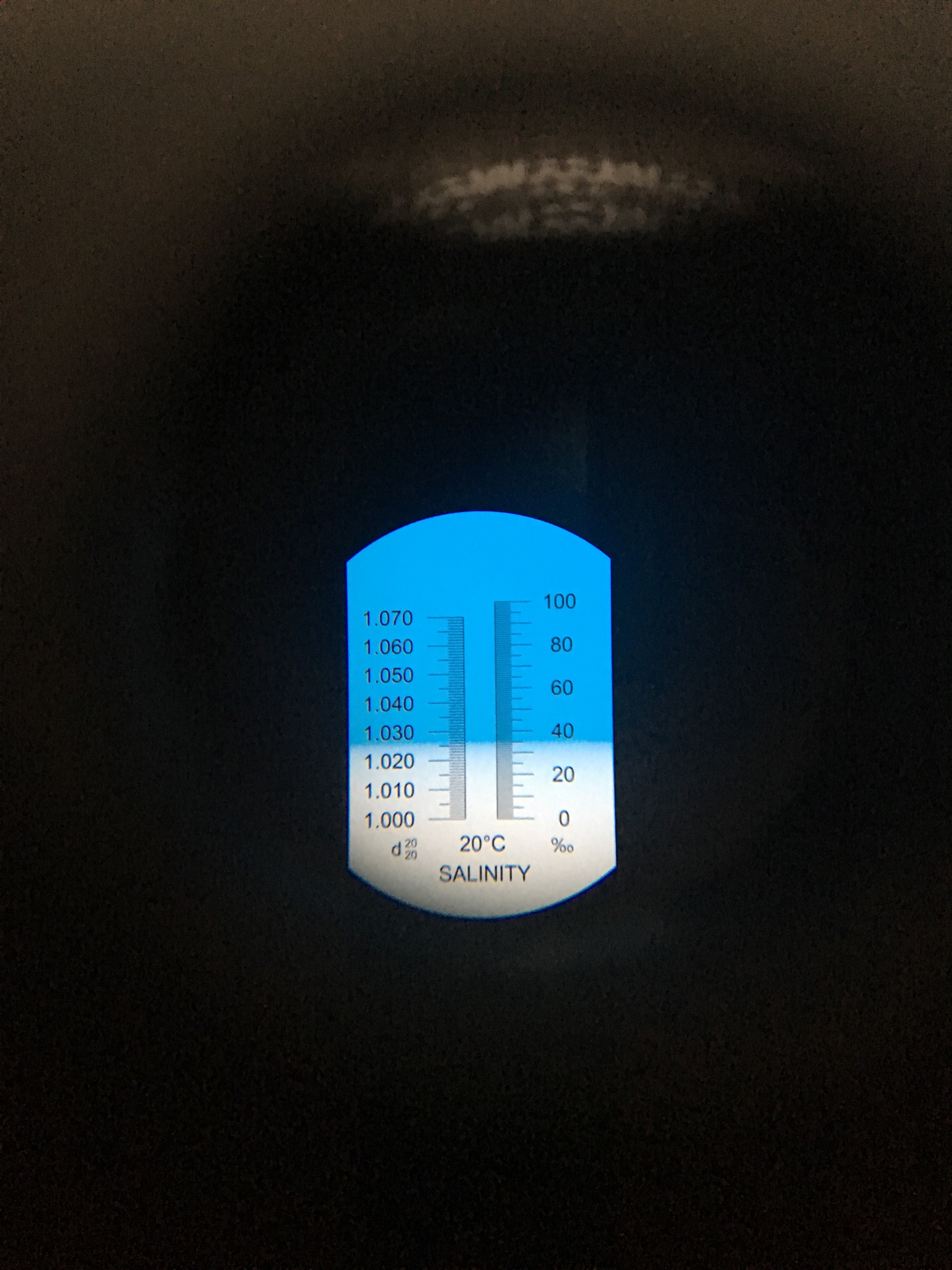
Still a bit high but it's better
Sent from my iPhone using Tapatalk

jason2459
Well-known member
This will not come out well but the RedSea refractometer is the worse refractometer I have used. Mainly because it could not keep its calibration worth a darn. Even cheap ebay and generic store braved brine refractometers were better. Many others have experienced the same. And using RO water really isn't the best method especially if not checked against a known reference solution near the point your are testing for like a seawater standard solution.I have Red Sea refractometer so yes it's the best you can buy
Sent from my iPhone using Tapatalk
DD H2Ocean has an ok seawater refractometer but it is a bit dark and I didn't like it's scale. My favorite and most trusted refractometer is a veegee. Milwaukee digital is ok. It tends to round up or be a bit high and can only handle a single point calibration.
If someone wants digital then conductivity meters are better and I like my pinpoint salinity meter. There are berer and more expensive ones. Misco also has a nice digital refractometer that is 2 point calibrated at the factory and can be sent in for another 2 point calibration when ever desired and NIST certification if wanted. Otherwise its a single point calibration at home but is a higher resolution then the Milwakee and seems to be more accurate as well. But it comes with a higher price tag.
As for calibrating a refractometer or conductivity meter its only as good as its reference solution. I would recommend make your own.
http://www.reefcentral.com/forums/showthread.php?t=2583418
A good post by Randy Holmes-Farley on the capabilities of different measuring methods
That's not needed
It is the method used by chemical oceanographers because it is instantaneous, continuous reading, temperature compensated, potentially more precise than the other methods available, and can easily be set up to read remotely, like at the end of a long line running down into the ocean.
Conductivity is actually how the salinity of ocean water is defined.* PSU, practical salinity units, is the preferred unit of measure (similar to ppt).* S=35 (no mention of units is needed for PSU with a capital S) is defined as seawater at 15 deg C with EXACTLY the same conductivity as a solution of 32.4356 g of potassium chloride in DI water to a total mass of 1 kg.
In chemical oceanography by Frank Millero, he gives the maximum precision of each of these methods using attainable devices (not hobby devices):
S = 35 +/-* error below
+/- 0.05 refractive index
+/- 0.03 speed of sound
+/- 0.01* Composition analysis of major components
+/- 0.01* evaporation to dryness
+/- 0.004 density
+/- 0.002 chlorinity
+/- 0.001 conductivity
Note that any of these, if done perfectly, are WAY more accurate than needed by hobbyists
All that said. Doesn't mater much if your slightly high or low. Sure 35 is the PSU of the average surface levels of the oceans but coral and fish grow in all kinds of variations of that.
Even south Florida coastal watersswing a lot Swings of salinity can be seldom to very often depending on locations. Could be driven by tidal events, weather events, just normal seasonal swings, etc.
Lots of resources covering salinity patterns around the world including south florida. I did some of it myself for noaa years ago in marine biology studies.
https://www.google.com/url?sa=t&sou...gg2MAU&usg=AFQjCNFKlBFil3-XPpXKwip21oG6gjm4oQ
Pretty cool site
https://fl.water.usgs.gov
Basically, IMO Choose a measuring device, choose a way to calibrate it, and be consistent.
But the red sea refractometer really was the worse refractometer I ever used.
Similar threads


- Replies
- 20
- Views
- 315

- Replies
- 17
- Views
- 3K

- Replies
- 17
- Views
- 3K
