DreamChip build

Yes, you should be able to do this.

At the same time I must say I won't be going that far, as I simply don't really need it at this time. I have 5 separate drivers which can support 2 DreamChips. Each channel from 2 chips goes to one driver, I then adjust the blues to my liking and leave them all just like that, no ramp up or down, simply all on at XX:XX hours and all off at XX:XX hours...

With your tank being that big I would suggest you contact Mr. Wilson who is also on RC as he has extensive experience with both very large tanks and with lighting them using these hybrid leds. I'm sure he could offer some advice and help.
 
Interesting...I would definitely want the ability to ramp them up and down though would be happy with ramping the intensity of a carefully adjusted overall color temp as opposed to ramping up blues and whites separately. Are these multichips the ones that can be overdriven to 150-200 watts or are they limited to 100?
 
Yes, these can be overdriven. I'm actually running mine just slightly over 100W and the reason I'm not going higher right now is just cooling - I'm not really sure the cooler I'm currently using is strong enough to support any higher currents / temperatures.

Some have gone wayyy higher, as in this example:

Actinic: 1275/34.55v @ 100%
746ma @ 50
White1: 1275/34.54v @ 100
759 @ 50
White2: 1300/34.72v @ 100
Blue1: 1309/35.02v @ 100
Blue2: 1304/34.36v @ 100

... all for a total of 260W! So yes, if you have adequate cooling you could really go high.
 
Last edited:
Wow subbed. Looks like the ultimate chip. Rethinking my lighting now on my current build. This thing looks awesome.
 
Yes, on one chip. For the 260W test it was driven by 5 x ELN60-48P Meanwell drivers.

However!!!
I strongly do not suggest you run your eventual DreamChips so high. The amount of heat is extreme and despite good cooling you are bound to significantly decrease chip life expectancy.

From 700mA up to a max of 1000 - 1100mA per channel should really be enough.
 
Oh I wouldn't go that high. I liked the output of mine at roughly 150 watts so I would probably stick to that. I was thinking of doing a ground loop with a bypass to a pex loop under the sand bed in the main tank on a controller to water cool the group of these I would need for my tank. With the tank being in the basement, I think I will need to focus more on heating the tank than cooling it and harnessing the heat these things make to assist with that would be smart...
 
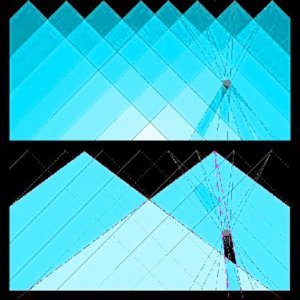
Here is an example on how the light is equally distributed and shadows are rendered using 2 multichip LED's compared to 32 multi-chip LEDs. Notice how the shadow is much more pronounced with the two chips compared to 32 chips. Also how much more evenly the light is distributed throughout the aquarium with multi led's.

The point I'm trying to make here is not that the multi-chips create a problem so much as the use of many chips gives much more even lighting and less dramatic shadows than fewer chips do.

You can consider this tank in the picture a 120 gallon tank with 16-20 watts multi chips on each side in a grid of 4X4 as opposed to a single 320 watt multi-chip on each side. Then keep in mind that you would get even less shadow effects the more chips your loosing such as a 5 X 5 grid of 25 chips on each side or even a 6 X 6 grid of 36 chips on each side.

I will agree that the multi-chip with 4 or 5 colors in it does eliminate the disco effect which is a real positive. However I would rather see lower wattage multi-chips that would allow the user to use more of them for more even lighting as well less harsh shadows.
 

Attachments

  • shadows.jpg
    shadows.jpg
    60 KB · Views: 35
Yes, on one chip. For the 260W test it was driven by 5 x ELN60-48P Meanwell drivers.

However!!!
I strongly do not suggest you run your eventual DreamChips so high. The amount of heat is extreme and despite good cooling you are bound to significantly decrease chip life expectancy.

From 700mA up to a max of 1000 - 1100mA per channel should really be enough.

I've used eln60-48p's before, I dont recall there being one that was one step lower that would work well with these multichannel multichips
 
Powering the MW-LDD driver with the constant current lpc-700 power source gives you a dimmable pwm driver for $21, if the current can be turned up to 1000ma. When I have more time I'll try to find who posted about turning up the internal pot on the MW-700. They were positive that was the only difference between the two drivers. Do a search on the Meanwell LDD-1000 there's a little bit of info on them but there really new.
http://www.reefcentral.com/forums/showthread.php?t=2222702&highlight=meanwell+ldd-1000h
 
I've used eln60-48p's before, I dont recall there being one that was one step lower that would work well with these multichannel multichips

Unless they internally made some changes to the ELN-60 series they are virtually the same between the ELN -60-12 and the ELN060-48. The big difference was the setting on the voltage limiting pot and the current limiting power internal to these drivers. They are basically designed to run most efficiently slightly below 60 watts each. Therefore if you running one for each channel of the 100 Watt Multichip you could drive one channel at 20 watts on three different chips at the same time.

With the ELN series of Drivers you have a selection of an additional D or P at the end of the serial number. The D would allow you hook up a controller or other 0 to 10 Volt DC supply as a dimming circuit. The P would require you to add a pulse width modulated power supply to control the dimming. The ELN series does not have an option for an external resistor dimming control.
 
Last edited:
I fail to see the logic in running Mean Well LDD drivers off another constant current driver, I'm not even sure it would work. LDD series drivers need to be run off a constant voltage power supply. I have a build going that will have 7 LDD series drivers (would have been here on 10/31, but the storm put the drivers on indeffinite delay) powered by a Mean Well SP-48-200. A power supply like the Chinese knock off would be perfect and would be less expensive than 5 LPC series drivers.
 
I thought the D was a pot, and the P was a 10v PWM signal

The D Series drivers need a 0 to 10 Volt DC supply to control the current. This 0 to 10 volt poser source can come from either a controler or a 10 volt supply with a mannual pot to adjust the voltage.

The P series needs a 10 Volt DC power supply which is pulsed and the percentage of the time that it is high or at the full 10 volts will determine the actual current the driver outputs. Most controlers do not normaly have a Pulse Width output module however some have them available as an add on extra.

If your using a controler for dimming I think the D's would be least expensive way to go.


Now for the other comment of using a Voltage regulated supply to power several curent controlers I will agree this a possibility and with multiple channels could even be less expensive. However good sized regulated voltage supplies are not always inexpensive. A good 10 Volt Regulated supply that puts out 500 watts might cost over $200 with good stability. From there it would easy to fabricate multiple current drivers for each channel costing only a few dollars each. However for a smaller system of say 5, 20 watt channels getting 5 small drivers may be more economincal.
 
Back
Top