Dsb's work, what makes them work best?

<a href=showthread.php?s=&postid=6551459#post6551459 target=_blank>Originally posted</a> by joefish
I love your tank , but would it be fair to say your corals are more nutrient forgiving then some others ?

This is part of making a system fit the needs of it's occupants thing .;)

I think that is a very accurate statement Joe, and I'm sure Paul himself will agree, when he gets the chance.

One question though, that should be offered up here, is whether his "tank" is "nutrient forgiving" as well.

I think he's getting a lot of milage out of his "mini-turf-scrubber", or "algae tray" as he so accurately describes it. Also the DSB is doing the "shock absorber" thing with the nutrients.

What is really so interesting, is that it has been around for so long, and with not much maintanence, if i remember correctly. He scrapes his algae tray every couple of weeks, I think. I'm not sure about his water changes.

But really, where is the Hydrogen Sulfide, and the "Heavy Metals", etc. ? ?

Still Joe, your point is well taken, that aquarisctic objectives vary, and with that variation comes differences in the "set-up".

I hope Npaden isn't reading this, or I may get an "earfull" ! :D


> Barry :)
 
<a href=showthread.php?s=&postid=6551592#post6551592 target=_blank>Originally posted</a> by barryhc
I think that is a very accurate statement Joe, and I'm sure Paul himself will agree, when he gets the chance.

One question though, that should be offered up here, is whether his "tank" is "nutrient forgiving" as well.

I think he's getting a lot of milage out of his "mini-turf-scrubber", or "algae tray" as he so accurately describes it. Also the DSB is doing the "shock absorber" thing with the nutrients.


OK let me be more specific ,

I'm not saying Paul has high or even medium nutrients or even a back up of nutriments .

What I've found is that color and growth rates of sps's are better suited for almost no nutrients in the water . I've seen the growth rates In some successful DSB tanks , while impressive I still think BB tanks are easier to get to that point or even past that point .

That's just my opinion from my experience and observations in threads like this .
 
Sometimes I wish that I hadn't setup my big refugium just so I could have seen how long my tank could have run without it. My tank was 3 1/2 years old and rocking along with good sps growth and no significant algae problems when I added it. I do like my big refugium though! ;) And with the amount of cheato that I've grown in the last year I wonder if my sandbed went through a release cycle and my cheato just sucked it all up.

As far as which method is easiest for SPS I'm not sure I would agree either. I personally don't think I could do the frequent siphons required by the avid BB tank keepers. But I guess I'm doing that when I prune cheato out of my refugium. The difference is that I can go a month without pruning cheato with no problems, but if you go a month without siphoning your BB tank you are going to start seeing some problems.

And remember you don't need extra tanks sitting next to your display, my refugium is 75 feet away in a shed! ;)
 
<a href=showthread.php?s=&postid=6551592#post6551592 target=_blank>Originally posted</a> by barryhc

But really, where is the Hydrogen Sulfide, and the "Heavy Metals", etc. ? ?

Still Joe, your point is well taken, that aquarisctic objectives vary, and with that variation comes differences in the "set-up".

I'M ADMITTING UP FRONT THAT THIS IS HIGHLY SIMPLIFIED SO LET'S DISCUSS BUT NOT ARGUE

Well, we've discussed that aerobic bacteria don't "eat" Ammonia nor nitrites. It is strictly the Electron Transfer System at work. Basically Oxygen acts as an electron receptor. In short, things that happen up there is called oxidation and it is done by oxidizers.

On the other hand, things can happen in low Oxygen environments. There's no possibility of using full Oxygen as an electron receptor. Luckily facultative anaerobes have found something great to work in the absence of full Oxygen. They like Nitrates (NO3) and that is where we get our NNR from.

If you go even lower to anaerobic environments, Oxidation no longer occurs. That's where Reduction occurs. There's no Oxygen so something else has to happen for electron transfer. That's where all of the metals, etc. come into play. Hydrogen sulphide is a result of Sulphide Reducing Bacteria (SRB) doing their biochemical thing.

I don't think that Paul has ever had a fully anaerobic area of his sandbed. No anaerobic zone = no SRB's = no Hydrogen sulphide. You are also not going to have any carbonate nor methane reduction going on in that situation.

Let me see if I can explain my thoughts. If Paul were to put a pump on his reverse undergravel filter that is twice as strong, I believe his bed would have too much Oxygen. Then his sandbed would act just like bioballs and would throw nitrates into the water column. Similarly, if he replaced his gravel with gravel that is twice as big but continued to use his current pump, there would be too much Oxygen and nitrates would be produced again. It's really a balancing act IMO.

I hope that made sense.
 
<a href=showthread.php?s=&postid=6551715#post6551715 target=_blank>Originally posted</a> by npaden
Sometimes I wish that I hadn't setup my big refugium just so I could have seen how long my tank could have run without it. My tank was 3 1/2 years old and rocking along with good sps growth and no significant algae problems when I added it. I do like my big refugium though! ;) And with the amount of cheato that I've grown in the last year I wonder if my sandbed went through a release cycle and my cheato just sucked it all up.

Interesting. Have you noticed any change in the growth rates of your SPS corals in the last year?


As far as which method is easiest for SPS I'm not sure I would agree either. I personally don't think I could do the frequent siphons required by the avid BB tank keepers. But I guess I'm doing that when I prune cheato out of my refugium. The difference is that I can go a month without pruning cheato with no problems, but if you go a month without siphoning your BB tank you are going to start seeing some problems.

And remember you don't need extra tanks sitting next to your display, my refugium is 75 feet away in a shed! ;)

Do most BBers really siphon that often? I was under the impression that most of them took care of detritus accumulation via extremely high amounts of flow and wet skimming. Do most BB tanks require daily or weekly siphoning?
 
<a href=showthread.php?s=&postid=6551766#post6551766 target=_blank>Originally posted</a> by aubee91
Do most BBers really siphon that often? I was under the impression that most of them took care of detritus accumulation via extremely high amounts of flow and wet skimming. Do most BB tanks require daily or weekly siphoning?

Mine doesn't (or didn't...I'm getting ready to move). However, I can guarantee you that in 6 months, you are going to see posts that say, "I went barebottom and now my tank is full of algae". If you allow detritus to rot in a BB tank, it's a recipe for disaster. You must remove it with good flow or siphoning, your choice. Like Mr. Miyagi said, "Karate do...good, Karate don't...good, Karate halfway...squish".
 
<a href=showthread.php?s=&postid=6539556#post6539556 target=_blank>Originally posted</a> by barryhc
Are you "fixated" on Phosphate? :p

What do we do with it? :eek2:

> Barry :)

I have to admit that I am pretty fixated on phosphate. Simply because I've never really been satisfied with explanations that I've seen for what happens to it in our tanks.

I see several candidates for where it goes once it enters our DSB tanks via feeding:

a) Uneaten food and fish poop get exported via high flow and skimming.

b) Food that makes its way to the DSB gets eaten by worms, snails, pods, and a series of other benthic organisms so the phosphate remains in their bodies fueling growth and reproduction. Some of this phosphate may end up skimmed out when fish eat some of these organisms and poop them out or when baby benthic organisms or eggs find their way into the water column.

c) Phosphate that is released as a result of bacterial action in denitrification is bound up in the bacteria and/or the sand particles making up the DSB.

d) Phosphate gets released into the water where it fuels the growth of macroalgae and is exported via pruning.

Do you guys see other possibilities for where the phosphate ultimately goes?
 
Npaden,

Please don't read to much into my statements . They are just my opinion .

With that said , I love your tank and wouldn't change a thing .;)

As far as which method is easiest for SPS I'm not sure I would agree either. I personally don't think I could do the frequent siphons required by the avid BB tank keepers. But I guess I'm doing that when I prune cheato out of my refugium. The difference is that I can go a month without pruning cheato with no problems, but if you go a month without siphoning your BB tank you are going to start seeing some problems.

I did siphoning weekly durring water changes I would have done BB or DSB . The detritus was settling in an easy spot to get at , So I just did it . I believe in weekly water changes not to get nutients out , but to keep the right amount of suppliments into the tank with fresh water .
 
<a href=showthread.php?s=&postid=6551802#post6551802 target=_blank>Originally posted</a> by inwall75
Like Mr. Miyagi said, "Karate do...good, Karate don't...good, Karate halfway...squish".


Oh that's great , I'm going to have to remember that one ....:lol:
 
Sorry, I didn't mean to get us off track, I was just responding to Joe's statements.

I feel that my flow and skimming are right up there with many if not most of the BB tanks even with my DSB. I think to be successful with either method you still have to have another method of nutrient export, i.e. harvesting macro algae or siphoning. I think the growth rates and colors of SPS on sucessful DSB tanks are right up there with BB tanks.

There are a lot of other factors as well though. I actually lost some color to my SPS when I added my big refugium but I attribute that more to the fact that I had to upgrade my calcium reactor and have ended up spending more time getting it up and running effectively than anything to do with my refugium. Heck, I even threw in 6 buckets of oceanic salt at that time and we all know what a mess that could have created. ;) There are way too many variables to tie it down though.

Now I'm thinking about converting my big refugium into more of a real tank and moving the algae harvesting to some other area! ;)

FWIW, Nathan
 
Let me see if I can explain my thoughts. If Paul were to put a pump on his reverse undergravel filter that is twice as strong, I believe his bed would have too much Oxygen. Then his sandbed would act just like bioballs and would throw nitrates into the water column. Similarly, if he replaced his gravel with gravel that is twice as big but continued to use his current pump, there would be too much Oxygen and nitrates would be produced again. It's really a balancing ac

I have to agree with this. For probably 15 years my reverse UG filter was run much faster and my nitrates were always at about 10. I also used a wet dry then too so I don't know if the nitrates were from the swift running RUGF or the wet dry.
Also, in this tank I never did have anerobic conditions that I know of.

As for LPS living in higher nutrient waters, that is the rumor but I can't remember seeing LPS corals on my dive trips. Most of the time all you see is SPS so I have no first hand data. That toungue coral I have is maybe 2 years old, it seems OK to me.
If I get ambitious I will put some SPS in there to see what happens. I don't have much room and I keep removing rock as the moorish Idol gets bigger.

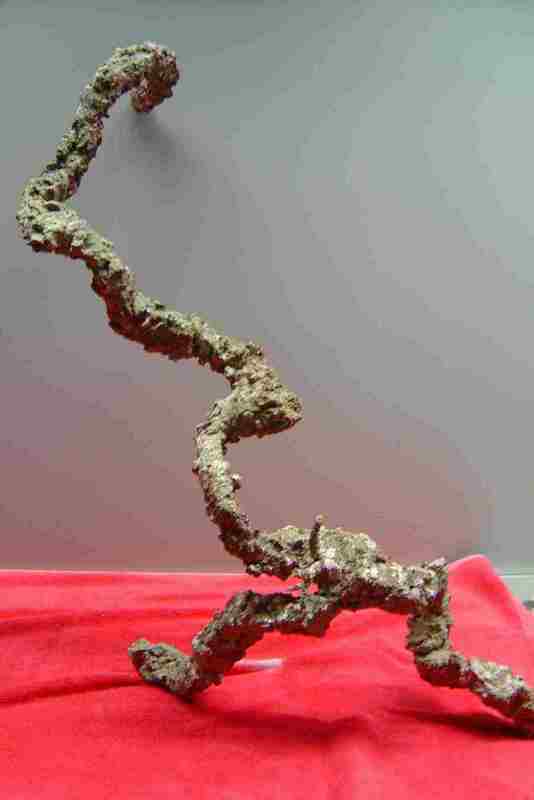
Also I think my home made rock helps with nitrogen also. They are hollow and I believe they can process nitrate better than real live rock. Of course this is a theory with absolutely no experimentation just some common sense.

This 3' rock is hollow and water can diffuse into it from many places.

Take care.
Paul


13094Copy_of_Copy_of_Copy_of_DSC00857-med.jpg
 
<a href=showthread.php?s=&postid=6551887#post6551887 target=_blank>Originally posted</a> by npaden
Sorry, I didn't mean to get us off track, I was just responding to Joe's statements.


I hope , your not taking what I said wrong or personal . I'm not saying my way is better , It just suits me better . Yours and other DSB I have seen are much to aspire to and should be used as models for a newbie .;)
 
I don't think that Paul has ever had a fully anaerobic area of his sandbed. No anaerobic zone = no SRB's = no Hydrogen sulphide. You are also not going to have any carbonate nor methane reduction going on in that situation.

Don't forget, I don't have sand, only dolomite
 
<a href=showthread.php?s=&postid=6551927#post6551927 target=_blank>Originally posted</a> by Paul B

As for LPS living in higher nutrient waters, that is the rumor but I can't remember seeing LPS corals on my dive trips. Most of the time all you see is SPS so I have no first hand data. That toungue coral I have is maybe 2 years old, it seems OK to me.
If I get ambitious I will put some SPS in there to see what happens. I don't have much room and I keep removing rock as the moorish Idol gets bigger.


Take care.
Paul


13094Copy_of_Copy_of_Copy_of_DSC00857-med.jpg

Just so you know , I didn't mean higher nutrients , just more forgiving . I don't mean to say your tank has high nutients . Just not as low as many SPS would prefer . Agian , I could be wrong , it won't be the first time .:)
 
No Joe, you are not wrong, my tank probably has way higher nutrients than most tanks. Even I can't believe the stuff I dump in there. I'm surprised I'm not growing lettuce.
If I mentioned all the stuff I put in there many people would think I was lying. I believe most tanks are too sterile.
Paul
 
<a href=showthread.php?s=&postid=6551836#post6551836 target=_blank>Originally posted</a> by aubee91
I have to admit that I am pretty fixated on phosphate. Simply because I've never really been satisfied with explanations that I've seen for what happens to it in our tanks.

I see several candidates for where it goes once it enters our DSB tanks via feeding:

a) Uneaten food and fish poop get exported via high flow and skimming.

b) Food that makes its way to the DSB gets eaten by worms, snails, pods, and a series of other benthic organisms so the phosphate remains in their bodies fueling growth and reproduction. Some of this phosphate may end up skimmed out when fish eat some of these organisms and poop them out or when baby benthic organisms or eggs find their way into the water column.

c) Phosphate that is released as a result of bacterial action in denitrification is bound up in the bacteria and/or the sand particles making up the DSB.

d) Phosphate gets released into the water where it fuels the growth of macroalgae and is exported via pruning.

Do you guys see other possibilities for where the phosphate ultimately goes?

Phosphate is an issue with any system. You need a small amount of it for life to occur but too much in an SPS system (which what I'm assuming you are asking about) is a big deal.

Phosphates and DSB's are an interesting combination. So are Carbon inputs and DSB's. Sandbeds release low level phosphates on a regular basis and the remainder recycle and accumulate. That's one of the reasons why the consistent point in this thread is just because you can get away with it for a while, don't EVER abuse a sandbed. You must be extra vigilent at minimizing imports and maximizing exports no matter what type of substrate you have.

Go back to my post where I was discussing reduction. What do you think is going to happen if you continually add Carbon and phosphate inputs (fish poo, waste, etc.)? What is going to happen is obvious, it's not going to be exported. A lot of it will accumulate and sink in the bed. Then ETS will happen, the metals and hydrogen sulphide will start to diffuse upwards. Then oxidizing bacteria will take care of that problem for you. They will oxidize the bad things and you basically have experienced a [CTRL][ALT][DELETE]. This is why you rarely hear of Hydrogen sulphide harming a tank unless there was a major disturbance in the bed. While the Hydrogen sulphide is gone, a lot of the Carbon is now exported, the phosphate stays for the most part bound in the bacteria in the bed.

If you abuse your bed long enough, bad things will happen. The anaerobic portion of your bed will get bigger, the aerobic portion of your bed will get smaller, and you will be sorry when you are no longer exporting low level phosphates.
 
Last edited:
<a href=showthread.php?s=&postid=6552273#post6552273 target=_blank>Originally posted</a> by inwall75
Phosphate is an issue with any system. You need a small amount of it for life to occur but too much in an SPS system (which what I'm assuming you are asking about) is a big deal.

Yep. That's exactly what I'm concerned about.


Phosphates and DSB's are an interesting combination. So are Carbon inputs and DSB's. Sandbeds release low level phosphates on a regular basis and the remainder recycle and accumulate. That's one of the reasons why the consistent point in this thread is just because you can get away with it for a while, don't EVER abuse a sandbed. You must be extra vigilent at minimizing imports and maximizing exports no matter what type of substrate you have.

Yeah, I agree. But it just seems to me that it's extra difficult to export from a system with a DSB. Mainly because it restricts the amount of flow one can have. And that seems to be made even more difficult by the restrictions some place on the necessary requirements for the DSB fauna. Like in the case Barry was discussing with Bertoni regarding a layer of larger particled substrate on top of the DSB. That is exactly what I was considering doing to my DSB so that I could up the flow significantly without creating sandstorms.

But it seems this can have a negative impact on the fauna. And just based on my impressions of what makes DSB's really work, the benthic fauna eating the "crud" that hits the bed is the most important part. It seems to me that if the stuff is not being eaten by a widely diverse group of organisms in the bed, it will end up being stored and ultimately wind up in the water column.

It also concerns me that even if every bit of food that goes into a DSB tank that doesn't get skimmed out winds up in the body of some benthic organism, it seems we are still "storing" the phosphate in the critters. If something goes wrong with them, they could let loose all of their satored phosphate. The more critters we have, the more potential for something to go wrong if something gets out of kilter in the tank.


Go back to my post where I was discussing reduction. What do you think is going to happen if you continually add Carbon and phosphate inputs (fish poo, waste, etc.)? What is going to happen is obvious, it's not going to be exported. A lot of it will accumulate and sink in the bed. Then ETS will happen, the metals and hydrogen sulphide will start to diffuse upwards. Then oxidizing bacteria will take care of that problem for you. They will oxidize the bad things and you basically have experienced a [CTRL][ALT][DELETE]. This is why you rarely hear of Hydrogen sulphide harming a tank unless there was a major disturbance in the bed. While the Hydrogen sulphide is gone, a lot of the Carbon is now exported, the phosphate stays for the most part bound in the bacteria in the bed.

If you abuse your bed long enough, bad things will happen. The anaerobic portion of your bed will get bigger, the aerobic portion of your bed will get smaller, and you will be sorry when you are no longer exporting low level phosphates.

Yeah, and even if one doesn't abuse the bed, it seems that it's possible to have issues down the road. It is also difficult, or at least it seems so to me, to tell whether one is abusing the bed or not as it does a good job of covering for our mistakes and hiding our errors.
 
<a href=showthread.php?s=&postid=6553272#post6553272 target=_blank>Originally posted</a> by aubee91
Yeah, I agree. But it just seems to me that it's extra difficult to export from a system with a DSB. Mainly because it restricts the amount of flow one can have. And that seems to be made even more difficult by the restrictions some place on the necessary requirements for the DSB fauna. Like in the case Barry was discussing with Bertoni regarding a layer of larger particled substrate on top of the DSB. That is exactly what I was considering doing to my DSB so that I could up the flow significantly without creating sandstorms.
Some of us have done quite well with larger particles on top that allowed higher flow (myself included).

But it seems this can have a negative impact on the fauna. And just based on my impressions of what makes DSB's really work, the benthic fauna eating the "crud" that hits the bed is the most important part. It seems to me that if the stuff is not being eaten by a widely diverse group of organisms in the bed, it will end up being stored and ultimately wind up in the water column.

You don't want things rotting in the water column. This is a known for whatever substrate you use or choose not to use. I've not found a worm yet that can nitrify nor denitrify. No matter how many worms you add, you will never achieve 100% efficiency. You also can't stop them from dieing. And even if you were to add a widely diverse group of organisms in the bed, you would still end up with nutrients being stored which would ultimately end up in the water column. That's why you need to minimize imports and maximize exports at every opportunity. If you want to be technical, even if the nutrients are in the bodies of the critters, they are still stored in the sandbed. Since fauna cannot nitrify nor denitrify, I consider them auxillary and not the most important part.

It also concerns me that even if every bit of food that goes into a DSB tank that doesn't get skimmed out winds up in the body of some benthic organism, it seems we are still "storing" the phosphate in the critters. If something goes wrong with them, they could let loose all of their satored phosphate. The more critters we have, the more potential for something to go wrong if something gets out of kilter in the tank.

This is a cycle that goes on in our tanks. A bigger critter poops, a smaller critter eats that, an even smaller critter eats the smaller critter's poop. In the end, bacteria take over. Until it gets to the bacterial level, nothing is exported....it's merely recycling. If you have a power outage, having a sandbed is a major disadvantage. However, there are ways of protecting dissolved Oxygen in case of a power outage and I think it is something that should be discussed on this thread.

Yeah, and even if one doesn't abuse the bed, it seems that it's possible to have issues down the road. It is also difficult, or at least it seems so to me, to tell whether one is abusing the bed or not as it does a good job of covering for our mistakes and hiding our errors. [/B]

This is a problem IMO because I don't know how to tell either. I've figured out to maximize exports and minimize imports. However, I don't know what to tell you other than follow good husbandry practices. It's been my experience thus far that the longer you are in this hobby, the less you feed and the more you export.
 
I have returned from lurking in the shadows!
As I did so long ago, I'm going to sum up where I think think we are. Before I do that, though, I must say a couple of things. I have spent a lot of time today preparing a 140 gallon freshwater setup to be converted to reef; it is 10PM; I am tired. Therefore, I don't really have the energy to give the proper people credit for their ideas. Please do not be offended if I am obviously referring to any posts that you made and I don't give you credit. Also, to the science people: the chance of me being in error concerning certain processes is very high this late at night. Please do not hesistate to correct such errors. I just ask that you do so gently:). Finally, I have added personal remarks in this format: {remark}. These remarks are intended only as food for thought. Many of them are marginally off-topic, and are not really intended to add to the discussion. They are my opinions and should be read as such, not as scientific fact.

Onwards to the summing!


1. In case you are joining late and didn't see the initial posts, well-cured live rock is very important. Whether you "cook" it
(and I still don't like that term; I think it's misleading as to what it does for the rocks) or use some other mode of curing is largely dependent on your specific goals. Using uncured live rock can allow the DSB to potentially become a nutrient sink (that can happen, but is not guaranteed).

2. There is not quite a consensus on particle size. The study that was quoted somewhere on page 20 stated that the highest diversity comes from mixed sizes. What constitues mixed sizes, it did not say. {Based on my own [admittedly limited] reading and experience, particle size is important, but not something to worry yourself to death with. There is most certainly an optimum size range for maximum diversity. However, I have had many tanks that use beds of different particle size, even crushed coral, and have had good results. There is no doubt in my mind that those beds have nowhere near the diversity of nature, but it is enough diversity to accomplish the goals of filtration. But I digress; the goal of this thread is to "optimize sand beds", not to simply "come up with a sand bed that works OK."}

3. Composition: Very interesting thoughts here. It might turn out that silica is a better base than aragonite. As is usually the case in the hobby, each has its pros and cons. Some reasearch is definitely in order. {I prefer aragonite. The fact that I started with aragonite and have had success with it makes me more than a little biased. I have not used silica, so I cannot comment on it. I will have excellent opportunities for research over the coming semesters, and I will definitely look into it}

4. Infauna (be warned, though, that this section has a lot of opinion in it): Studies have shown that faunal extinctions often occur within two years in captive aquaria. As the fauna are a crucial part of the filtration in a sand bed, this is very significant. I think that many problems with DSB collapse are a result of fanual extinction. I have zero evidence to back that up; it's just me connecting the dots, so I could very easily be wrong. So far, it looks like the only way to circumvent this problem is with recharge kits.

5. Phosphate: talk about the "great unknown." Actually, more properly, phosphate with relation to sand beds should be called the "great fuzzy." There is a great deal of information about the processes concerning phosphate. Phosphate will bind to things; that's in its nature. Eventually, binding areas will be taken up, and the phosphate will remain in the water column. There are, however, numerous ways to keep phosphate under control to slow the process. In the DSB, the fauna consume detritus before it can break down and release phosphate. Given the plethora of life in a sand bed, I am sure that there are also organisms that use phosphate is some way. However, one thing remains clear: no matter what happens, phosphorous is phosphorous; it cannot change without nuclear decay. Unfortunately, unlike the case with nitrogen, no phosphate mechanism ends in free phosphorous leaving the aquarium. However, phosphourous is continually added to the aquarium. Therefore, you must have a system of export. Agressive skimming is one good way, as is harvest of macroalgae. {Oh, and yes, the fact that macroalgae grows does mean there is P in the water, albeit in very tiny concentrations. The hope is that the macroalgae is limited by the P, and thus removes it before it can get to harmful concentrations. Algae grows on the reef, too, it's just exported (by herbivores whose water-soluble waste leaves the area on currents) before it makes itself known.}

6. Good water flow helps increase the effectiveness of DSBs, primarily by keeping wastes in solution where they can be removed by export processes. Good water flow is also good for your corals, so adding flow should just help all around. The potential for sandstorms does exist, but that can be avoided with some good engineering, as well as by possibly layering some heavier particles over the fine ones, although that is currently under debate as to its effect on infauna. {Personally, I see no problem with coarser substrate, having had succes with coarse substrate. Again, though, this is the "optimization" thread, not the "OK" thread. Also, I have set up or maintained many sand beds that are in tanks with very high flow. There will be some sandstorms at first, but, like dunes on the beach, the bed will eventually reach a permanent, non-sandstorm, configuration.}

7. Finally, good all-around husbandry helps maintain the effectiveness of DSBs. Limiting the rate of phosphate import is crucial (ie don't overfeed), and coming up with a good nutrient export system is very important as well {keeping the skimmer clean and operating well is also a big part of this}. The DSB will only do what you set it up and maintain it to do. {One thing that I think is often overlooked is learning to "read" your tank and its inhabitants. They will tell you long before any test that something is going wrong. Also, by the time you read their warning signs, there is usually still ample time to act. With test kits, though, you might get readings only when its too late for prevention.}

8. The Rest of the Story. So far, what happens deep in the sand bed has not really been dealt with. This might be an area in which research is required, or the information might be floating around out there and no one's picked it up.

I'm going to close with my personal mantra. When in doubt, look to nature. Nature has been keeping reefs a lot longer and better than we have. Of course, at the same time, you also have to remember that nature wasn't doing it with a glass box.

 
Pretty good summation IMO. :thumbsup:

I would argue on point #4 that infauna are useful for bioturbation but the health of the bed does not depend on diversity. I also believe that adding a "critter recharge pack" of worms, etc. is INCREASING the bioload of your system and not reducing it.

If your hope is to maintain a reef tank and utilize a sandbed for NNR, diversity is not required IMO. On the other hand, if your hope is to represent a lot of the diversity in a lagoonal ecosystem because you're interested in maintaining full food chains, then more power to you. I just don't feel that it is necessary to maintain a sandbed.

On the other hand, if you believe that diversity is important, then there are some authors who say you should not use silica sand because it is too sharp for some fauna which also hits point #3. Also on point #3, if you are counting on aragonite for large amounts of buffering, I feel you are going to be sadly dissapointed. In a sterile environment, I would say yes you will get buffering. In an environment where you are dealing with biochemistry vs straight chemistry, things get a 'little' more complicated.
 
Back
Top