Duplex sump concept

Any pics on these duplex systems ?

Check out "ReefVideos.com" when you see the select a video click on the one that is second from the left on top. This is how I based my sump design, saved alot of money doing it myself. Also, you can build the sump the way YOU want it, not just buying some thousand dollar pre-made sump. Hope this video was as inspiring to you as it was for me. Have fun building.
 
Yes I've seen the video and the nice drawing but would like to see some aged duplex systems.
3 months old
6 months old
and maybe 1 or 2 years old
 
I have been doing a ton of reading on subjects that feed into the duplex sump system/benthic filtration that started by Steve Tyree’s idea and were modified with Mr.Wilson's duplex sump idea. I find it funny that after doing a lot of reading and thinking, I was beginning to come up with my own ideas that were right in line with those of the people listed above. Except these guys obviously beat me to it by several years...

I have a ton of ideas and questions that I'd like to throw into the discussion, but I'll break it down into a couple of post.

Overall, I think the duplex sump idea is a great idea. I'm a firm believer in nature's ability to solve our issues in the hobby. However, has anyone experimented in detail with removing the protein skimmer?

Taking the following articles/research into consideration, here are some major conclusions I've come up with regarding protein skimmers:

1) Protein skimmers remove mostly inorganic materials from the water, mostly calcium carbonate and silicone dioxide. http://www.advancedaquarist.com/2010/2/aafeature#

2) Protein skimmers have been shown to selectively remove certain strains of bacteria from aquaria while leaving other untouched, creating an unnatural selection/imbalance situation. http://www.advancedaquarist.com/2011/3/aafeature#

3) Protein skimmers decimate zooplankton populations (This is a generalization on my part and I might be wrong with this assumption. Please correct me if I'm wrong. Have nothing to support this statement.)

4) at most, protein skimmers have been shown to reduce TOC by 30-35%. It has been theorized (but not proven) that the majority of the skimmate is actually the cell structures of the bacteria that the skimmer removes (i.e. silicone dioxide and calcium carbonate could be present in the outer membranes of the cells and the various organic compounds present in the skimmate could be the "guts" of the bacteria removed. http://www.advancedaquarist.com/2010/1/aafeature# and the article referenced in bullet 2.

5) "Natural reef" water has been shown to have bacteria populations roughly 10x those of heavily skimmer and filtered aquaria. Additionally, TOC levels on reefs are typically around 1.2-1.4 ppm while many of our aquaria are around .7 ppm or so (I know this is a big generalization) http://www.advancedaquarist.com/2011/3/aafeature#

I currently don't have a tank set up, but I'm in the process of researching and planning my next tank. I'm leaning towards setting up a tremendously large cryptic sump with an oversized planted refugium and deep sand bed. Ideally I'd like to set something up with roughly 20% of the total water volume is the display tank and the remaining 80% of the water volume is eaten up by my sump, but that is a discussion for a future post! However, I believe firmly in the removal of a protein skimmer from my system (provided that the sump/natural filtration area is sufficiently large enough).

Overall, I believe that removing the protein skimmer would be key to replicating a "natural reef" as closely as possible. Any thoughts on this?

 
Last edited:
Furthermore, assuming that everything I said above is correct, removing the protein skimmer would serve to increase the overall bacteria, plankton, and zooplankton populations and thus improve the function of the duplex sump concept.
 
You could, in theory, remove the protein skimmer, IF you want to do more water changes. I use a skimmer and will not remove it because I see the nasty looking and smelling stuff that it removes, and I know what systems look like w/out one(yellowish water). On a more relevant note, I have been using Mr. Wilson's duplex sump concept, and I believe it is an ingenius idea for natural filtration. My system is 5 mo. old now and it already has a ton of the little sea squirts and tunicates that Mr. Wilson refers to in his video. I believe that this sump concept allows you to do less water changes and maintain better water quality, as opposed to using a commercially manufactured sump. Thank you Mr. Wilson.
 
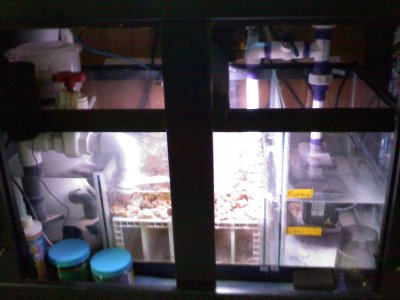
Any pics of your setup?

What did you do for your refugium zone ? Sand, crushed coral, crushed live rock and did you go with mangroves or cheato?
 
Any pics of your setup?

What did you do for your refugium zone ? Sand, crushed coral, crushed live rock and did you go with mangroves or cheato?

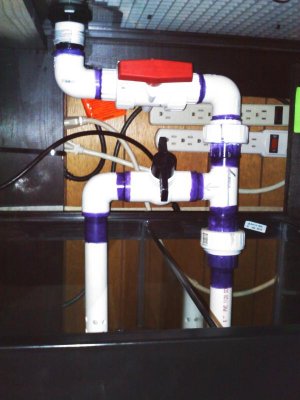
I did it just like his vid on that big reef except no uv sterilizer and I put in panels for a bubble trap. I used a 40 breeder, have the skimmer in the 1st compartment. Dial back the return pump so that the skimmer processes everything that goes into compartment#2, have the eggcrate design in comp#2 with live rock rubble on the top of it and caulerpa growing under a t8 light on a 14hr on 10 hr off photoperiod. I will try to get some better pics for tomorrow, have to go to bed now, I get up at 3:00am. Good Night !:hmm5:
 

Attachments

  • Sump.jpg
    Sump.jpg
    51.2 KB · Views: 14
  • Return Pump Plumbing.jpg
    Return Pump Plumbing.jpg
    50.6 KB · Views: 15
I have been doing a ton of reading on subjects that feed into the duplex sump system/benthic filtration that started by Steve Tyree's idea and were modified with Mr.Wilson's duplex sump idea. I find it funny that after doing a lot of reading and thinking, I was beginning to come up with my own ideas that were right in line with those of the people listed above. Except these guys obviously beat me to it by several years...

I have a ton of ideas and questions that I'd like to throw into the discussion, but I'll break it down into a couple of post.

Overall, I think the duplex sump idea is a great idea. I'm a firm believer in nature's ability to solve our issues in the hobby. However, has anyone experimented in detail with removing the protein skimmer?

Taking the following articles/research into consideration, here are some major conclusions I've come up with regarding protein skimmers:

1) Protein skimmers remove mostly inorganic materials from the water, mostly calcium carbonate and silicone dioxide. http://www.advancedaquarist.com/2010/2/aafeature#

2) Protein skimmers have been shown to selectively remove certain strains of bacteria from aquaria while leaving other untouched, creating an unnatural selection/imbalance situation. http://www.advancedaquarist.com/2011/3/aafeature#

3) Protein skimmers decimate zooplankton populations (This is a generalization on my part and I might be wrong with this assumption. Please correct me if I'm wrong. Have nothing to support this statement.)

4) at most, protein skimmers have been shown to reduce TOC by 30-35%. It has been theorized (but not proven) that the majority of the skimmate is actually the cell structures of the bacteria that the skimmer removes (i.e. silicone dioxide and calcium carbonate could be present in the outer membranes of the cells and the various organic compounds present in the skimmate could be the "guts" of the bacteria removed. http://www.advancedaquarist.com/2010/1/aafeature# and the article referenced in bullet 2.

5) "Natural reef" water has been shown to have bacteria populations roughly 10x those of heavily skimmer and filtered aquaria. Additionally, TOC levels on reefs are typically around 1.2-1.4 ppm while many of our aquaria are around .7 ppm or so (I know this is a big generalization) http://www.advancedaquarist.com/2011/3/aafeature#

I currently don't have a tank set up, but I'm in the process of researching and planning my next tank. I'm leaning towards setting up a tremendously large cryptic sump with an oversized planted refugium and deep sand bed. Ideally I'd like to set something up with roughly 20% of the total water volume is the display tank and the remaining 80% of the water volume is eaten up by my sump, but that is a discussion for a future post! However, I believe firmly in the removal of a protein skimmer from my system (provided that the sump/natural filtration area is sufficiently large enough).

Overall, I believe that removing the protein skimmer would be key to replicating a "natural reef" as closely as possible. Any thoughts on this?

Well the short answer is turning the skimmer off at night. This can be in conjunction with turning the refugium throughput pump off at night. The reason for this is algae respire at night and leak nutrients back into the water.

Zooplankton are more active at night so this is a good time to shut down the skimmer. Corals are night feeders, sending out feeder tentacles so they will have more zooplankton and bacterioplankton to eat. Bacteria bond to detritus which is in turn removed by skimming.
 
You could, in theory, remove the protein skimmer, IF you want to do more water changes. I use a skimmer and will not remove it because I see the nasty looking and smelling stuff that it removes, and I know what systems look like w/out one(yellowish water). On a more relevant note, I have been using Mr. Wilson's duplex sump concept, and I believe it is an ingenius idea for natural filtration. My system is 5 mo. old now and it already has a ton of the little sea squirts and tunicates that Mr. Wilson refers to in his video. I believe that this sump concept allows you to do less water changes and maintain better water quality, as opposed to using a commercially manufactured sump. Thank you Mr. Wilson.

Removing a protein skimmer from almost ALL reef tanks in our hobby is a BAD idea. We continuously overstock our systems and expect a fuge/benthic zone2-10% of our total volume to compensate for poor skimmer maintenance, minimal water changes and no particulate filtering. I tried the duplex sump design along with a skimmer and turf scrubber for more than a year. My judgement for MY system is there is no way/no how that the little 1ft^2 could process the amount of matter I required. Not bashing the idea or design, just stating my short-comings.

Fast forward after my move to MI. I incorporated three thinigs that I attribute to the much greater success I have had with larger sps growth spurts and even a larger fish bioload. I have used a Rubbermaid stock tank as my sump. The far side has the skimmer, carbon (when in use) & overflow with felt filter sock.

1)I will NEVER create a system w/o a filter sock again, as I control input then and of what. Poo may feed corals, but they cannot and will not process the qty that 6 clowns and hoards or worms, snails, and crabs produce.

2) The remainder of the sump is filled with my own MMLR that is lifted off the bottom by 1.5"dia. pvc cut to about 1" high. Eggcrate then rests on top these 'pucks'. The rock is then placed on top of the eggcrate with as minimal contact between each rock. A PH is near the edge with a spray bar pushing water underneath the eggcrate. This eliminate the previously mentioned excess detritus. In the past I tried leaving the detritus build-up in the 1ft^2 benthic zone, but w/o the addition of the turf scrubber the cyano was horrible. I have had NO cyano to date with this new system that eliminates/collects detritus.

3) I have taken a second Rubbermaid stock tank and use it as my lagoon. I have only a maxi-mini carpet, a few ricordia and some 'wild' polyps in this zone. The remainder is various types of algae including any/all invasive species I could get my hands on. To follow-up this nutrient removal, I also regularly harvest this algae and any stray majano I find. The GSM pair loves swimming through the taxifolia and this just seems more natural.

4) I aggresively, read AGGRESIVELY, skim wet 24/7/365.

My experiences have been driven by coral color for the longest time and I feel this has best suited my needs. I would say a RDSB is absolutely, positively NOT needed if you have any decent amount of sand in your system. When it comes to sand, a little goes a long way. I currently have nearly 200lbs between the lagoon, sps DT and the nem DT. Only the nem tank is even near the 3.5"-4" depth. A RDSB is a novel idea, but not what was intended by Mr. Shimek. Keep it in the tank if you want it. I, along with E. Borneman, have all the same sand I started with 11 yrs ago and have only rinsed it once after my move from PA. No toxic tank IME.

This is mainly my ramblings of what I have experienced in the past few years from experimentation. I have found, as Borneman has wrote many times in the past, that the more your system counts on technology the less stability you may have with the least amount of labor. Old mother nature knows what she is doing, so take her lead. If a benthic zone works in your setup, why not try a bigger zone for that or a bigger 'fuge. A skimmer is a great tool, but as MrWilson states it mainly removes mircoscopic creatures that are feeding on the microscopic detritus. I cannot remember the exact advanced aquarist/marine biologist I was listening to a couple years back, but he stated that 60-75% of what we collect in our skimmer cups is a microscopic creature that feeds mainly on sources of phosphate. For that reason alone he said he would never shut his down besides the added benfit of increased dissolved oxygen.

Now a true cryptic zone as Tyree's would be interesting, but I think I'm out of room to test the size required. Maybe another 32gal Brute can filled with MMLR in the closet will be in my future. The only advice I can give is diversify your system and try as many tiers/zones as possible as you will be amazed at how much more life your system will have with this microcosm of environments.

Happy Reefing!:fish2:
 
Last edited:
Responding to one of DeathWishes statements: I will never use a filter sock again after my Yellow Watchman Goby took a ride down the overflow pipe(must have gotten up and over the overflow box) and was beat to death inside the filter sock. If that death sock wasn't on the pipe, I would have simply retrieved him from the sump no harm done. I have found that a big enough sump with enough compartments will allow sediment, detritus, and particulates to settle on the bottom from which they can be siphoned out at the next W.C., therefore a filter sock is just giving us one more maintenance item to clean and worry about clogging.
 
A skimmer is a great tool, but as MrWilson states it mainly removes mircoscopic creatures that are feeding on the microscopic detritus. I cannot remember the exact advanced aquarist/marine biologist I was listening to a couple years back, but he stated that 60-75% of what we collect in our skimmer cups is a microscopic creature that feeds mainly on sources of phosphate. For that reason alone he said he would never shut his down besides the added benfit of increased dissolved oxygen.

I'm not arguing that a skimmer removed microscopic creatures that are feeding on detritus, but I don't believe that removing them is a good thing.

The article linked below (which is also one of the supporting articles I referenced in my original post) is an extremely interesting read about what a skimmer actually removes from the water.

http://www.advancedaquarist.com/2010/2/aafeature#

Basically, a skimmer hasn't been shown to have a significant impact on the reduction of TOC in our aquariums while it has been shown that a heavily skimmed system does have a greatly reduced bacterial count (roughly 1/10th of that found around reefs in nature) - which I don't think is a good thing. The article belows goes into detail about bacterial counts in reef aquaria.

http://www.advancedaquarist.com/2011/3/aafeature#

Reefs are naturally low on dissolved nutrients, however micro fauna isn't considered dissolved nutrients. Protein skimmers are decimating the populations of life that are there precisely to remove what we are hoping to remove through technology.

If the removal of TOC is our primary goal, Advanced Aquarists featured an article that looked into the use of granulated activate carbon (which I'll link below this paragraph). They showed that roughly 200 grams of activated carbon will reduce 90% of TOC in 100 gallons of aquarium water for roughly 30 days. However, a skimmer has only been shown to reduce TOC by 30-35% (as per article referenced a few paragraphs up). Unlike the skimmer, activated carbon isn't going to decimate the population of micro fauna in our aquariums. However, you are going to have to replace it periodically.

http://www.advancedaquarist.com/2008/2/aafeature1#

But, I believe all of this ties right into what you were getting at in the beginning of your post (and what I firmly believe) that we aren't going to be able to be able to enjoy the benefits of a "natural" system if our cryptic zones and duplex sumps constitute a minority of the total volume of our systems.

Interestingly enough there are a lot of companies out there that sell filters that are designed to house bacteria that are used in industrial applications to reduce DOC by up to 90% on a single pass through a sufficiently large enough biological filter -without any mechanical filtration. It would be interesting to get a couple of these industrial sized filters to see what they'd do on our reef systems.

http://www.bioprocessh2o.com

I'm convinced that the small duplex systems I've seen posted here are beneficial and do add biodiversity to the systems, but on their current scale I don't think most of them are filtering a significant portion of the wastes out of the system.

Any ideas on how large of a cryptic zone/duplex sump you would need to run in order to create a successfully balanced natural aquarium?

This is a purely arbitrary number on my part, but I'd guess you would need to break up the volume to 80% sump to 20% display. But I have nothing to base that guess on...
 
sorry for the late reply, but I read the article mentioned in page 7 i believe

http://reefkeeping.com/issues/2002-12/rs/feature/index.php

So according to the article, would it be more effective if I had both a xenia and a chaeto chamber in my sump (separated by baffles)? or would one dominate and hog all the nutrients?

You could try to get the "best of both worlds" but I always thought that sticking to one was the key. I use caulerpa, despite the stories of it leeching and crashing a system, most people have chaetomorphia(morphic,morphica) whatever it's called. Maybe somebody will input their thoughts about the downside of me using caulerpa. I just might throw it out if they make a strong enough case. LOL
 
Responding to one of DeathWishes statements: I will never use a filter sock again after my Yellow Watchman Goby took a ride down the overflow pipe(must have gotten up and over the overflow box) and was beat to death inside the filter sock. If that death sock wasn't on the pipe, I would have simply retrieved him from the sump no harm done. I have found that a big enough sump with enough compartments will allow sediment, detritus, and particulates to settle on the bottom from which they can be siphoned out at the next W.C., therefore a filter sock is just giving us one more maintenance item to clean and worry about clogging....

My juvenile clowns/shrimp have taken the water slide before. That's before I added strainers on my Bean style overflow. Nothing that large get's by now. I still turn each filter sock inside-out and pull each pod,collonista snail, strombus snail and bristleworm I find and release into sump. Takes 30 seconds to do and I save a ton of life this way. I do have my filter sock setup so that if it is completely clogged with build-up, the overflow water just overflows the filter sock.

I also run a 6"x18" filter sock for ~2200 gph turnover, so anything in the sock doesn't experience an environment like a pressure washer.


I'm convinced that the small duplex systems I've seen posted here are beneficial and do add biodiversity to the systems, but on their current scale I don't think most of them are filtering a significant portion of the wastes out of the system.

Any ideas on how large of a cryptic zone/duplex sump you would need to run in order to create a successfully balanced natural aquarium?

This is a purely arbitrary number on my part, but I'd guess you would need to break up the volume to 80% sump to 20% display. But I have nothing to base that guess on...

I agree on all your points about skimmers. I just prefer to keep one running on my system for that 'safety net' since I travel for work at a week at a time for 30%+ of te calendar year. I have noticed that nuisance algae is much less prone to take a foot hold when running the skimmer in my system.

As for the percentage of the cryptic/duplex to display, I think your number is maybe very close +/-10%. If you look at the current oceans, the lagoon and grass bed regions account for a large percentage of the inhabited shallows. Look at the vast FL keys with no prominent reef structure except the occassional outcrop such as in Key Largo and a few other remote dive areas and state parks (i.e. Dry Tortugas). That is an immense amount of grass beds and lagoon-type regions that is filtering an immense amount of material.

The next question is should the precentage relate to volume, footprint or sq. ft. of the medium for the cryptic and benthic organisms? I think area for the organisms is the most important, but in a truly diverse system I would prefer at least equal areas of cryptic, lagoon & display. My grassbed is more than twice that of the display and the benthic area has at least 1.25 times that of the display. I'm very intrigued with just starting a huge batch of some new LR and chucking what is currently in the sump into a 32gal Brute and see what I have in ~6 months.

Carbon is a useful tool to combat the dreaded 'yellowing' compounds when using an immense amount of algae as a nitrate control. The major problem I have with carbon is the uncertainty of what else if may be removing such as trace elements. I prefer the salt manf. to correctly dose these additives so I'm not blindly dumping loads of these into my tank. Therefore, I have mainly used carbon as a 'polishing' aid when the water becomes a little yellow or the white bucket test yields anything but a white bucket.
 
sorry for the late reply, but I read the article mentioned in page 7 i believe

http://reefkeeping.com/issues/2002-12/rs/feature/index.php

So according to the article, would it be more effective if I had both a xenia and a chaeto chamber in my sump (separated by baffles)? or would one dominate and hog all the nutrients?

IMO, chaeto is for removing nitrates and xenia is for particulate matter. These are used to export two completely different animals: nitrate-phosphate versus food-waste particles in the water column. I would say that some LR rubble and about 1" LS will process just as much particulate matter after it becomes established with pods and worms. The xenia is a pain b/c it's just another draw for electricity since it requires moderate light. Chaeto and all the invasive species of algae I have require only light from 23W/16W CFL flood lights and receive supplemental lighting from a window. I prefer refugiums for particulate removal when I'm not running a filter sock. Another idea I've thought about using is sun corals as a first stage of a sump to sump as much particles from the water, but have not grown out my colony nearly large enough for this task.

BTW...were you on or currently on PU SAE Formula? Just wondered as I was on Baja for about 5 years.
 
Basically, a skimmer hasn't been shown to have a significant impact on the reduction of TOC in our aquariums while it has been shown that a heavily skimmed system does have a greatly reduced bacterial count (roughly 1/10th of that found around reefs in nature) - which I don't think is a good thing. The article belows goes into detail about bacterial counts in reef aquaria.

http://www.advancedaquarist.com/2011/3/aafeature#

Ok....Bingo!!! This was the exact article Ken went through at the meeting I spoke about in the prior post. He went through this report that he performed along with some experimentation he also performed on Sanjay's clown tank. After revealing all of this info I have several questions that were slowly answered by other reefers' at the NCPARS Fall frag swap 2 years ago. The I asked Ken if he would ever shut down his skimmer. That's when he stated that the positive side of oxygenation along with the removal of the phosphate laden organsims removed were too valuable to increase bacteria populations to 'natural' levels. This is what Ken stated at our club frag swap and everyone may have walked away with differing opinions.
 
@Deathwish, well. I got the complete opposite situation.
I had anemones dying, golden algae taking over and a crystal clear water.
For over 16 months ago, I pulled of my freakishly big deltec skimmer added a algae scrubber and started feeding like Eric borneman.
Impact you say.... As of now a feed 500g of frozen and dry food monthly. I got 10 fishes and a large rbta anemone. This particular anemone was the size of a small cellphone, 7 months after it eats cellphones.
The amount of gunk and particles in the water is staggering. My blochii tang is growing a cm each second month or so.
I got critters growing from the mouth of the fishes so the fish only swallow to be fed.

I had to buy a small hob skimmer to skim off the foam in the bottom compartment of the sump, due to the ato sensor getting stuck.
I will never go back to filter sock and skimmers. Ozone on the other hand I use from time to time to get rid of the tint the water gets, about 5-10mg/h.
This is 300gal tank with sump.
 
Carbon is a useful tool to combat the dreaded 'yellowing' compounds when using an immense amount of algae as a nitrate control. The major problem I have with carbon is the uncertainty of what else if may be removing such as trace elements. I prefer the salt manf. to correctly dose these additives so I'm not blindly dumping loads of these into my tank. Therefore, I have mainly used carbon as a 'polishing' aid when the water becomes a little yellow or the white bucket test yields anything but a white bucket.

I didn't think about activated carbon's ability to remove trace elements from our systems. From some reading that I did yesterday, activated carbon has a significantly greater afinity for organic compounds than it does for metals/trace elements, but it will remove trace elements. What I'm not sure of is whether or not activated carbon (1) would absorb a trace element compound and hold on to it or (2) if it will release the compound when an organic compound with a higher afinity comes around and bind that organic compound instead. If the second situation is the case, than the affects on the removal of trace elements would be minimal once the carbon is sufficiently saturated with organics.

I have access to an optical emmision spectrometer at work and I might be able to put together an experiment to figure this out. However, don't hold your breath. I'm usually kind of slow to getting around to these sorts of things...

Anyways, I think I'm starting to get pretty far off from the thread's original topic. If I do any sort of experiment with activated carbon I'll start a new thread. But it'll probably be a while before that happens.
 
Last edited:
Back
Top