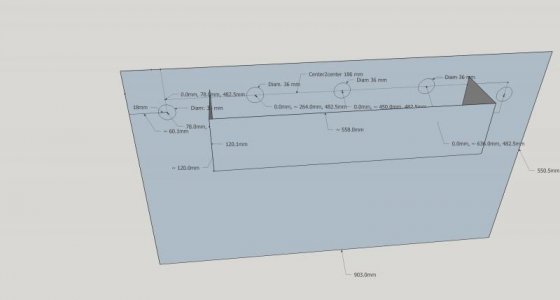
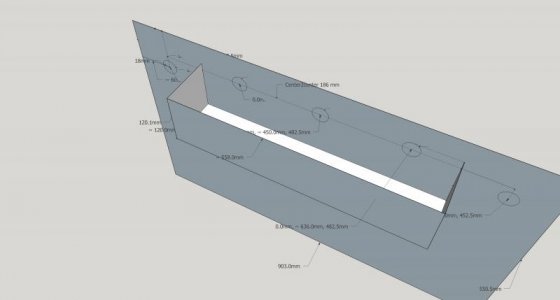
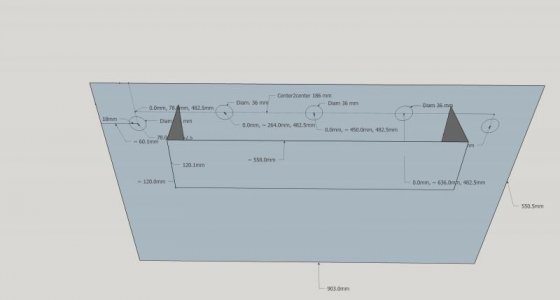
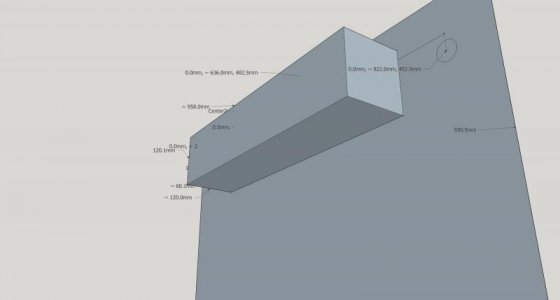
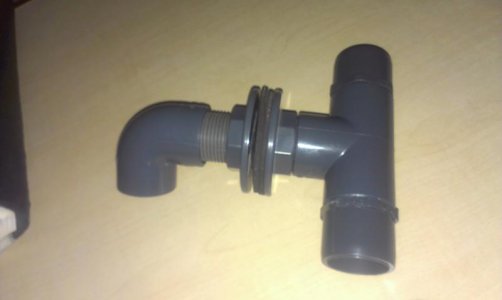
Final check before drilling glass, please take a look !

Ontheway

New member
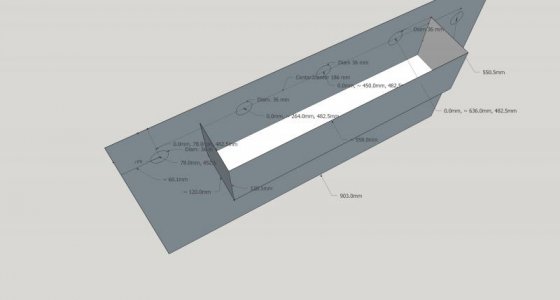
Hey there, I did my best to create whats in my mind for the back-glass, below. Planned a Beananimal with internal almost C2C overflow, two returns. Headpump Jebao DC-10000, PS is Reef octo. P.O.V. 5500. Dimensions are 90x70x55, in centimeters.

Here are the pics, could not find a way to display them full size. I can provide more angles or zoom details if needed. TIA,

Alper
 

Attachments

  • 1eng.jpg
    1eng.jpg
    18 KB · Views: 4
  • 2eng.jpg
    2eng.jpg
    17 KB · Views: 5
  • 3eng.jpg
    3eng.jpg
    18 KB · Views: 4
  • 4eng.jpg
    4eng.jpg
    16.9 KB · Views: 5
  • 5eng.jpg
    5eng.jpg
    13.1 KB · Views: 6
My suggestion would to only do one return hole. The spot you would have used for the second hole is a great place for a powerhead. Less plumbing to fiddle with. The return is really just to get water back to the tank, flow is better managed with powerheads, IMO.
 
+1 on the single return hole... splitting to 2 outlets does nothing... (basically a return just needs to put water BACK IN the DT) let your powerheads do all the circulation.

less holes to leak, fewer plumbing joints to leak, less head pressure on your pump from plumbing.
 
+1 on the single return hole... splitting to 2 outlets does nothing... (basically a return just needs to put water BACK IN the DT) let your powerheads do all the circulation.

less holes to leak, fewer plumbing joints to leak, less head pressure on your pump from plumbing.

Thanks for the comments, I was thinking that splitting the return to two, may take pressure from headpump. Then I will go for a single return. I especially wonder if the distances for overflow is ok? I keep the weir line in parallel with upper edges of 3 holes, About 5 cm glass left on top of holes. Overflow is 12cmx12cm, too deep? too shallow? Do you think these numbers are ok?

I will use smoke-colored glass, (6mm) for overflow. Are there any adventages to make weir part of overflow angled, instead of perpendicular to ground? I am not planning to use toothed plastic blockages on weir, just rounded glass edge.
 
FWIW - I made a mistake on my 1st tank by putting my drill template on upside down - the hole was too far from the top and would have made my box too low. I ended up using it as a return instead. So the next time, I put masking tape where the overflow box would be going so I could see the big picture.

Also - looking at the drawing I'm not sure if the 78mm is from the top of the tank or the bottom of the trim on the top of the tank. Make sure there is enough room for the flange of the bulkhead, if that makes sense.
 
FWIW - I made a mistake on my 1st tank by putting my drill template on upside down - the hole was too far from the top and would have made my box too low. I ended up using it as a return instead. So the next time, I put masking tape where the overflow box would be going so I could see the big picture.

Also - looking at the drawing I'm not sure if the 78mm is from the top of the tank or the bottom of the trim on the top of the tank. Make sure there is enough room for the flange of the bulkhead, if that makes sense.

Thanks for alerting on drill mistakes but a professional will apply the plans, so if there is a mistake, it will not be my responsibility :)

This sketch-up software is not good enough for annotation, 78 is from left edge to center of first (return) hole. There will be about 12 cm center to center (slightly modified dimensions of pics above) so I believe there will be enough room for the flanges of 1" pipes.
 
Thanks for the comments, I was thinking that splitting the return to two, may take pressure from headpump. Then I will go for a single return. I especially wonder if the distances for overflow is ok? I keep the weir line in parallel with upper edges of 3 holes, About 5 cm glass left on top of holes. Overflow is 12cmx12cm, too deep? too shallow? Do you think these numbers are ok?

Splitting the return line would actually increase the dynamic head on the return system. Pressure is an ambiguous term, and has several definitions in pump fed systems. It is simpler to examine using friction loss, rather than pressure.

You want the top of the weir ~ 2.54 cm below the top of the glass, which on a rimmed tank is even with the bottom of the trim on the outside of the tank. With a rimless tank, the top of the glass is easier to find. ;)

For safety, the hole centers need to be ~7cm down from the top edge of the glass. Further down in the range of ~8.25cm is a bit better, and gives a little more head room. The holes need to be spaced by 1 hole diameter, edge to edge of the holes. Get those dimensions right before you drill the tank, and before you plan on the sizes of other components.

I will use smoke-colored glass, (6mm) for overflow. Are there any adventages to make weir part of overflow angled, instead of perpendicular to ground? I am not planning to use toothed plastic blockages on weir, just rounded glass edge.

There is no advantage to angling the weir, so there is no point in considering it. The longer the water is in contact with the "down river" side of the weir, the more drag is created. Angling the weir increases the drag time...Folks do it I imagine to reduce noise, however, keeping the water level in the overflow <= 2.54cm below the tank water level, and using a long weir, (reduces head height behind the weir) is a better idea.
 
For safety, the hole centers need to be ~7cm down from the top edge of the glass. Further down in the range of ~8.25cm is a bit better, and gives a little more head room. The holes need to be spaced by 1 hole diameter, edge to edge of the holes. Get those dimensions right before you drill the tank, and before you plan on the sizes of other components.

Planned hole center distance is at exact 7 cm from glass top (there will be no rim) and return hole is at 10 cm. You state that "the holes need to be placed by 1 hole" Is this obligatory, for some reason? since I decided to give equal distances, across the back Wall, including the return hole. Btw, a sample flange pic is below;
 

Attachments

  • IMAG0422.jpg
    IMAG0422.jpg
    20.6 KB · Views: 3
Planned hole center distance is at exact 7 cm from glass top (there will be no rim) and return hole is at 10 cm. You state that "the holes need to be placed by 1 hole" Is this obligatory, for some reason? since I decided to give equal distances, across the back Wall, including the return hole. Btw, a sample flange pic is below;

Hole spacing at 1 hole diameter is obligatory as the minimum safe distance, further apart is not a problem. However, spacing the drain lines that far apart will not improve the system performance, and creates issues with getting the pipes into the sump. A problem that is very difficult to solve. You want all the pipes in the skimmer section with no horizontal runs and a minimum of "snaking" the plumbing around. The closer the holes are together, and the closer to the skimmer section the holes are the better, but observe the minimum distance...

Honestly, you would be better off taking the return up over the top of the tank, and using only a single return outlet, (Less holes to drill for one,) and making the weir the full inside length of the tank. For larger tanks, (like 240 - 300 +) a convincing argument exists for using multiple returns to take some of the burden off the power heads. I run tanks like this above 3000gph, so I am moving a lot of water.
 
Hole spacing at 1 hole diameter is obligatory as the minimum safe distance, further apart is not a problem. However, spacing the drain lines that far apart will not improve the system performance, and creates issues with getting the pipes into the sump. A problem that is very difficult to solve. You want all the pipes in the skimmer section with no horizontal runs and a minimum of "snaking" the plumbing around. The closer the holes are together, and the closer to the skimmer section the holes are the better, but observe the minimum distance...

Honestly, you would be better off taking the return up over the top of the tank, and using only a single return outlet, (Less holes to drill for one,) and making the weir the full inside length of the tank. For larger tanks, (like 240 - 300 +) a convincing argument exists for using multiple returns to take some of the burden off the power heads. I run tanks like this above 3000gph, so I am moving a lot of water.

I get the point, many thanks for the tip, I will immediately change the plans, according to your advises. Three holes with 1-hole spacing, will be placed closer to left edge. I will also follow your advise on taking the single return over the top of the tank, therefore return hole is cancelled also, weir will be real coast2coast.

About the weir placement, holes (center) will be drilled 7cm below the glass edge (means hole-top to glass-edge is 5 cm=2inches). The weir will be placed right in the middle of this distance, 1" from hole-top, so another 1" lefts to glass edge. This means water level will be at 1" below glass, do you think may the water drip-jump around due to powerhead-agitated water surface?

And one last question, I will keep overflow box depth 4 3/4". Is this fine or should be shallower? An info, my return pump is a DC motor, flow speed can be adjusted with an electronic gadget. Thanks for the answers and patience.
 
Wait, before you decide on the overflow box depth, till after the bulkheads are installed and have elbows on them. You want ~ 3/4" from the elbow to the bottom of the overflow.

Converting from metric to imperial and back gets a little cumbersome for me ;)

top of glass to hole center: 2 3/4" minimum for a 1" bulkhead. It is better to drop down to 3" - 3 1/4" to pull the dry emergency a bit further down below the top of the weir, with a rimless tank, but it is optional. Be sure that the weir is placed far enough from the elbows that the waterfall does spill into the dry emergency.

Water level in the overflow will be ~ the top of the down turned elbows. This can vary a little bit, but generally will be above the center line of the elbows.
 
Wait, before you decide on the overflow box depth, till after the bulkheads are installed and have elbows on them. You want ~ 3/4" from the elbow to the bottom of the overflow.

Converting from metric to imperial and back gets a little cumbersome for me ;)

top of glass to hole center: 2 3/4" minimum for a 1" bulkhead. It is better to drop down to 3" - 3 1/4" to pull the dry emergency a bit further down below the top of the weir, with a rimless tank, but it is optional. Be sure that the weir is placed far enough from the elbows that the waterfall does spill into the dry emergency.

Water level in the overflow will be ~ the top of the down turned elbows. This can vary a little bit, but generally will be above the center line of the elbows.

For metric to imperial, just let me worry about it, I will do the calc.

For the rest of the sentences, each of them invaluable, thank you so much !

Regards,

Alp
 
Back
Top