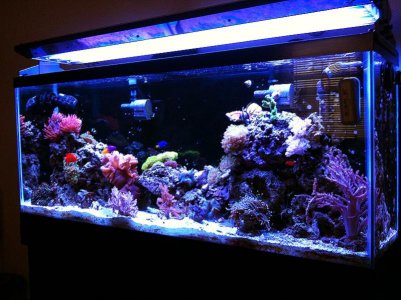
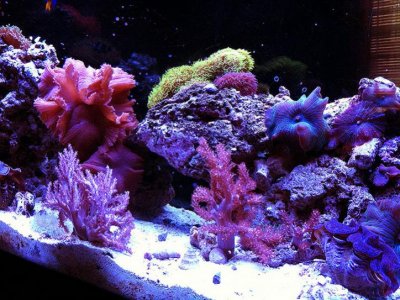
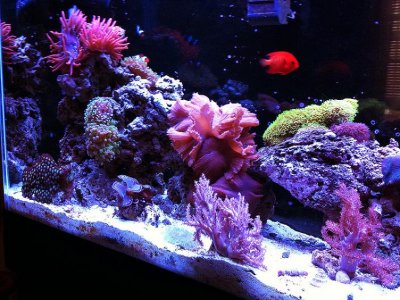
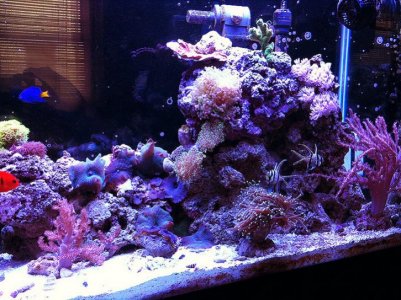
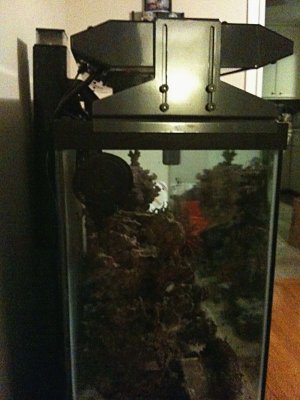
Interesting article by Scott Fellman regarding water changes.
by
Scott Fellman
Published on 05-19-2010
14 Comments Comments
With advances in technology, collection practices, and communication among hobbyists, it’s never been easier to enjoy a healthy and beautiful display of reef creatures in your own home. After spending some time in the hobby and achieving success, you might still see someone else’s amazing reef system, supporting a thriving population of rare or challenging species and wonder to yourself, “How did that guy do it?” Did he/she spend a lot of money on fancy gadgets, or just hit a run of extraordinary luck?
You didn’t think it would be that simple, did you? Let’s be honest. Successful reef systems involve the merging of proper planning, good design, and husbandry techniques to create optimum conditions for captive animals to thrive. To sum it up, in a word, it’s about acquiring habits- the good habits that set apart a truly successful hobbyist from the masses. Sometimes, it’s helpful to re-visit seemingly basic practices to move ahead successfully.
One of the easiest (and best) things that we can do to achieve and maintain success with our captive reef systems is to perform regular water changes. Yet, it is baffling to me why so many aquarists resist performing regular water changes on their systems. In fact, you’re bound to encounter hobbyists who will proudly boast that they perform a water change “once in a while”, if ever!. Seriously?
Water changes tend to be viewed by most hobbyists as a necessary evil; a practice that we begrudgingly embrace to achieve a modicum of success with our aquariums. I mean- it must be easier to dose something or to tweak our controller.. anything but the siphon hose!
However, the benefits of regular, frequent water changes are quickly apparent, and the cost of not doing them is equally motivating (nuisance algae growth, poor livestock health and long term water quality issues). If you put it into perspective, you’ll soon realize that performing regular water changes on your system will pay great dividends in better health for your aquarium!
Today’s reef aquariums often contain substantially larger amounts of biomass than in decades past. Efficient filtration systems, protein skimming, “miracle” additives and chemical filtration media have arguably enabled today’s reef hobbyist to keep more animals in a given system than ever before. Of course, this is not always a good thing! These technological “crutches” can foster a false sense of comfort and lead to relaxed husbandry efforts by the hobbyist.
Many of us hobbyists, both new and experienced, seem to be easily charmed by manufacturer’s claims that you’ll be able to get by with fewer, or even no water changes in your aquarium by using their “magic elixir” or hardware. In reality, heavy bioloads necessitate more aggressive husbandry practices to process dissolved organics. The old environmental adage that “The solution to pollution is dilution” is more important than ever before.
How much to change depends on a number of factors. You can take into account the various methods that you a re using to assist with nutrient export in your system already. Aggressive protein skimming, use of chemical filtration media (such as activated carbon), and vegetable or animal filtration (macroalgae or filter feeders in refugia) can alleviate some of the burden on water quality, reducing some of the need for massive frequent water changes. However, it’s not possible to avoid these water changes altogether. Like death, taxes, and morning breath, it’s unavoidable, kids!
Think about it. Even with a 50% monthly water change, 50% of the nutrient-laden water is still left behind in your aquarium. And the nasty stuff will continue to accumulate month after month. Am I advocating 50% monthly water changes for everyone? Of course not- it’s simply not practical for everyone. However, it is completely realistic to perform a weekly 5%-10% water change (that is- 5% to 10% of your aquarium’s water volume), or even 2%-5% twice a week! The object here is to get into the habit of making frequent small water changes, so that these organics don’t have the chance to accumulate to any great extend in the first place. When performed on a regular, frequent basis, water changes help provide the inhabitants of your closed system with a stable, consistent environment. And stability is a big key to success in the hobby!
Do you need more convincing? If you’re regularly dosing your system with “additives”, think of all of the money you’ll save by regularly exchanging some of your water with freshly-made synthetic seawater. Any decent brand of synthetic salt mix will deliver a high quality dose of the perfect balance of trace elements and compounds required to keep your animals in healthy condition. In a nutshell, freshly-made seawater replaced during water changes is THE best “additive” that you can use!
It’s no secret that lighting issues are some of the most hotly-contested topics in the hobby. It’s bitterly ironic to see hobbyists spend small fortunes (or large ones!) on sophisticated lighting systems, only to ignore the fact that poor water clarity is working against them and their photosynthetic invertebrates. To make matters worse, the discoloration need not be great to create a significant reduction of light in the water, Light penetration is greatly aided by regularly exchanging water. Don’t take my word for it, though; take the time to notice the difference in color between new synthetic seawater versus aged water from the aquarium when compared side-by-side in clean white plastic buckets.
I wonder which water is the new water?
“How much do I really have to change- and how often?”
Less than you might think, but more often than you’d assume! A weekly 10% water change is a manageable, easily-accomplished practice that will yield consistent water quality and provide a healthy, stable environment for your animals.
Better still would be two 5% water changes a week. Before you get ready to pelt me with calcium reactor media for recommending such a practice, think about it for a few seconds: Five percent of your aquarium’s water volume is really not that much. We’re only talking about 5 gallons in a 100 gallon aquarium, or just 2.5 gallons in a 50 gallon aquarium, performed on say, Wednesday and Sunday. By following such a routine, your aquarium’s inhabitants are never more than 3 days away from the next water exchange. Interesting concept, isn’t it?
Water changes, regardless of how frequently they are performed, need not be complicated procedures. You can perform a meaningful and efficient water change in just a few minutes with decidedly low-tech methods. By “low-tech”, we’re talking about a flexible plastic hose, a bucket of appropriate size, and a few towels for those inevitable “accidents” that always seem to happen when water, carpet, and a watchful spouse are in the equation!
Obviously, when performing a water change, you’ll need to utilize high quality source water and a reputable synthetic salt mix. As with all incoming water, the water that you will be utilizing needs to be aerated and warmed to the appropriate temperature at least one day in advance. Utilizing untreated tap water is a bad practice, and I am shocked to find that some hobbyists still use untreated tap water for their systems. Unless you have an excellent quality of source water (like a well), you’re much better off using some form of water pre-treatment (like reverse osmosis or deionization).
Also, it should go without saying that the specific gravity of the new water should be adjusted to match that of the aquarium water. It should, but I can’t tell you the number of times I’ve worked with hobbyists who suffer “anomalous” livestock losses after water changes, and a quick test of the new water indicated parameters which varied wildly from those in the system .
Always use an accurate hydrometer or refractometer to measure the specific gravity of your prepared saltwater before use. Never underestimate the caustic nature of newly-mixed synthetic seawater. Chemical reactions in dissolving synthetic salt mixes can take some time to complete. Ideally, you’ll prepare your seawater several hours or days in advance of use in your aquarium.
While you’re making those more frequent water changes, you will become more intimately involved with your aquarium. You’ll see what is really going on in your system, and be able to take corrective measures promptly if required. It also cannot hurt to clean or replace mechanical or chemical filtration media during these changes, which will further assist in maintaining good water quality.
In relatively little time, you’ll begin to notice some wonderful effects on your system. Fishes will display brighter colors, feed better, and be more alert and active than ever before. Corals and invertebrates will display significant improvement in color, growth and recovery following imposed propagation techniques. Nuisance algae will begin to subside, and your aquarium will take on a visual clarity that will astound you. Follow the simple practice of regular water exchanges and you will be well on the way to your own gorgeous reef aquarium that will make fellow hobbyists wonder how you did it!
'Til next time…
Stay Wet