GFI's & Grounding Probes

GFI's & Grounding Probes


  • Total voters
    70
I am not sure I understand the question.

A ground probe just creates a path to ground fom the tank water, there is nothing to "trip". The GFCI is a very simple device that compares the amount of current that is sent down the HOT wire to the amount of current that is returned on the NUETRAL wire. If there is a difference, it means that current is "leaking" from the circuit someplace. This could be to GROUND or to another circuit. In either casae, it trips. disconnecting anything attached to it.

The ground probe is not attached to a GFCI, your lights, pumps and other equipment are. :)
 
Now I am confused I think I will take my chances with no ground and no gfci. I do have breakers on the lines but they need to make gfci a little better for me to feel safe to go on vacation and leave my pumps on one. I can see them for lights and such though I have been working on getting everything electric wise out of my tanks once I got rid of Korlia's I haven't been shocked in a long time.
 
Now I am confused I think I will take my chances with no ground and no gfci. I do have breakers on the lines but they need to make gfci a little better for me to feel safe to go on vacation and leave my pumps on one. I can see them for lights and such though I have been working on getting everything electric wise out of my tanks once I got rid of Korlia's I haven't been shocked in a long time.

Are you going to take the circuit breakers out too? Those might trip and cause your tank to loose power too.

Circuit breakers are used to prevent your house from burning down in case of an electrical fault.
GFCIs are used to prevent you from being electrocuted in case of an electrical fault.

My life and my house and kids are more valuable than my tank.
 
Bean:

Electricity is WAY above my head. You said a ground is not connected to a GFCI, what if you plug the ground into a GFCI plug? We have a dedicated line running to our tank. The two plugs are linked with one having a GFCI plug, the other does not. There is not a GFCI breaker. We recently ran a new dedicated line to our new tank in the basement that DOES have a GFCI breaker. Should I add one to the one upstairs when we move it to be a second dedicated line for the basement tank?

Second question, can you safely "upgrade" your your breaker from a 15 amp to 20 amp?

Thanks for chiming in and providing advice!
 
I would never put a GFI on my tank. They are way to sensitive. They trip due to voltage losses that most of us wouldn't even feel. Voltage losses so low that they often trip without us being able to determine why. I would hate to come home to a dead tank because a GFI tripped out.

All light fixtures should be well grounded. Running a light fixture that isn't grounded is just asking for trouble. Trust me, been there, done that. :furious: In the scenario above, where the electricity moves from the light fixture, through someones heart, and to the ground probe of the tank, it's highly unlikely if the light fixture is well grounded. At least it's unlikely to have enough current move through the human body to cause damage, if the light fixture is well grounded. Path of least resistance.

In the end, this is a decision everyone must make for themselves. Personally, I have to much invested in my systems to have their fate relying on a GFI. Keeping everything well grounded offers me all the protection I need, and doesn't put the lives of my pets at risk.
 
For what its worth I've run all my tanks, SW and FW, off GFCI outlets for years and have never had the GFCI trip. I also use a GFCI outlet at my SW mixing station. That one did trip recently when I accidentally squirted SW on an outlet strip.

You will feel a shock at levels that won't make a GFCI trip. I've gone to unplug an outlet with hands wet with SW and have received a nice shock in return. The shock, obviously not enough to kill me, did not make the GFCI trip.
 
Bean:
You said a ground is not connected to a GFCI, what if you plug the ground into a GFCI plug?
That is not what I said :)

A GFCI does not need to be connected to a ground to work. It only measures the current traveling down one wire and compares it to the current returning on the other wire. If they do not match, it trips.

You can plug the ground probe into ANY grounded receptacle. The center, round prong is the ground. GFCIs have center ground prongs just like all other receptacles. They have nothing to do with the operation of the GFCI and are not affected by the state of the GFCI.

We have a dedicated line running to our tank. The two plugs are linked with one having a GFCI plug, the other does not.
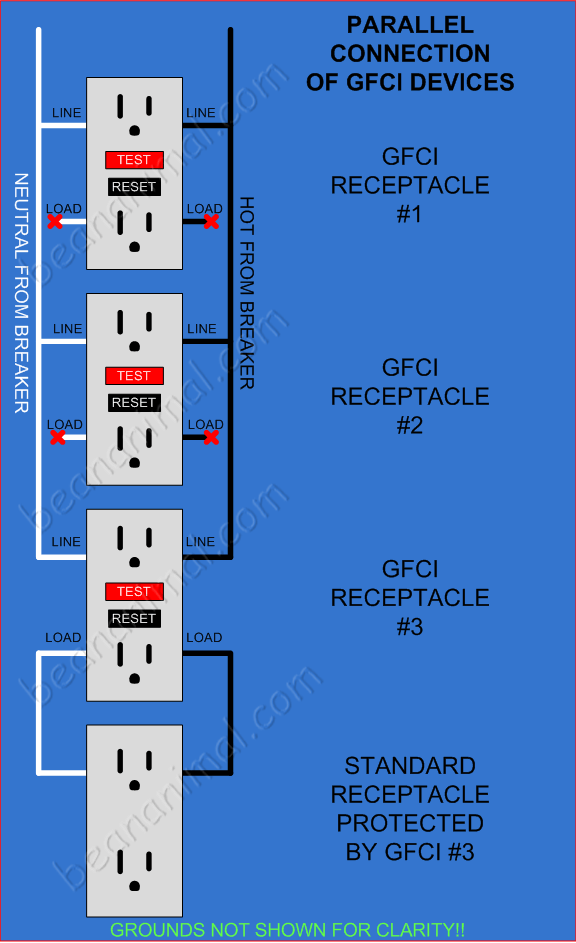
The second receptacle can be either in parallel to the GFCI or connected to the LOAD side of the GFCI. If it is on the LOAD side, it will trip when the GFCI trips. You can test this by pressing the test button and see of BOTH receptacles lose power. If they BOTH lose power, have your electrician replace the second receptacle with a GFCI receptacle and wire it in PARALLEL to the first, not to the LOAD side. If does not understand that, find another electrician.

We recently ran a new dedicated line to our new tank in the basement that DOES have a GFCI breaker. Should I add one to the one upstairs when we move it to be a second dedicated line for the basement tank?
NO... GFCI breakers are a bad idea for aquariums. If ANYTHING on the circuit faults, the entire circuit loses power. Have your electrician replace EACH receptacle in the new fish room with a GFCI. He will wire them all in parallel so that each works independelty.

Second question, can you safely "upgrade" your your breaker from a 15 amp to 20 amp?
Short answer, NO! It can be safely upgraded of ALL of the wire on the branch circuit is #12 AND all of the devices are UL listed for 20A service. The recepacles can be 15A as they are UL listed for 20A. This is certainly something that you should consult your electrician for.
 
Bean Animal, a ground is a ground is a ground. Dosent matter if it runs through a GFI or not, the probe will work effectivly either way. I have been an electrian for 20 years and your theories are way out of proportion. I also have a aquarium maint business on the side and NEVER use GFI on any of the tanks, including my own. A 'grounding probe' is commonly used in the aquariumj hobby to release 'stray voltage' from the tank and not to be used incase of a ground fault. These are two completly different functions. Grounding probe= good, GFI= bad....JMHO.

*Giving faulty electrical advice could be dangerous....if anyone has an electrical question please consult an electricain and not your local reefer....
 
BeanAnimal, assuming you had all your devices on GFIs, does the grounding probe provide a benefit? I understand the issue you raised of it's extreme danger when only some of your components are protected, but assuming all of them are, is it worth bothering with?
 
Bean Animal, a ground is a ground is a ground. Dosent matter if it runs through a GFI or not, the probe will work effectivly either way.
Respectfully sir, I never said anything to the contrary and that fact that you are infering that I have indicates that you have not read what I posted :)


A 'grounding probe' is commonly used in the aquariumj hobby to release 'stray voltage' from the tank and not to be used incase of a ground fault. These are two completly different functions. Grounding probe= good, GFI= bad....JMHO.
You are missing the important point sir. Using a ground probe on an aquarium system that is NOT protected by GFI creates dangerous situation that otherwise did not exist. The NEC requires pools and spas to have GFCI protection for this very reason. This is not up for debate and not "theory" it is basic electrical fact. I clearly pointed out two very relevant and easy to understand examples that illustrate the danger of a ground probe connected to a system that is running equipment that is not GFI protected.


*Giving faulty electrical advice could be dangerous....if anyone has an electrical question please consult an electricain and not your local reefer....
Sir, in the kindest manner, you are an electrician and you just offered dangerous advice by saying Grounding probe= good, GFI= bad..... You jsut told people that GFCIs are bad? I am stunned and honestly not sure what else to say.
 
BeanAnimal, assuming you had all your devices on GFIs, does the grounding probe provide a benefit? I understand the issue you raised of it's extreme danger when only some of your components are protected, but assuming all of them are, is it worth bothering with?

That is a double edged sword and looks different depending on what perspective you take.

From a safety perspective (GFCI and probe):
Yes the ground probe adds a layer of safety by giving fault current a path to ground. It will trip as soons as something faults instead of waiting for your BODY to be the fault path that trips the GFCI.

Lets look at a basic example. You have a submerged pump that is connected to a GFCI and it develops a crack in the HOT wire. There is no ground probe, so the current has no path to ground. The water is energized at 120V and does not trip the GFCI (becuase no current flows) until you stick your arm in the tank with another part of your body grounded. The GFCI protects you, but there was no early warning that there was a fault. If there WAS a ground probe in place, you would have walked up to a tank with a tripped GFCI and realized the pump was bad and not had to find out by sticking your arm in the tank and causing the trip.

From the perspective of the livestock:
If you have a ground probe, any voltage present in the water (as the result of a fault, or induced) will create current that flows through the water to the probe. I will leave it up to you to decide if this has an adverse effect on the livestock.

With a PROBE and GFCI this current is limited to about 5mA.

With a PROBE and NO GFCI, the current flowing through the tank is only limited by the branch circuit breaker (15A or 20A) or the fuse on the faulting device, several AMPS at least.

That brings us full circle. Protecting the entire system with a single GFCI is perfectly safe, but not in the best interest of your livestock. Critical life support systems should be driven from dedicated GFCI receptacles. Using a ground probe without full GFCI protection of the system creates a danger that would not otherwise exist.

I choose not to run a ground probe on my system. I do use GFCI protection, with multiple GFCIs per branch circuit. That said, I am sure that there are gound paths through thinks like impeller shafts on my pumps (that is another story for another discussion and likely the reason that some people have so many problems with pump bearings).

 
Pretty sure I am going to stay with my GFCI unit and keep an I on it at all times. Since I installed the one where my tank is I have made sure to check it all the time to see if has tripped with my laptop plugged into it. Hasn't tripped yet and it's been two months. Not to say that it won't happen and the laptop can't compare to what equipment will be on the tank. I also check all of the other GFCI's to make sure none of them have tripped (5 in total) and same thing, no trips. Could it just be a matter of where you live and the quality of electricity that flows throughout different homes? Cause I'm sure if you live out in the "dead zones" where even cable signals are hard to obtain that could possibly mean a lot of power outages.
 
Run both

Run both

run both but as an electrician I will say gfi since it will open the circuit fast but I have seen the gfi not trip and others trip more than what they need to. use both and save yourself and you animals in the tank.
 
Bean: Thanks for the advice. I was not trying to miss quote you, just don't understand much about electricity, that is why I hired a professional.

The one upstairs has both on the "load" side, so they both shut off when tripped. Each receptical in the basement will have its own GFCI. I need to check, but the breaker was already GFCI protected on the one run downstairs. That way the bathroom did not need a GFCI plug (or did it?). The bathroom was the only thing running on that individual breaker, maybe that is why he put the GFCI on the breaker vs. the plug. Would your theory run true about shuting down all plugs if each has its own GFCI plug?

As an FYI, I hired a profession to do the work, but he is only doing what I ask him to do. He has no experience with reef tanks therefore unable to recommend anything. I have decided to run two dedicated lines, each are currently on a 15A breaker. The line used, I believe, is 14/2. Can that handle a 20A breaker or do you think I am safe with two 15A? Our system, just to name a few major items: 3 400w MH's, Dart Hammerhead, 300w heater, LED's for supplemental, three MP40's, 1 250w MH, and other misc. stuff (not done yet). We will be using an ACIII Pro for controls (I have two DC8's).
 
I am not sure I understand the question.

A ground probe just creates a path to ground fom the tank water, there is nothing to "trip". The GFCI is a very simple device that compares the amount of current that is sent down the HOT wire to the amount of current that is returned on the NUETRAL wire. If there is a difference, it means that current is "leaking" from the circuit someplace. This could be to GROUND or to another circuit. In either casae, it trips. disconnecting anything attached to it.

The ground probe is not attached to a GFCI, your lights, pumps and other equipment are. :)

First off THANK YOU for the information BeanAnimal.

Instead of a question I will give you my scenario. I had at CT that was chewing my powerhead cords (didnt notice until I stuck my hand in the tank). So of course upon contact with the water I got shocked (as I now created a path for the electricity to flow through). At that time I did not have my equipment plugged into GFI outlets (very stupid). Anyways, after I got shocked I connected all my equipment into GFI receptacles. A week or two later I stuck my finger in the tank, which had a small cut on it and I could feel a stinging as if the tank had voltage (not sure that is the right word here). So, I decided to unplug each piece of equipment until I stopped feeling the voltage on my finger (turns out it was a heater producing the stray voltage). This heater was plugged into a GFI, however it did not set it off (maybe not enough voltatge to shut it off???). I then purchased a new heater.

After my incident I decided to eliminate any stray voltage by buying a GP and connecting it to the GFI receptacle.

Now lets say I still had the old heater that was leaking voltage with a GP plugged into a GFI. Since the electricity is now traveling from the tank via the the GP to the GFI would this trip the GFI?

Thanks
 
Bean: Thanks for the advice. I was not trying to miss quote you, just don't understand much about electricity, that is why I hired a professional.
Sorry if my response gave that impression. I was attempting to ensure that others did not read my words or your response and get the wrong idea. There are no dumb questions and you are doing just fine for somebody who is new to electrical discussions :)

The one upstairs has both on the "load" side, so they both shut off when tripped. Each receptical in the basement will have its own GFCI. I need to check, but the breaker was already GFCI protected on the one run downstairs. That way the bathroom did not need a GFCI plug (or did it?).
You can't run GFCI receptacles on a circuit protected by a GFCI circuit breaker, unless you want strange things to happen :)

The bathroom was the only thing running on that individual breaker, maybe that is why he put the GFCI on the breaker vs. the plug. Would your theory run true about shuting down all plugs if each has its own GFCI plug?
The idea having having multiple GFCI receptacles on a single branch circuit is to keep all of them running except the one that has the faulty device connected to it :)

As an FYI, I hired a profession to do the work, but he is only doing what I ask him to do. He has no experience with reef tanks therefore unable to recommend anything. I have decided to run two dedicated lines, each are currently on a 15A breaker. The line used, I believe, is 14/2. Can that handle a 20A breaker or do you think I am safe with two 15A?
14/2 is only suitable for a 15A breaker. You can put several GFCI receptacles on each 15A breaker so that your important equipment is not all on one GFCI. Just ask the electrician to use multiple GFCI receptacles in parallel instead of a single GFCI receptacle with standard receptacles hanging off of its load lugs.

Our system, just to name a few major items: 3 400w MH's, Dart Hammerhead, 300w heater, LED's for supplemental, three MP40's, 1 250w MH, and other misc. stuff (not done yet). We will be using an ACIII Pro for controls (I have two DC8's).
So 1500W worth of MH 500W of pumps, 300W heat... say 3000W max load. A 15A breaker is capable of being loaded to about 1440W, so that gives you about 2800W worth of usable power. I would step up to a 3rd 15A branch circuit if it is not too late already :)
 
Maybe this will help you see how multiple GFCIs can be wired to the same branch circuit...

parallel%20gci%20illustration.gif
 
You can't run GFCI receptacles on a circuit protected by a GFCI circuit breaker, unless you want strange things to happen :)

And just to clarify... there is no danger in doing so. The problem is that when a fault occurs, one or both may trip. This can be very confusing for some people.
 
If you are going to go to all the well spent expense and effort of so many gfis on individual legs of the same circuit, you might as well just switch them all. Its hardly any more work or expense and you really dont want it any other way

On each of my control centers I run 2- 20 amp circuits to 12 individually switched gfi outlets(6 per). I control lighting seperately, that is just for everything else but the lights.
 
Back
Top