
H. malu or dyed common sebae?

jayelblock

New member
I bought this anemone believing it was H. malu, but now I'm not so sure. I do see white bands on the tentacles when they are less inflated. Also, a few tentacles are pink, so perhaps it is not dyed.

Opinions from the experts, please. It was purchased from a reputable LFS who will take it back if I wish.
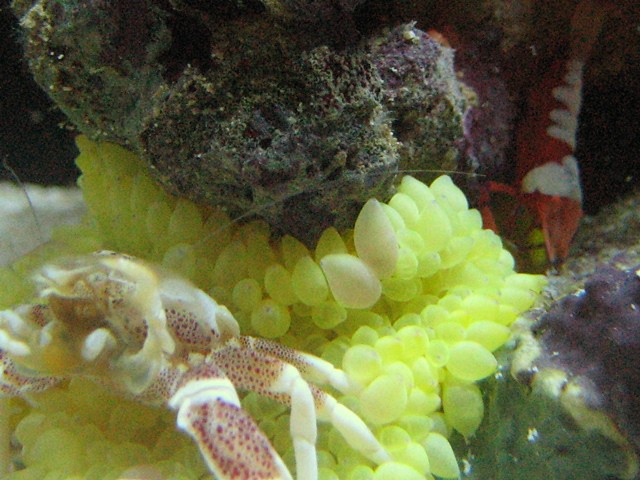
5610056386_710ae958a8_z.jpg
 
It is bleached. It is dyed.

As far as whether it is H. malu or H. crispa, it is almost impossible to tell from above - particularly when the anemone is stressed and the tentacles are short. Any way you could get a photo of the column? The column of H. crispa looks very different from that of H. malu.
 
It has tucked itself under a rock and into the sand. I don't wish to stress it more by digging it out. What column characteristics differentiate H. crispa from H. malu?
 
This thread shows an anemone identified as H. malu, undyed, which also has a few pink tentacles. That's why I'm not sure...

http://www.reefcentral.com/forums/showthread.php?t=1881773&highlight=yellow+malu

I'm not 100% convinced that is a H. malu and not a H. aurora. I am almost positive it is dyed, however. People need to look at the column for a definitive ID. In captivity, and particularly when stressed, anemones can look very different from when they are seen in the wild. However, "lumpy" tentacles generally means H. aurora - H. malu looks similar but does not have the swellings on the tentacles. People get confused because H. malu can sometimes have striping on the tentacles - but never lumps.
 
Last edited:
It has tucked itself under a rock and into the sand. I don't wish to stress it more by digging it out. What column characteristics differentiate H. crispa from H. malu?

H. crispa has a column that looks wrinkled - particularly up beneath the oral disk. Some people describe it as looking "leathery". It is also relatively thick-feeling to the touch.

H. malu has a thinner column that is smooth (though it has prominent verrucae). The column of H. malu is also very soft.

If I had to GUESS - I would say that looks like a dyed H. malu. But I have been wrong before when guessing based only on tentacles. This weekend I was at a LFS where I saw a carpet that I would have said 99.9% was a haddoni based on the tentacles. However once I saw the column it was unmistakenly a gigantea. Once settled in a new healthy tank, it would probably go back to looking like a gigantea as well...
 
Probably H. crispa then, although it I only saw the column during acclimation, and the anemone was rather contracted. I'll keep an eye on it once it settles in and see if the column remains wrinkled.
 
For what it's worth - signs of dying include universal coloration, particularly the fluorescent yellow/green that this anemone is exhibiting (probably caused by the use of fluorescent green marking dye which is biodegradable and widely available). I have never seen an anemone in the wild (either personally, or in a photo) with this coloration.

Natural fluorescent pigmentation in anemones is typically only found on surfaces that are exposed to bright sunlight - and it fades in the absence of bright light relatively quickly. Understand that fluorescent pigmentation BLOCKS light - so generally an anemone would only generate it if it was being bathed in intense light with a relatively high intensity of UVR.

I would bet that in a year this anemone (assuming it recovers from being bleached) is a healthy brownish color without any yellow/green left.
 
Probably H. crispa then, although it I only saw the column during acclimation, and the anemone was rather contracted. I'll keep an eye on it once it settles in and see if the column remains wrinkled.

The reasons why I think it might be a malu (based only on the tentacles) is that the tentacles look a little bulb-shaped. H. malu has short tentacles that are thin at the base, get thicker, and then taper to a point. Additionally, H. malu will have a lot of variability in tentacle size and length - even within the same row. H. crispa is much more uniform, and its tentacles are more consistently tapered and do not exhibit bulbs.

Just sharing my thoughts - we won't really know until we can see the column. Over time however the anemone should settle in and start to look more "natural".
 
Because there is so much incorrect information out there, here are a couple of decent images of H. malu to reference.

malu_1.jpg


malu_2.jpg


Notice the short tentacles (versus crispa's much longer ones) and the unique shape that they have. The second anemone is displaying fluorescent green pigmentation on the oral disk - note that it does not cover the entire anemone.

(First anemone may be dyed... note the uniform color, and the fact that the interior of the actinopharynx (the "throat" of the anemone) is also a purple color (should be off-white or pale))
 
Last edited:
Here's a malu exhibiting striped tentacles. Note - stripes YES, lumps NO.

fishtank116md2.jpg


Same anemone, after it had settled into the owner's aquarium. Note the lack of lumps on the tentacles.

aprilmay2008058fq0.jpg
 
Thanks for all the excellent information and pictures. I will keep an eye on it and baby it along until it recovers. As soon as I can get a picture of the column, I will post it in this thread. I'm hoping the anemone will begin to stretch toward the light more aggressively and then I can get a good shot.
 
These have been talked about before, it is a H. Aurora (or at least that is what it has been I.D. as in the past).

It is NOT a H. aurora. Here's a photo of a H. aurora. H. aurora is called a "beaded anemone" for a reason. Hard to mistake those tentacles for anything else.

Just because a web site is in German, doesn't mean it's correct :) LOL - ich bin Deutscher :)

aurora1.jpg
 
Last edited:
It is NOT a H. aurora. Did you read anything I posted? Do you even know what an H. aurora looks like?

Wow did someone take your favorite toy?

I have probably seen 30-40 of these over the past year and some of them show beading some do not. I qualified my statement to say that is what others have identified them as. That being said I feel confident that the anemones shown in the links I posted are the same as the one pictured by the OP.
 
Back
Top