H. malu or dyed common sebae?

Wow did someone take your favorite toy?

No, I just write a long detailed description of the difference between a couple of species, and someone else comes along and says - nope you're wrong and here's a blurry fuzzy photo of a bleached and stressed anemone to show why :)

I may have SOUNDED upset but I was being honest. Did you read what I wrote? Do you have the slightest idea of what you are talking about? Or do you just make this stuff up?

If you Google Heteractis malu probably 75% or more of the images are incorrect. If your only reference is what you see on a some random site, how do you know it is correct? At least I can say with honesty that I am posting information from scientific books - and have seen all of these species in the wild when they appear "normal" - and I try to say I am uncertain when anemones are stressed and have been dyed.

And no I am not mad :) I'm just being frank.
 
Last edited:
For fun, here's a couple of anemones from the same location:

First, H. aurora

aurora2.jpg


Second, H. malu

malu3.jpg


For bonus points, name the clownfish. It's relatively uncommon.
 
Here's a hint. First, another photo of the same fish in the malu:

malu4.jpg


Then an older version of the same species in a mertensii:

mertensii_1.jpg
 
Melanistic tricinctus :)

Funny thing is that folks from meerwasser lexikon asked for our FAQ and translated it into German. It is posted somewhere on the site. I would've thought that meerwasswer wiki folks had a look at it... Or it could be just two unrelated sites :)
 
Marina wins the prize! Had I known she was coming I would have tried something harder LOL!

Here's two special ones just for her :)

tricinctus1.jpg


tricinctus2.jpg
 
You know what? Sometimes I feel like the guy in that photo when I've been bad :) You were running some seriously bright lights in that tank!
 
Last edited:
I agree looking at tents as in first pic is not best ID, but FWIW I have seen a number of bright yellow Malu's.
There is another nem keeper on here that has had one fairly long term as well, and still maintained pretty bright yellow.
As for the purple like the pic you posted, that is what I have, and very solid color throughout.
My comment was just going off OP assuming it was a sebae, just not sure which kind of sebae.
When we see the typical Crispa bright yellow, yes, those are dyed, but yellow is a natural color for a Malu.
 
This has been an interesting discussion, and I appreciate everyone's input. In some ways I feel like a sucker, having most likely purchased a dyed anemone, but I will say that the color of my picture is a bit off, and the LFS owner was duped as well. It isn't quite such a toxic yellow in real life, and the pink tentacles have no yellow in them whatsoever. The 'nem is sleeping now, but I will try to get a better picture tomorrow.

As davocean noted, I was primarily looking for an ID first, which I'm now fairly convinced is H. malu. As for whether it's dyed, I'm not sophisticated enough to know, but time will certainly tell...
 
Well let me tell ya, I was actively seeking out a Malu for quite some time, and I kept missing out on some nice ones just because I wasn't quick enough, but my eyeballs were burnin' from staring at Malu pics all the time.
I saw pink, purple, pink purp combo, blue, orange and green combo(Though I did suspect that as a aurora) and on here some peeps posted pics, and I'm pretty sure it was Orion(who's been on here a while and knows nems fairly well) who had a pinkish purple and a bright yellow one, and that was the long term yellow I was recalling.
I understand some may be dyed or enhance in some way, but I have seen some of these bright colors that were long term, so not dyed.
I can't say for sure yours is totally natural, but I do know yellow is a natural color for Malu.
 
Time will tell. Certainly some anemones have been dyed, and there are some brightly colored ones that look dyed, but are not. I HOPE it stays that cool color - nothing upsets me more than dyed animals. I think even brown anemones are awesome.

We had a long discussion on one of these threads about yellow giganteas - and whether there was any such thing in nature. It was clear the giganteas in question were not dyed - since only the ends of the tentacles were yellow. However the only yellow giganteas that could be found were bleached - there were no photos of any yellow giganteas in nature. There was some question about what they would look like when they regained their zooxanthellae. According to one person in the discussion who said he had kept a yellow gigantea from bleached to healthy status - the yellow morph was a natural color, but when the anemone was not bleached it made the anemone look a light greenish color - not a bright yellow.

The only answer - keep a nice photographic record and enlighten us all!
 
Something to keep in mind...

Everything you needed to know about H. crispa...

Healthy
Heteractis%20crispa%20(cream).jpg


Bleached
Heteractis%20crispa%20(white).jpg


Bleached and dyed
Heteractis%20crispa%20(yellow).jpg


Does the color look at all similar?
Heteractis%20crispa%20(redfoot).jpg


Now maybe I am completely wrong... but I would think if there were tons of brilliant yellow malus available in the ocean that SOMEONE would have snapped a photo. But I freely admit I could be wrong...
 
The crispa's no doubt yellow is dyed.
I don't think there are a "ton" of yellow Malu's, I recall the other person was looking for a replacement for his that he lost after time, and was having a hard time finding one, and this came up after someone else posted a yellow one on here.
I know even though mine isn't rare by any means, it still took a while for me to find one the color I wanted, as Malu's just aren't as popular for some reason(which I don't get, they are my favorite for a mixed reef, and seem to keep bright color)
Crispa's and LTA's I've seen way too many dyed ones lately, especially LTA's, seems way too common lately, keep seeing the "phantom" or "ultra" label on those, and most I've seen just die.
Agree, keep posting pics, show what it does.
 
I just saw this pic I saved when I was searching, pretty sure these were Orion's Malu's.

Look like malus to me... Don't you think the color looks more natural? They are purple and bright green - but the color is not universal like they were dipped in a bucket of paint.
 
I might as well chime in. I have had this Malu for a few weeks nowhe was in the sand , not happy for a week or two, then he went to the rocks and LOVED it for 2 weeks then bailed back to the sand , its a tough battle with this guy but he eats well and looks great. If you look at the last piture closely you can see it very happy in the top of the rocks were it was for two weeks before it released back down into the sand.

100_4318.jpg

100_4268-1.jpg

100_4185-1.jpg

100_4334.jpg
 
Here are a few new pictures under a combination of 14K halide and 12k LED. They are accurate for color:

5612682139_d920618047_z.jpg


5612682141_af488d5d36_z.jpg


5612682131_4b33ae0ea2_z.jpg


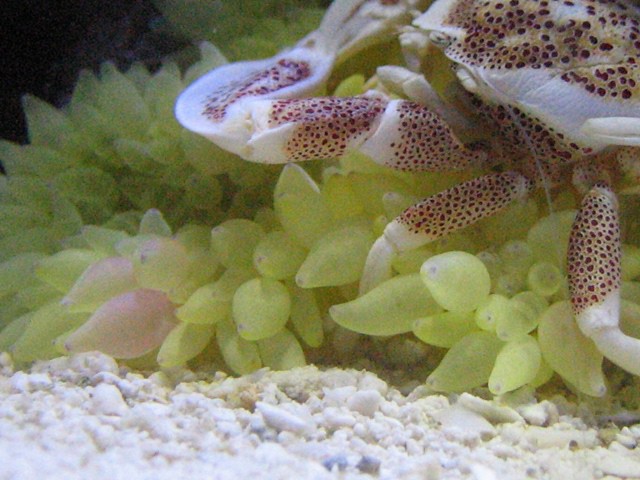
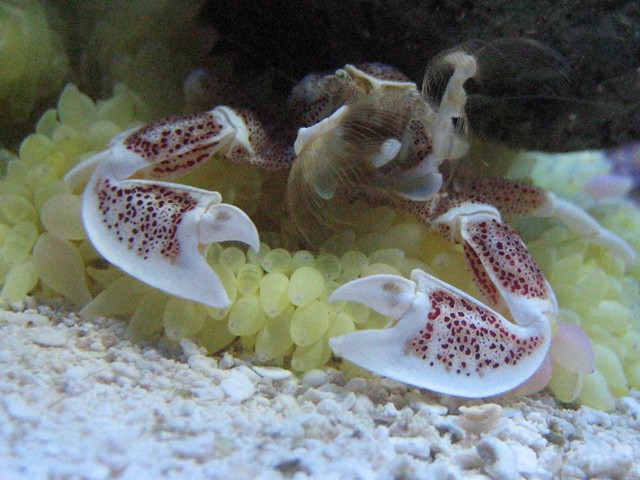
Unfortunately, the anemone seems to be in poor health. It's tentacles are not sticky, and my efforts to feed it aren't going well. I've tried shaved scallop, PE mysis and oyster eggs to no avail (however, the porcelain crab is getting fat). Advice would be appreciated.
 
Last edited:
Is it my imagination, or has the yellow faded significantly?

When feeding a bleached anemone try really fine foods. The crab may be an issue just because he will eat the food before the anemone has the chance to consume it. You might want to remove him for a week or two (put him in a breeder cage or similar).

If the anemone is not taking even fine minced food, you may consider force-feeding it. There have been some threads here on the topic. Basically you want to use a syringe (perhaps with a long nozzle or tube on the end) to inject a SMALL amount of diced/liquid food into the oral cavity of the anemone. I have had success with frozen reef food diced fine soaked in Selcon. Be really careful when inserting the tube that you do not injure the anemone. The most you want to try feeding via this method is about a pencil-eraser size quantity of food.

See how the anemone does after being fed. If it rejects the food immediately it is not a good sign. Hopefully it will eat. Small feedings frequently (once a day) are better than trying to get it to eat large chunks of stuff.
 
Last edited:
Back
Top