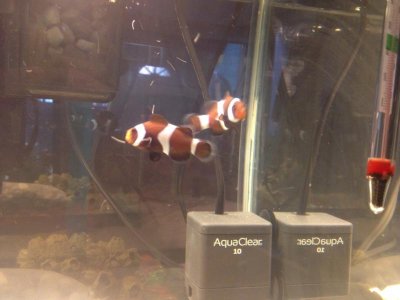
You should have QT'ed them. Always QT everything!
If those fish have Velvet, by the time you know, it will be too late.
You should be watching them for signs of infection in a QT, not in your display.
If they end up having ICH, you'll have to go 72 days fallow to get it out of your DT.
If they don't, you'll be lucky and know what to do from here on out.
TTM on all fish reguardless if you see symptoms or not.
Flukes are easy to miss, and Brook can show up 3 weeks later.
Good luck!
I missed that. Smart man.
Here's what to look for. This is from Snorvich. One of the best disease experts IMO.
Diagnosis of Problems
Tiny white dots on body or fins (looks like salt)
Research:
a) Marine Ich (parasite)
Gold, brown or rust colored patches on body
Research:
a) Marine Velvet (parasite)
Tiny black dots on body or fins
Research:
a) Black Ich (parasite)
Raised white bumps on body or fins which looks lumpy
Research:
a) Lymphocystis (viral)
b) Fungal Infection in marine fish
Excessive mucus on body or gills
Research:
a) Brooklynella (parasite)
b) Marine Flukes (parasite)
c) Uronema (parasite)
Ragged, torn, or missing fins
Research:
a) Fin Rot and Tail Rot (bacterial)
b) Marine Ich (parasite)
c) Ammonia Poisoning in marine fish
d) Uronema (parasite)
e) Brooklynella (parasite)
f) Marine Flukes (parasite)
Cloudy eye(s)
Research:
a) Marine Velvet (parasite)
b) Fin Rot and Tail Rot (bacterial)
c) Marine Ich (parasite)
d) Marine Flukes (parasite)
e) Bacterial Infection in marine fish
f) Brooklynella (parasite)
Holes or pits on face, head, or lateral line
Research:
a) Head and Lateral Line Errosion "HLLE"
Fuzzy white or brown patches on body or fins
Research:
a) Fungal Infection in marine fish
b) Columnaris (bacterial)
Open sores or lesions on body
Research:
a) Marine Flukes (parasite)
b) Brooklynella (parasite)
c) Bacterial Infection in marine fish
d) Uronema
Raised or missing scales
Research:
a) Dropsy (bacterial)
b) Bacterial Infection in marine fish
c) Uronema
Stringy thread-like attachments on anus
Research:
a) Thread worms (parasite)
Stringy thread-like attachments on body
Research:
a) Anchor worms (parasite)
Fish is scratching on rocks or substrate
Research:
a) Marine Ich (parasite)
b) Marine Velvet (parasite)
c) Marine Flukes (parasite)
d) Anchor worms (parasite)
Fish is rapidly breathing or gasping
Research:
a) Marine Velvet (parasite)
b) Brooklynella (parasite)
c) Marine Flukes (parasite)
d) Bacterial Infection in marine fish
e) Ammonia Poisoning in marine fish
f) Marine Ich (parasite)
g) Uronema (parasite)
Fish is lethargic and/or hiding
Research:
a) Marine Velvet (parasite)
b) Head and Lateral Line Errosion "HLLE"
c) Dropsy (bacterial)
d) Bacterial Infection in marine fish
Fish is swimming erratically
Research:
a) Marine Ich (parasite)
b) Marine flukes (parasite)
Fish is twitching
Research:
a) Marine flukes (parasite)
White stringy "poop"
Rsearch:
a) internal parasites (parasite)