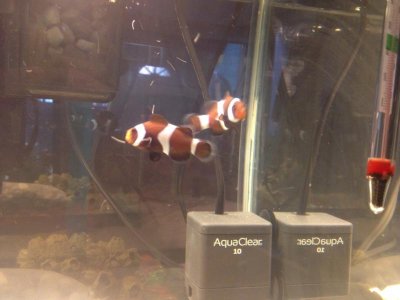
Happy Black Ocellaris in QT - Now what?

W1ngz

New member
Kind of excited, and really want to make sure these guys get the best chance I can give them. On the weekend I got my first ever marine fish - a pair of juvenile captive-bred black ocellaris. They look to be settling down well, swimming together constantly, at all levels of the tank. No darting around, no hiding. They don't even swim away when I walk up to the tank. They're eating well (but really only chase after mysis for the moment). They don't seem to like the pellets I got, even if I soak them for a half hour to soften them up. I might try flakes instead.

No spots, marks, or missing chunks of fin. But it's only been 3 days.

Any suggestions on behaviors or anything else to watch for to make sure everything is ok for the next few weeks?
 

Attachments

  • IMG_3971.jpg
    IMG_3971.jpg
    41.4 KB · Views: 16
You should have QT'ed them. Always QT everything!

If those fish have Velvet, by the time you know, it will be too late.

You should be watching them for signs of infection in a QT, not in your display.

If they end up having ICH, you'll have to go 72 days fallow to get it out of your DT.

If they don't, you'll be lucky and know what to do from here on out.

TTM on all fish reguardless if you see symptoms or not.

Flukes are easy to miss, and Brook can show up 3 weeks later.

Good luck!
 
Nice clowns and great start by QT'ing. Are you planning to treat with any medications or just plan on observing?
As you mentioned, watch for spots, marks, fin rot, labored breathing,...
Now is a good time to figure out what they like to eat and fatten them up.
Is that rocks I see in the QT? If so, that's a bad idea for a QT.
 
The bottom has a scrap resin decoration and some Seachem Matrix in a media bag, which was stored in my sump. It goes in the trash after the fish come out and I reset the QT for the next species.
 
You should have QT'ed them. Always QT everything!

If those fish have Velvet, by the time you know, it will be too late.

You should be watching them for signs of infection in a QT, not in your display.

If they end up having ICH, you'll have to go 72 days fallow to get it out of your DT.

If they don't, you'll be lucky and know what to do from here on out.

TTM on all fish reguardless if you see symptoms or not.

Flukes are easy to miss, and Brook can show up 3 weeks later.

Good luck!


I missed that. Smart man.

Here's what to look for. This is from Snorvich. One of the best disease experts IMO.

Diagnosis of Problems

Tiny white dots on body or fins (looks like salt)
Research:
a) Marine Ich (parasite)


Gold, brown or rust colored patches on body
Research:
a) Marine Velvet (parasite)


Tiny black dots on body or fins
Research:
a) Black Ich (parasite)


Raised white bumps on body or fins which looks lumpy
Research:
a) Lymphocystis (viral)
b) Fungal Infection in marine fish


Excessive mucus on body or gills
Research:
a) Brooklynella (parasite)
b) Marine Flukes (parasite)
c) Uronema (parasite)


Ragged, torn, or missing fins
Research:
a) Fin Rot and Tail Rot (bacterial)
b) Marine Ich (parasite)
c) Ammonia Poisoning in marine fish
d) Uronema (parasite)
e) Brooklynella (parasite)
f) Marine Flukes (parasite)

Cloudy eye(s)
Research:
a) Marine Velvet (parasite)
b) Fin Rot and Tail Rot (bacterial)
c) Marine Ich (parasite)
d) Marine Flukes (parasite)
e) Bacterial Infection in marine fish
f) Brooklynella (parasite)


Holes or pits on face, head, or lateral line
Research:
a) Head and Lateral Line Errosion "HLLE"


Fuzzy white or brown patches on body or fins
Research:
a) Fungal Infection in marine fish
b) Columnaris (bacterial)


Open sores or lesions on body
Research:
a) Marine Flukes (parasite)
b) Brooklynella (parasite)
c) Bacterial Infection in marine fish
d) Uronema


Raised or missing scales
Research:
a) Dropsy (bacterial)
b) Bacterial Infection in marine fish
c) Uronema


Stringy thread-like attachments on anus
Research:
a) Thread worms (parasite)


Stringy thread-like attachments on body
Research:
a) Anchor worms (parasite)


Fish is scratching on rocks or substrate
Research:
a) Marine Ich (parasite)
b) Marine Velvet (parasite)
c) Marine Flukes (parasite)
d) Anchor worms (parasite)


Fish is rapidly breathing or gasping
Research:
a) Marine Velvet (parasite)
b) Brooklynella (parasite)
c) Marine Flukes (parasite)
d) Bacterial Infection in marine fish
e) Ammonia Poisoning in marine fish
f) Marine Ich (parasite)
g) Uronema (parasite)


Fish is lethargic and/or hiding
Research:
a) Marine Velvet (parasite)
b) Head and Lateral Line Errosion "HLLE"
c) Dropsy (bacterial)
d) Bacterial Infection in marine fish


Fish is swimming erratically
Research:
a) Marine Ich (parasite)
b) Marine flukes (parasite)

Fish is twitching
Research:
a) Marine flukes (parasite)

White stringy "poop"
Rsearch:
a) internal parasites (parasite)

 
The bottom has a scrap resin decoration and some Seachem Matrix in a media bag, which was stored in my sump. It goes in the trash after the fish come out and I reset the QT for the next species.

Just go bare bottom with ur QT.

If it's been 3 days do a tank transfer now. As long as your at the 72 hour mark.

Say fish went in on 1st.
Transfer on day 4
Day 7
Day 10
Day 13
-DONE-

Make sure you sterilize all equipment and tank with mild bleach solution inbetween transfers.

After or during the TTM, hit them with Parzipro 2x.

Observe for 4-6 weeks. During this time your looking for the big 3. Velvet, Brook, and flukes. Just watch for anything abnormal.

The Parzipro should have killed flukes and TTM the ICH- if the fish were infected.

So usually only Brook or Velvet is a concern now.

If you missed anything, the fish will typically break out "in a non-medicated tank" in about 4 weeks. This is why 4-6 weeks observation is recommended.

Copper at theraputic level will kill Velvet.

Formalin Ms and fresh water dips will take care of Brook.

Anything I missed?
 
Last edited:
Thanks for the suggestion.

While I can see the benefits of tank transfers, it's not something I will be doing unless I observe some sort of parasite or infection. It's simply impractical to spend that amount of time tearing down and redoing the tank every three days for the next 6 months as I stock my display.
 
Thanks for the suggestion.

While I can see the benefits of tank transfers, it's not something I will be doing unless I observe some sort of parasite or infection. It's simply impractical to spend that amount of time tearing down and redoing the tank every three days for the next 6 months as I stock my display.

He's bond to have an infested DT.
 
Thanks for the suggestion.

While I can see the benefits of tank transfers, it's not something I will be doing unless I observe some sort of parasite or infection. It's simply impractical to spend that amount of time tearing down and redoing the tank every three days for the next 6 months as I stock my display.

Snorvich is pretty much a disease expert on the disease forum. This is his suggested protocol.


My suggested protocol is to use tank transfer for all new specimens to insure against cryptocaryon irritans. 12 days and two 20 gallon tanks is all it takes.

The initial receiving tank is temp and SG adjusted to the bag water( SG a few points couple of points lower than the bagwater is ok but not higher) This obviates the need for drip acclimation and prolonged stays in bag water where pH can rise and ammonia toxicity can increase once the bag is opened. This is particularly important after prolonged stays in the bag.

During the 12 day tank transfer process ( 3 day stays 4 transfers, move fish on the morning of days 4,7,10,13) observe for other maladies. Since there are no meds to interact with in the transfer tanks which contain freshly mixed salt water aged and aerated overnight , use an ammonia detoxifier during each 3 day period. Bound copper products for example can't be safely used with ammonia detoxifiers as more toxic free copper occurs with lethal copper toxicity,even though total copper measures the same.

If there is reason to suspect infestation with brooklynellosis, velvet or flukes , do a formalin bath before starting treatment with copper for velvet, formalin for brooklynellosis or prazi pro for flukes.

Since not all maladies will present symptoms in the 12 days( flukes can easily be missed, velvet can take up to 30 days to present), use a larger cycled QT tank for an additional 2 to 4 weeks of observation depending on the condition of the fish with treatment as necessary.

Most fish receive no medications yet all are effectively prophylactically treated for ich,the most common killer

Ammonia is monitored and has never been an issue during the 3 day stay but a detoxifier is added just in case, The cycled tank takes care of itself.

BTW there is no need to worry about nitrite or nitrate.
 
He's bond to have an infested DT.

Thank you for your input. However, many, many people have very successful healthy tanks, without rearranging their lifestyle around the absolute strictest quarantine practices. An hour or two every three days is simply not possible.

If you have further input, please try and present it in a less condescending and elitist manner.
 
Thank you for your input. However, many, many people have very successful healthy tanks, without rearranging their lifestyle around the absolute strictest quarantine practices. An hour or two every three days is simply not possible.

If you have further input, please try and present it in a less condescending and elitist manner.

No, that's incorrect. Most people who don't QT & Treat get a disease infested tank.
 
TT method is not that time consuming. I did my first pair of clowns with 20gal Tank transfer. Draining and filling was a pain. Later I just used a bucket, heater and air stone. 4th day put in new bucket, dump old bucket. After 12 days, put them into your nicely set up 20g for observation.

it is an almost guaranteed way of protection against ich.

I agree lot of other reefers have had success without TT QT, but it's just risks. some older experienced reefers here don't QT. but they have a lot more knowledge than I do.

beautiful clowns! I was struggling between Black or Snowflakes.
 
TT is really easy.

Drain tank: 2 minutes
Fill another tank: 2 minutes
Put heater & powerhead in tank: 1 min

TT= 5 min x 4 transfers. ICH free.

Sterilize other equipment: 1 Hr...and can be done at anytime during the 3 days.
 
beautiful clowns! I was struggling between Black or Snowflakes.

Clowns seem really well suited to a beginner, but are an incredibly average species for a saltwater tank, so I wanted something a little different. I looked at snowflakes too, but sticker shock scared me away VERY quickly considering that I'm transitioning from freshwater where most fish cost only a few dollars.
 
while tt would be ideal, i completely understand the time constraints. i have done tt several times and while it's an easy process, it does take some time.

if you don't plan to do tt or treat these guys with anything as a preventative, just extend your qt to a couple of months.

they're very pretty fish, good luck with them!
 
Clowns seem really well suited to a beginner, but are an incredibly average species for a saltwater tank, so I wanted something a little different. I looked at snowflakes too, but sticker shock scared me away VERY quickly considering that I'm transitioning from freshwater where most fish cost only a few dollars.

worst part is you can't keep more than 1 pair usually.. I want a pair of maroon and a pair of black. my maroon tank is being set up right now :)

designer clowns are quite expensive.. good thing we can find them fairly cheap in LA. I got a pair of snowflakes for $40
 
Back
Top