Help! understanding 'spectral irradiance' and choosing a 1000w bulb/ballast combo

You can use the LumenBrite, but I don't think I would, unless you use enough to cover the area. Look closer at the charts showing the spread, you will not get a good spread at 36" but you will get a nice hotspot of light directly under the bulb. If that is the goal then that would be the reflector, but if expect a larger area of adequate par then it won't be a good choice.
 
diffuse reflection

diffuse reflection

Well, looks like its back to the drawing board. haha.

Now I'm wondering which of these designs would work best for my application? My gut tells me the final one wins, because of the success of the Adjust-a-wing design. But then again, as you mentioned, it depends on the application. In my case, with the 1000 watters, intensity wouldn't be an issue regardless (except for hot spots). All I'm really concerned with is equal, efficient light distribution across each ~4x3x3 area.

I wonder if there is an equation to determine the sizes and angles needed to dial it in perfectly.. If only I were better at math. :jester:

^^Actually I may have found it (lambert's cosine law). But have no idea how to use it and what to make of it..


P.S. What about working a spreader into the design? (See photo).
 

Attachments

  • orca reflector ideas.jpg
    orca reflector ideas.jpg
    33.4 KB · Views: 20
  • spreader.jpg
    spreader.jpg
    12.6 KB · Views: 25
Last edited:
You are trying to reinvent the wheel, but it has already been perfected. Google sanjay joshi reflectors and you may learn a lot. Is OrcaFilm able to withstand the intense heat from a MH?

IMO you would be better off getting 3 of these...
http://www.hamiltontechnology.com/item/Cabo-Sun-Systems---Large-Mogul-Base-Reflector--2123
...and add some supplements like either VHO or T5 and using 400 watt bulbs with enough PAR to penetrate. The reality is a high par 250 may be better suited than a low par 400, wattage does not equal par.
 
Jedi could point you in the right direction with a Bridgelux and Luxeon M that would easily put a 1000w to shame with optics
LOL, yeah, it doesn't take all that much in comparison. I managed to squeeze out 1900 PAR at 24" with ~70w of LEDs :)

The shape you are considering would be better than a flat one, but there is a lot more to it. A properly designed reflector suits the purpose intended. Some are designed like spotlights, sending the majority of the light in a tight bean downward so that the bulk of the light is concentrated in the center. Others are more of a floodlight, which will spread the light more evenly over a larger area. Considering the dimensions I would be looking at reflectors that will adequately cover a 36x36 area and a bulb/ballast combination that will have enough punch to penetrate the 36" height.

This will help a little in understanding shape and design. Two reflectors may have a similar shape but function opposite of each other.
http://www.advancedaquarist.com/2009/1/review

I am using a LumenMax large with a single 250 watt Radium and M80 ballast to cover a 40x40x17" area. It is effective enough that I have the bulb about 14-16" above the water and have more than enough light to keep SPS happy on the sand.

Wow, those are some badass reflectors. Thanks for the link. So in other words, I should buy Lumenbright 24" reflectors? :)


"The Lumenbrite ... more suitable for tanks 3ft or less in width. They tend to provide a more focused coverage and higher peak values than the Lumenmax and Lumenarc reflectors. This can allow for better use in taller tanks, as more light can reach the bottom, or allow for higher placement of the lights thus reducing the heat dissipating in the water, or allow for higher light values to be obtained lower in the tank. This would allow the user to create a reef with a much lower rock profile."

THANKS FOR YOUR HELP EVERYONE! :bounce1:

Well, looks like its back to the drawing board. haha.

Now I'm wondering which of these designs would work best for my application? My gut tells me the final one wins, because of the success of the Adjust-a-wing design. But then again, as you mentioned, it depends on the application. In my case, with the 1000 watters, intensity wouldn't be an issue regardless (except for hot spots). All I'm really concerned with is equal, efficient light distribution across each ~4x3x3 area.

I wonder if there is an equation to determine the sizes and angles needed to dial it in perfectly.. If only I were better at math. :jester:

^^Actually I may have found it (lambert's cosine law). But have no idea how to use it and what to make of it..


P.S. What about working a spreader into the design? (See photo).
Melev uses the 20"x20" Lumenbright 'Large' (the models that support glass covers), three of them, on his 72x30x30 tank. You can see the PAR he gets from his bulbs here: http://www.melevsreef.com/par_readings.html

I still believe that, no matter which bulbs or reflectors that you choose, that you will have full coverage without using at least a pair of fluorescent bulbs on either side. Even with bulb replacements and electricity on the fluorescents added to the pair of 400w bulbs (360w if you use the Radium), you're still at less power and bulb replacement costs yearly than using only two 1000w bulbs (2x 1000w Radiums are $4-500, 2x 400w Radium and four ATI 60" bulbs are ~$250, and power consumption is half that of the pair of 1000w'ers), and more than likely you will have much better results, which is what you're after :)
 
Melev's tank is a perfect example of why the LB isn't the optimal choice, but it is buried in the pics. It doesn't highlight the spread, or lack of it, the way Sanjay's testing does. Using a par meter directly under the bulbs is misleading, it doesn't show the whole picture.
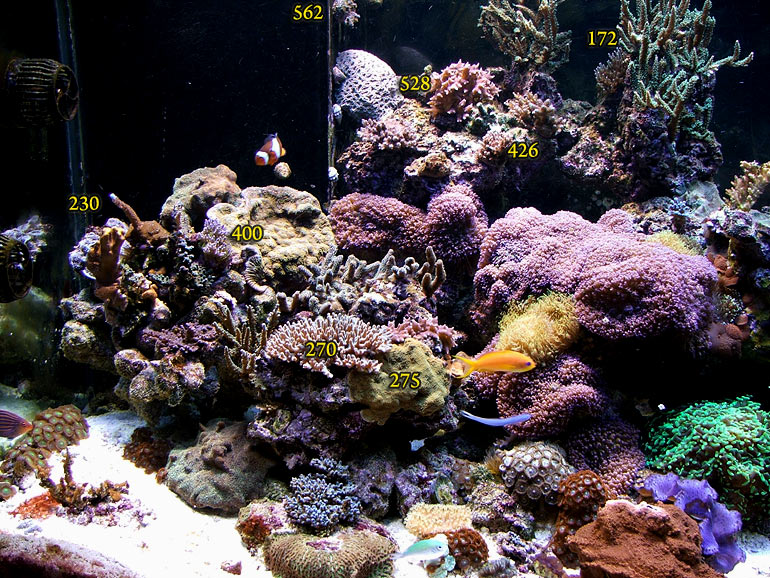
Here is the example from his own testing...
par_left.jpg


Because it is a spotlight you get a par of 528, 426 and a couple of inches away 172. Trying to cover 36" with the LB will be futile and against the design of the reflector. Using a reflector designed to spread the light out gives coverage over a larger area. You can put any reflector over any tank but for optimal coverage use a reflector designed for the tank. :beer:
 
You are trying to reinvent the wheel, but it has already been perfected. Google sanjay joshi reflectors and you may learn a lot.

That was the great thing about the sanjay tests, it put numbers and context to each tested reflector, no more of the he said, she said.

If you want to go it alone and redesign what already has been done, a good starting point would be to read all sanjay joshi's articles.

MH lighting is old school, still the choice of many, LEDs are the future.
with LEds you can do more with less.

I really think you are going about this backwards, A good starting point would be to decide what par you need/want at the bottom of your tank and go up from there.

If your only choice is 1000w MH then you should look in a hydroponics forum.
 
But even with a 36" tall tank, 1000w is overkill to the point where it will be damaging. Yes, efficiency on metal halides are around 20-30% and goes down as you get into higher-wattage bulbs, but the radiant/luminous output is still high.
 
Why are you stuck on 1000w mh?

I have a 36x36x72 tank and 3 250w mh giesman fixture with 36 day leds on each side can keep demanding sps happy on the sand and burn sps near the surface.

I think you are under estimating the heat two 1000w bulbs will produce.
Go buy two 800w space heaters, put them in the room the tank is in and turn them on full blast for your proposed photo cycle time.

No amount of passive cooling is going to help you. You will need a chiller for the tank and an air conditioner for the room.

You say you don't care about the cost. But let's take a rough cost look for the first year.
So initial investment with reflectors and bulbs, 2000$. 2 kilowatts an hour of running. Let's say 8 hour run time, that's 16 kilowatts a day. 5840 kilowatts a year. So take your monthly power bill and add 50% more to it. But really double it because of the ac and chiller.
Then we have 500$ to replace the bulbs. What are we at about 4000$ plus the ac and chiller costs, so maybe 6000, more?

And remember you'll probably need at least 3' between the water and the bulb, hope you have high ceilings.

Listen to what's being told to you. A couple 400 or three 250 with some led or t5, it's proven to work and be far more cost effective.
 
Back
Top