So I have an achilles tang that started showing sign of ich after being in the DT for 2 weeks. I pulled him and placed him in QT and started the cupramine treatment. Problem is, he's no longer eating. While in the DT, he was eating seaweed and mysis shrimp. It's been 2 days. How long can I wait before pulling the AT and putting him back in the DT? Does treating with cupramine only for a few days do any good? I thought I asked this question about feeding here instead of the achilles tang primer since I can get more general responses on feeding.

You are using an out of date browser. It may not display this or other websites correctly.
You should upgrade or use an alternative browser.
You should upgrade or use an alternative browser.
How Long Can a Fish Go without Eating
- Thread starter eho72
- Start date

In my opinion, for specialized fishes such as an achilles tang, the primer is the BEST place to find information or ask questions since owners of this fish normally will follow that thread with a subscription. But remember that if you have a fish in a DT with ich, your DT has ich. Is the DT a reef or FO or FOWLR? And of course, all information about your two tanks would be beneficial in order to answer intelligently.

LargeAngels
Premium Member
Do you have other fish in the DT? If so it is pointless to just treat the achilles. To do it properly all fish should be pulled from the DT, moved to QT, treated for 6 weeks (while DT is fishless) then placed in DT. Anything else is just a waste of time and you are better off leaving the fish in the DT, feeding well, keep water parameters high and hope the AT can fight it off.
The DT is has been up over a year with other fish in there. There's no sign of ich whatsover and the achilles tang seems to be the only one with the disease. I've already gone through the trouble of caching the AT and placing him in the QT for the past 2 days. I can't move all my other fish. The 30g QT is not adequate for all of them. My question is just about feeding and how long a fish can go without food. That will determine when I need to pull the achilles and place him back in the DT if he continues to not eat.

timmytimtim
New member
+1 for LargeAngels. eho....unfortunately you may as well put the tang back in the DT. Regardless if any other fish showing signs of ich or not, it is in your dispaly and as long as there are fish in the DT it will continue to live. Some fish can fight if off better, or aren't as susceptible to it, that may be why you aren't seeing any signs. But ultimately, you will end up treating your tang and when you put him back in the DT...it'll break out all over again. IMO, since you can't remove everything you should just put him back in the DT, feed the tank well. Using garlic guard will help entice him to eat and give him some extra vitamins. Then just sit back an hope that he can fight it off. But until your DT is fallow for 6-8 weeks the Ich will always be in there. Also, a cleaner wrasse is great for eating the parasites off the tangs. Everyone will tell you that a wrasse doesn't eat the ich, but I know my wrasse helped my powder brown when it broke out with ich. Maybe it was just a coincidence, but I will always have a wrasse with tangs.
But to directly answer your question about eating...IME about 3 days is it and the QT tank is probably just adding stress to an already sick fish. GOOD LUCK, I hope he makes it.
But to directly answer your question about eating...IME about 3 days is it and the QT tank is probably just adding stress to an already sick fish. GOOD LUCK, I hope he makes it.
LargeAngels
Premium Member
My question is just about feeding and how long a fish can go without food. That will determine when I need to pull the achilles and place him back in the DT if he continues to not eat.
You are missing the point. Ich is in your tank and unless you do it properly you might as well put him back and get him eating again because even if you get rid of all the ich on the tang it will just come back when you put him back in the DT. Either you always had ich and the other fish just don't show symptoms or your tang brought it in. Either way there is ich in the tank.
I agree with BOTH Largeangels and timmytimtim. Best to read up on the lifecycle of Cryptocaryon irritans. The display tank needs to be kept clear of fish for 6-9 weeks, the longer the better. This gives time for the encysted tomonts to release infectious theronts, which die within 24-48 hours when they cannot find a host. The problem is that the tomonts do not release theronts on a predictable schedule. Raising tank temperature, however, will reduce the fallow period.
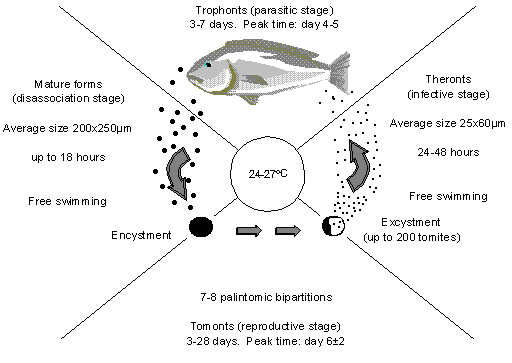
A bit more information so you can put what we said into perspective. The life cycle of this parasite is interesting and is important to understand when evaluating a treatment. The stage where the parasite is attached to a fish is called a trophont. The trophont will spend three to seven days (depending on temperature) feeding on the fish and that is what you see symptomatically when you see "salt sprinkled on the fish". After that, the trophont leaves the fish and becomes what is called a protomont. This protomont travels to the substrate and begins to crawl around for usually two to eight hours, but it could go for as long as eighteen hours after it leaves it's fish host. Once the protomont attaches to a surface, it begins to encyst and is now called a tomont. Division inside the cyst into hundreds of daughter parasites, called tomites, begins shortly thereafter. This noninfectious stage can last anywhere from three to twenty-eight days. During this extended period, the parasite cyst is lying in wait for a host. After this period, the tomites hatch and begin swimming around, looking for a fish host. At this point, they are called theronts, and they must find a host within twenty-four hours or die. They prefer to seek out the skin and gill tissue, then transform into trophonts, and begin the process all over again. What this means is that when your tank is infected, you can actually see symptom during a very small part of the life cycle, and it why your tank is infected even though your fish are resistent.
Many hobbyists are fooled into believing they have cured their fish of the parasites, only to find Ich present again on fish a few weeks later; a reason why following through with a full treatment protocol is so important. Don't make this mistake and be lulled into a false sense of security. The parasites may be in a stage where they are merely regrouping and multiplying for their "next offensive." In the wild, this sort of massive reproductive phase ensures that a few will find a suitable host to continue on the cycle. In the close confines of our aquariums, though, it means comparatively massive infection rates.
This disease is usually associated with several environmental triggers. Changes in water temperature, exposure to high levels of ammonia, nitrite, or nitrate, low pH levels, low dissolved oxygen often associated with overcrowding, are all factors contributing to the onset of the disease. You could lump all of these in a general category of "stress", but it is more appropriate to think of all of these as "unnatural conditions". In fact, Cryptocaryon irritans is rare in the wild even more unlikely to be lethal. Ich is truly a disease that exploits the conditions of captivity to reproduce and easily find suitable hosts.
By the way, trophonts are under the skin so cleaner wrasses and cleaner shrimp have no real effect on reducing this parasite.
See articles by Steven Pro for additional information.
Many hobbyists are fooled into believing they have cured their fish of the parasites, only to find Ich present again on fish a few weeks later; a reason why following through with a full treatment protocol is so important. Don't make this mistake and be lulled into a false sense of security. The parasites may be in a stage where they are merely regrouping and multiplying for their "next offensive." In the wild, this sort of massive reproductive phase ensures that a few will find a suitable host to continue on the cycle. In the close confines of our aquariums, though, it means comparatively massive infection rates.
This disease is usually associated with several environmental triggers. Changes in water temperature, exposure to high levels of ammonia, nitrite, or nitrate, low pH levels, low dissolved oxygen often associated with overcrowding, are all factors contributing to the onset of the disease. You could lump all of these in a general category of "stress", but it is more appropriate to think of all of these as "unnatural conditions". In fact, Cryptocaryon irritans is rare in the wild even more unlikely to be lethal. Ich is truly a disease that exploits the conditions of captivity to reproduce and easily find suitable hosts.
By the way, trophonts are under the skin so cleaner wrasses and cleaner shrimp have no real effect on reducing this parasite.
See articles by Steven Pro for additional information.
LargeAngels
Premium Member
Fish are like most any other type of animal and could probably go a week without food with very little problems. I haven't tried this before, but the fish at my work tank eat once friday at noon, and then not again until monday at noon. I even think a long weekend has occurred a few times without ever damaging any of them.
Have you tried spirulina enriched brine shrimp? If the Tang isn't eating normally, he might still go after these.
And if that doesn't work, maybe New Life Spectrum pellets?
What are the water levels in your QT? Ammonia, nitrite, ph, temp, salinity, etc. Maybe poor water quality in the QT is impacting him as well.
And if that doesn't work, maybe New Life Spectrum pellets?
What are the water levels in your QT? Ammonia, nitrite, ph, temp, salinity, etc. Maybe poor water quality in the QT is impacting him as well.
Great information on the disease by Snorvich and LargeAngels. I have not tried spirulina enriched brine shrimp; only seaweed, spectrum pellets, and frozen mysis. I am going to pickup some more variety of food tonight and give it a try. If the tang is still not eating, then it's back into the DT where he was eating actively before.

MrTuskfish
Team RC
Great information on the disease by Snorvich and LargeAngels. I have not tried spirulina enriched brine shrimp; only seaweed, spectrum pellets, and frozen mysis. I am going to pickup some more variety of food tonight and give it a try. If the tang is still not eating, then it's back into the DT where he was eating actively before.
I'm lost on the timeline. has it been just 4 days? He can go a lot longer than this without eating.
Also, I'd sure take the advice above seriously; you're looking at a disaster if you don't treat all of your fish.

TampaReefer79
Premium Member
To answer the original question (and please correct me if I'm wrong) but I thought fish could go a couple weeks without eating. 2 weeks or so? Maybe 3?
It's a moot point because the AT should be pulled from the 30 gallon tank and put back into the display since the 30 is probably just stressing him more. How big is the DT you're putting him back into and what are the other tank inhabitants? What kind of water movement do you have in that tank? What about the water movement in the 30? What kind of skimmer on each? After you feed and it doesn't get eaten, do you siphon the food out so it doesn't rot?
It's a moot point because the AT should be pulled from the 30 gallon tank and put back into the display since the 30 is probably just stressing him more. How big is the DT you're putting him back into and what are the other tank inhabitants? What kind of water movement do you have in that tank? What about the water movement in the 30? What kind of skimmer on each? After you feed and it doesn't get eaten, do you siphon the food out so it doesn't rot?
To answer the original question (and please correct me if I'm wrong) but I thought fish could go a couple weeks without eating. 2 weeks or so? Maybe 3?
The problem is, that when a fish stops eating, there is always a problem. IF you can figure out AND solve the problem, they MAY resume eating. So your answer, while technically correct, is not useful, because it is the length of time from when they stop eating until they die.
To answer the original question (and please correct me if I'm wrong) but I thought fish could go a couple weeks without eating. 2 weeks or so? Maybe 3?
It's a moot point because the AT should be pulled from the 30 gallon tank and put back into the display since the 30 is probably just stressing him more. How big is the DT you're putting him back into and what are the other tank inhabitants? What kind of water movement do you have in that tank? What about the water movement in the 30? What kind of skimmer on each? After you feed and it doesn't get eaten, do you siphon the food out so it doesn't rot?
You don't want to know what's in my display tank. I am going to get some grief from listing. It's a 120g 4x2x2. I know it's not recommended for an achilles tang, but I really like to have one. I would love to upgrade to a 240 or even a 180, but that is not going to fly with the wife. I took out a third of my rocks in the DT in preparation for the achilles. Opened up a large amount of swimming room so the AT is able to do enless laps throughout the tank instead of just back and forth.
My skimmer is the Euro-reef RC180 rated for 300 gallons. Water movement is 2 vortech mp40w. My QT has 2 pumps in there creating a lot of turbulence. I try to take out whatever leftover food I can from the QT, but that's not always possible since many of the pieces are small.
My fish list:
achilles tang (4") :worried2:
hippo tang (3.5")
goldflake angel (3.5")
picasso clown
mccosker's flasher wrasse
sixline wrasse
diamond goby
7 bartlett anthias (I started with 3 but it didn't quite look like a school)
Finally, on the 3rd night, the achilles tang is eating in the QT. I bought some new food (omega flakes, frozen cyclopeeze, spirulina brine shrimps), mixed it all together and bam, AT is chowing it down. He's even working on the seaweed on the clip now. It's a good sign.

Glad he is eating. However, as you know (or will soon know), the DT is a problem that will not solve itself. The hepatus tang is a total ich magnet, the most highly susceptible of all tangs. By the way, how are you treating him in QT? Hyposalinity or copper?
Last edited:
Glad he is eating. However, as you know (or will soon know), the DT is a problem that will not solve itself. The hepatus tang is a total ich magnet, the most highly susceptible of all tangs. By the way, how are you treating him in QT? Hyposalinity or copper?
I am treating with cupramine. I realize I am risking the health of all my fish by introducing the achilles tang to the DT, but it's not possible to keep pulling him out and only treating him for ich since it's not really doing much good to the rest of the fish. This is a one time thing to relieve the fish of whatever parasite is already on him.
Similar threads

- Replies
- 11
- Views
- 216
