How to dim a Meanwell ELN-60-48D...

I was actually trying to do that last night and I found out my 10v regs were mis-labeled, they say 10 on them, which means they should put out 10V, but 4/5 put out 13V. one got fried because of a solder bridge i didn't see. it was funny. it got so hot i melted solder with it.
 
Also, set your meter to A or mA not AC, and you have to move the leads. One in COMM (GND), the other in A/mA

Stu, in looking at my multimeter, it has 200ma max! written on it and the switches only go to 200ma, so I'm assuming its useless for this job? Any recommendations on a good relatively inexpensive meter. I don't do alot of electrical work so I dont need anything real fancy, just something that will work.

Thanks!
 
madmike,

You can get a Craftsman DMM that reads thermocouples AND does all these voltage & current measurement things I do to my LEDs.

Front panel says: 82139 ~$30 from Sears.

Stu
 
I got DWZMs ELN shield this weekend and fired it up. It works great! It worked on Meanwell ELN-60-24P and ELN-6048D drivers.

I was completely wrong earlier in this thread! The drivers are not a current source, they are a sink. The controller should be a source. Tunzes work in the opposite way from these. My confusion came from hooking the meanwell up incorrectly, thinking it was working off the circuit, when it was really just working directly off the arduinos signal. Sigh.... dammit self... you're an idiot. Anyways, the shield works great. Anyone trying to get an Arduino to work with meanwells, this is the way to do it!

EDIT.. but don't try to test the output with a multimeter! I fried one of the transistors doing that!
 
Anyone trying to get an Arduino to work with meanwells, this is the way to do it!

EDIT.. but don't try to test the output with a multimeter! I fried one of the transistors doing that!
Mines been going for a little over a week now. Havent had a glitch that wasnt my fault.
Test that transistor channel. I had one go to 2 ground and it seems like it went up in a fireball. Flame, smoke, the whole nine yards. However, its still trudging along!!! I got 10V out of it, and it dims fine.
 
I'm happy to hear it worked on both drivers. This is big news because it means people wanting to control them via Arduino can do so with ease, regardless of which version of the driver they got.

If people want to try the shield, I have around 7 of the prototype PCBs left. Since they're "flawed" I'll give them away free, you pay shipping ($2 covers a padded envelope via first class). Send me a PM so this thread doesn't give the appearance of commercial activity. The "flaw" doesn't alter functionality, it just makes it a bit harder/confusing to assemble. The flaw is that the voltage regulator I designed for doesn't quite fit. You can fix this by either using a different reg, or bending the pins on the one I designed for. I wanted to use an LM4940 in a TO-262 package but accidentally put a TO-252 package on the board. If you want to use a different reg, get a 7810 in a TO-252 package. The main difference is that the 4940 (not available in TO-263) has a lower dropout so you can use it with any wall wart above 10.5v, whereas the 7810 (IS available in TO-263) needs 12v input. For most people it won't make a difference which one you end up with, since I'm guessing most people will just use a 12v wall wart anyways.

Otherwise, I've posted the EAGLE docs in svn for the hydra project. These files show the correct package size to use the low dropout 4940 regulator. This is released under creative commons 3.0 BY-SA-NC (so you can use it for non-commercial purposes):

http://code.google.com/p/hydra-reef/source/browse/#

click the "trunk" folder on the left, then "hardware" then "ELN_shield". Then click on the links under "filename" on the right to download the EAGLE files, then you can open the project up in EAGLE and make gerbers, send them to a board house, etc.

There's also a BOM in excel format showing part numbers from Mouser.
 
can somebody post pictures???

all these lingo is really confusing for someone who isn't in the engineering field.
thanks

evilc66,

"While an LM317 isn't the best choice, it's a readily available one for anyone that walks down to the local Radioshack."

Agreed, and I have a LED light running on my QT with two CREE XR-E using just a LM317 as a driver.

However - you need to install at least two Caps and a variable resistor in the circuit.
This is a little beyond most DIYers ability to solder discrete parts together without a PWB. ( although DWZM could easily do a VERY nice LM317 driver PCB for us ).

Anyway, if the variability of wall warts bothers you, lets say:

Get TWO 5k Pots.
Hook high side of POT 1 to Wallwart ( unknown voltage < 24V )
Hook Wiper of POT 1 to High side of POT 2 ( insulate low side of Pot 1 )

Hook Low side of POT 2 to wall wart ground

Turn on wall wart & measure voltage across POT 2
Adjust POT 1 until max Voltage across POT 2 = 10.0 VDC

Hook wiper of POT 2 to Meanwell Dim+
Hook wall wart Ground(RTN) to Dim-

NOW you can get 0-10V by adjusting POT 2 regardless of voltage of wall wart. ( DO NOT adjust POT 1 ever again )

Sorry if that sounds complicated but it's not.

Stu
 
I'm not sure how I've missed this thread.

I'd like to share how I solved the issue for me.

First I tried wiring up the LM317, and wound up re-soldering it four times (and wasting two LM317)--- all I ever got was a small voltage drop, the max voltage stayed around 13v (no load). So I chalked it up to user error.


Dug around in a box of old power supplies we had at work and found 4 or 5 "9v" power supplies. ALL of them gave more like 12-14v (no load)..... EXCEPT this one particular unit that had on the back, "Regulated 9v" and it gave a fairly constant 9.14v.

It looks like any other 9v power supply, except it says "Regulated 9v" on the back.

Then I come here today and see this comment by D_W_Z_M:
Or, buy a 9v regulated supply with a voltage trimpot on it and cheat by turning it up to 10v.

I don't know just what a trimpot is, but my "Regulated 9v" stays solid on 9.1v output.


I can assure you that you can adjust the SRV2 (current) internal pot on the 60-48D to get a full 1,000mA out of 9v. I'm doing it right now and I have been for about 6 months. You just have to hook your mulitmeter inline and watch the current as you dial up the SRV2.

I stopped, actually, at 960mA just in case the voltage ever floundered around. I now can dim my LED's all I want with the 10K pot.


I only have one array of blue XRE's that are actinic supplements to my 250DE Phoenix.

Here's the big question: where can I find something like this online???? Somebody, somewhere, made one. Mine has no name on it, no brand, no anything other than "regulated 9v"
 
I can assure you that you can adjust the SRV2 (current) internal pot on the 60-48D to get a full 1,000mA out of 9v.

Of course you can. But your only getting 90% of actual full power. If you give it 10V, you'll be over 1000mA.

You may be able to open it and find a trimpot to adjust it.
 
Of course you can. But your only getting 90% of actual full power. If you give it 10V, you'll be over 1000mA.

You may be able to open it and find a trimpot to adjust it.


I don't think you'd want to go over 1,000mA for most of the LED's we use.

I personally wouldn't drive an XRE over 1,000mA. No need to unless you're trying to do laser surgery lol....

But you can definitely get 1,000mA with 9v input.
 
I don't think you'd want to go over 1,000mA for most of the LED's we use.

I personally wouldn't drive an XRE over 1,000mA. No need to unless you're trying to do laser surgery lol....

But you can definitely get 1,000mA with 9v input.

I dont think you understand what I am saying. You are not supplying the max power on the dim circuit. 9V is only 90%, so I guess, if my math is correct, if you go up to the full 10V you'll be at 1100mA. I know you dont want to go over 1000mA. I am saying that you are not getting 100% out of yours. You can get 1000mA no matter what is supplied on the dim circuit.
But I guess that brings up the argument, of driving them at lower intensity for more efficiency, life, etc. If you are only giving it 90% on the dim circuit, but still 1000mA is that still 1000mA? I guess its hard to put into type what I am trying to say. Maybe Stu or DZW will chime in.
I think it would be better to provide full power to the dim circuit, then lower the current. Not a fraction of power, then full current. (If that makes sense)

Also and what I was trying to mean, was open up the WW and see if there's a trim pot to turn it up a little to get a true full 10V.
 
I dont think you understand what I am saying.

Apparently not, lol.

You are not supplying the max power on the dim circuit. 9V is only 90%, so I guess, if my math is correct, if you go up to the full 10V you'll be at 1100mA.

It's not quite as linear as you'd think, but you're close (I think it varies a little from meanwell to meanwell.

I know you dont want to go over 1000mA. I am saying that you are not getting 100% out of yours.

As far as I'm concerned, with XRE's, 1,000mA is as good as it gets. Sure I could get more juice out of the Meanwell but what would it benefit me?

You can get 1000mA no matter what is supplied on the dim circuit.

That is NOT true with the Meanwell I have. I hooked mine up to a 5v wall wart and couldn't get anything close to 1,000mA. I don't remember what, but it wasn't anything close to 1,000mA.

If I'm not mistaken, you HAVE to give the Meanwell something close to 10v dimmer input (maybe 8 to 10v?) to actually get 1,000mA out of it.


But I guess that brings up the argument, of driving them at lower intensity for more efficiency, life, etc. If you are only giving it 90% on the dim circuit, but still 1000mA is that still 1000mA?

Yes, 1000mA is 1000mA, and the intensity will be the exact same provided the voltage going to the LED's is appropriate. The Meanwell automatically detects the load and adjusts the voltage accordingly.


Are you assuming that the voltage from the dimmer input has anything whatsoever to do with the voltage on the LEDs themselves? It doesn't. Only the internal electronics of the Meanwell determine this (there is an adjustment screw SRV1 but it's not necessary to mess with it-- mine puts out the appropriate voltage for the number of LED's I have).

I guess its hard to put into type what I am trying to say. Maybe Stu or DZW will chime in.
I think it would be better to provide full power to the dim circuit, then lower the current. Not a fraction of power, then full current. (If that makes sense)

I see what you are saying here but I'm not sure what it would benefit.

If the Meanwell is supplying the proper voltage to the LED's (which it automatically detects/compensates), and they are getting 1,000mA--- then it doesn't matter at all whether you give it 9v or 10v. You just adjust the internal pot (SRV2) on the Meanwell to dial in the max current--- with your dimmer potentiometer "wide open".

Also and what I was trying to mean, was open up the WW and see if there's a trim pot to turn it up a little to get a true full 10V.

If I had an extra, I might try that, but I'm terrified to mess up this wall wart since I don't have an extra one like it, and have no clue where to get a "Regulated 9v" that actually puts out 9v.

Yes, something is definitely amiss here.

 
We're really guessing at the function of the meanwells, but in the end it's likely more a matter of semantics - we have two ways of adjusting current - the internal trimpot, and the DIM circuit. The "typical" approach is to adjust the internal pot to give your intended max brightness when the external signal is at 100% (10v). IMHO that doesn't make it "wrong" to use a 9v signal as your "max" setting, it's just "different."

FWIW, regulated wall warts aren't quite as common as unregulated wall warts, but they're definitely out there and easy to get. Generally, if you see a wall wart for sale and there isn't an obvious claim that it's regulated, you can assume it isn't. But there are plenty that tout regulation:

http://www.sparkfun.com/commerce/product_info.php?products_id=298

And I doubt a wall wart will have an adjustment pot inside - they're not made to be serviced. My comment quoted above was intended for something like this:

http://www.mpja.com/prodinfo.asp?number=17430+PS

Except of course that one's in 5v, but you get the idea. :)
 
Thanks D_W_Z_M.

I will most likely use that power supply on my next build if I decide to put them over my frag tank.

I personally feel safer using a 9v input and adjusting the SRV2 pot up to get 100% current.

I spoke on the phone with a Meanwell rep, months ago when I put together my LED rig, and he definitely cautioned me not to exceed 10.5v (as mentioned earlier in this thread). I'd rather not risk any sort of voltage noise from a 10v supply cooking my dimmer.


Hopefully one day soon we'll have (or find) a driver comparable to the Meanwell that has the dimmer already in place (other than buckpucks, which I think aren't as reliable as a Meanwell).
 
do you mean there's two power source. one for the driver and one for the dimmer? a wallwart for the dimmer and a regular power cord to the driver?
 
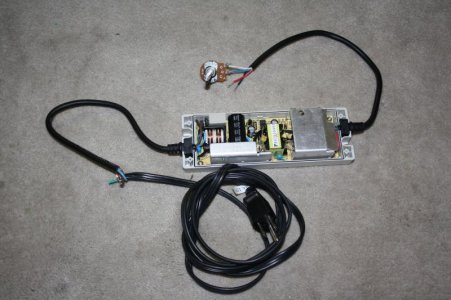
Is this correct? a picture like this explains a lot. thanks.

the black/red goes to led. does the potentiometer knob dimming thing need to be connected to a power source that then connects to the wall power outlet?
-------------------------------------------------------------------------------------------------------------
from Stu I believe:

Get a 12VDC "wall wart" Get a large potentiometer ( variable resistor with a knob ).

It can be anywhere from 1000 Ohms to 100,000 ohms ( 1K to 100K ).

Hook the high side of the Pot ( either end ) to +12VDC.
Hook the low side of the Pot ( opposite end from above ) to 12V RTN/GND.
Also hook this line ( 12V RTN/GND ) to the Dim- line ( White on the Meanwell )

Quote
NOW take the "wiper" of the Pot ( this is the part that adjusts ) and hook it to the Dim+ line of the Meanwell ( Blue )

Remember to turn down the internal current adjust before trying it and you need to know how to measure the current through the LED string to adjust. I use a DMM in current mode & I adjust my max current to 700mA.

Then you can experiment with the Dim knob (CAREFULLY) until the max on the knob corresponds to the max current through the LED string.

The spec sheet of the Meanwell does not state the absolute maximum voltage that can be applied to the Dim+ Pin, so I would advise you to not just "turn it all the way up" with the above design as you could apply 12VDC to the Dim+ pin.

My guess is that it wont care, but I wont guarantee it.
 

Attachments

  • meanwell.jpg
    meanwell.jpg
    68.1 KB · Views: 21
Hey I just found this thread! Yes the dimmer needs to have a power supply of 10V going into the driver, so I think all you would need to do is have the 10 V power supply coming from the wall with the positive going into that dimmer and then the negative going into the driver and have the line coming out of the dimmer going into the positive in on the dimmer line going into the driver.
 
ok, i finally got it...i've asked for pictures, but nobody seem to have them. i hope this picture will cure some frustrations from those that was like me.

the potentiometer aka driver (i think) connects to the meanwell, and you also need a power source (wallwart) 10v 1A. I got one off ebay. then the other end of the meanwell, you just need either a 2 prong or 3 prong regular power cord. if you use 3 prongs, don't use the middle wire.

meanwellwiring.jpg


potentiometer.jpg
 
Back
Top