how to make rbta tentacles bubble

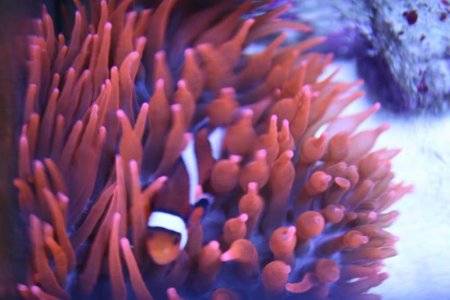
I've had my RBTA(/s) for about 2 years. It was bubbley for a few months after introducing it to my system, but has been looking like an LTA ever since.

Then..
rbta7.jpg


The only time my RBTA's bubble up now is when they're stressed. I've had one get sucked into my overflow and a bit chewed up, pop back out and bubble up. Also had a tank crash a few months ago subsequently causing my 3 RBTAs to bleach and bubble up as well. So as far as I'm concerned, my BTA's only bubble when they're stressed.

Most recently after crash:
clownfish_101409.jpg


Using 150-w MH, temp 77-78F, MJ-1200 for flow.
 
Anyone have one with and one without bubbles in the same tank?

This could shed light on the high flow theory.

I did briefly when mine split. I didn't remember this until reviewing photos of both after you posted this. One of two clones located themselves in an area of very low flow and moderate light initially (before I manually relocated it) and would bubble. The other located itself close to where the parent was and was stringy. Unfortunately with such a small sample population I can't say for sure if this (flow) was the cause or not.
 
i would not feed everyday, 2 0r 3 times a week at the most. it must be a feeding think that makes them not bulb. now that i think of it a co worker had a bubbletip in his tank at home and he said it was always long tenticled, he broght it in and its currently in the 144 and it seems to bulb up occasionaly.

some of you who dont regularly spot feed your BTA how do they look? bulbed, stringy

has anyone experienced bulbing after feeding?

I believe its the inverse per my own research. Feed and it bubbles. Don't feed and its stringy. I find this to be true both with my own anemone and from what others have observed. This is post flow change in my tank as well.

I am getting PAR readings of 360+/- where my anemone is located so its not a low light issue. With the gentler wave motion she no longer does the string tentacles unless she is hungry. Post feeding she goes back to bubble. I feed about 1-2 times per week and she picks up spillover pellets from feeding the fish in the tank.

FWIW I have found that by aggressively feeding initially after placing the anemone where *YOU* want it as opposed to where *IT* wants to be can cause a higher likelihood if it staying there because it associates the location as a good food source location. Of course I have also seen and heard about some anemone's being dumber than my couch and locating themselves in places where they simply starve and die due to lack of food/light.
 
for those with bubbly rbta, when you feed, do the tentacles become stringy during feeding time or do they stay bubbly?
 
I have both a Gbta and a Rbta less than 4" apart. They both get fed the same time and the same amount.
The Gbta has bubbles. the Rbta does not. They recently changed places on the rock. Kinda like a dosey-doe.

One OT note...They both started off the same size...they both get fed the same thing, same amount...The Gbta is 4 times the size.
 
What we need is a Marine Biology graduate student looking for a thesis experiment. I would think that this would be easily discovered with the right experimental conditions. I know food is not it for me. I feed every other day and the nem keeps growing but no bubbles.
 
Here's a quote from a scholarly article that might be slightly related. I'm going to keep checking google schoolar and post findings here.

On a coral reef at Eilat, northern Red Sea, individuals of the sea anemone Entacmaea quadricolor that possessed endemic anemonefish Amphiprion bicinctus expanded their tentacles significantly more frequently than did those lacking anemonefish. When anemonefish were experimentally removed, sea anemone hosts contracted partially. Within 1"“4 h in most cases, individuals of the butterflyfish Chaetodon fasciatus arrived and attacked the sea anemones, causing them to contract completely into reef holes. Upon the experimental return of anemonefish, the anemone hosts re-expanded. The long-term growth rate and survival of the sea anemones depended on the size and number of their anemonefish. Over several years, sea anemones possessing small or no fish exhibited negative growth (shrinkage) and eventually disappeared, while those with at least one large fish survived and grew. We conclude that host sea anemones sense the presence of symbiotic anemonefish via chemical and/or mechanical cues, and react by altering their expansion behavior. Host sea anemones that lack anemonefish large enough to defend them against predation may remain contracted in reef holes, unable to feed or expose their tentacles for photosynthesis, resulting in their shrinkage and eventual death.
 
LOL

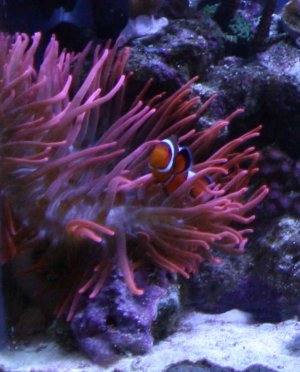
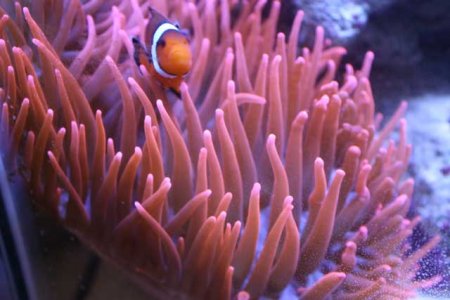
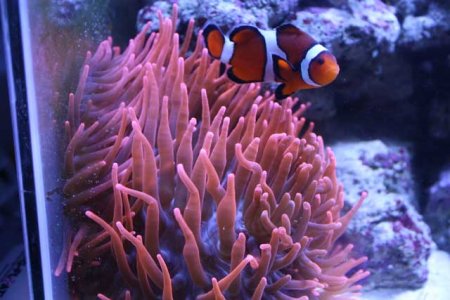
Longest thread about nothing that I have ever read :) No one knows why BTA tentacles bubble. No one knows why sometimes they bubble, sometimes they don't and sometimes they bubble again. No one knows why a single BTA can have some tentacles with, and some tentacles without bubbles. No one knows why, in a colony of BTA clones in the wild, some anemones will have bubbles and some won't - in the same environment, with the same access to the same food and water flow.
Good luck developing hypotheses and testing them :) Otherwise stop posting about how "my anemone develops bubbles when the Packers win the SuperBowl" LOL.
 
it's the light !!!

it's the light !!!

Here's an update.

I changed my light three days ago from a 150w to a 250w metal halide, and this is the result so far.

first pic is from august, second is from one day after the light change, the third pic is from today, 3 days after the light change.

you can definitely see bubbles starting to form. I have never seen it like this since I put the nem in my tank until now. I did not change feeding or flow or temp. The only change I made is the light.
 

Attachments

  • IMG_2520.jpg
    IMG_2520.jpg
    44.7 KB · Views: 10
  • IMG_2926.jpg
    IMG_2926.jpg
    28.6 KB · Views: 11
  • IMG_2933.jpg
    IMG_2933.jpg
    36.4 KB · Views: 13
It is not the lights alone that cause it. I have seen RBTA's in greenhouse tubs that are getting 1200 micromol PAR for most of the day and they do not bubble up.
 
Correlation does not imply causation.

Science 101.


the null hypothesis is not proven wrong (cannot be rejected), so it follows your alternative hypothesis cannot be accepted.

as far as I am concerned, I have seen the light (pun intended).
 
the null hypothesis is not proven wrong (cannot be rejected), so it follows your alternative hypothesis cannot be accepted.

as far as I am concerned, I have seen the light (pun intended).

I don't have to prove null. I am not offering a hypothesis to prove :)

You are the one suggesting that you have proven something, based on the shakiest of personal observations of one occurrence of an event in an uncontrolled environment with no control.

Why don't you:

(1) Show that you can repeat the event with the same individual.
(2) Show that you can repeat the event with other individuals.
(3) Isolate all individuals from each other, and show that you can repeat the event at will, keeping all other environmental factors fixed.
(4) Keeping the causal factor fixed, adjust other environmental factors without impact to the outcome (i.e. keep light fixed, and change temp, water chemistry, food, etc)

Since other people have tried what you have tried and been unsuccessful, and other people have done other things and been successful, I remain unconvinced.
 
you really think you are so smart offering the imported lemons analogy?
I'll let readers decide on that one.
its not like I said friday the 13th caused the rbta to bubble.
your own explanation makes your own hypothesis invalid.

some pessimists who can't get their rbta to bubble just can't accept that others are able to. I am just happy my rbta has bubbled (I am sure you are not happy about that). I am sorry if others are unsuccessful.
 
doughboy, I am happy you were able to get it to bubble. Please keep us updated if it stays like that. From my own tests the bubbles are caused more by stress events such as damage, splitting or aggression instead of just sustained increases in flow, lights or food.

Changing from 150w, probably old bulbs, to 250w, new bulbs, is a huge change. Hopefully you reduced your photoperiod by about two hours to account for the increase. My guess is that it bubbled up as a defensive state to the light being basically doubled.

Check out this thread of some green house RBTAs. Outside in the sun all day with very strong flow and they are not bubbled at all. It is a good read even if you don't care about the BTA bubble issue.

http://www.wamas.org/forums/index.php?showtopic=31724&st=25
 
thanks coral hind.

here's a top view pic I took today.
the tentacles up against the front and side glass are not bubbled, but most of the rest are. Yes I reduced my light time by 2 hours, and I am using an old 250w bulb another reefer was going to toss out.

I found this link which adds another observation data point that increasing light resulted in bubble tip.
http://www.advancedaquarist.com/issues/nov2002/feature.htm

all these observations means we cannot outright reject the null hypothesis that light is a factor causing bubble, therefore it follows the alternative hypothesis that light is not a factor cannot be accepted. only if one can prove without any doubt that increasing light never result in bubble can we accept that light is not a factor hypothesis.
 

Attachments

  • IMG_2945.jpg
    IMG_2945.jpg
    47.2 KB · Views: 9
I've had a RBTA for two years now. In my reef, it kinda bubbled, but certainly never got stringy. It was fed A LOT, and was under 250W MH. It definitely got less "bubbly" if I missed a feeding. Since then, it's been to hell and back. It (well, one third of it after splitting) now resides in my FOWLR with no clowns. It couldn't be more "bubbly". Lighting is 6 t5's. Water, is, well, less than pristine.

I'm a fan of the idea that multiple factors influence the tentacle shape.
 
Back
Top