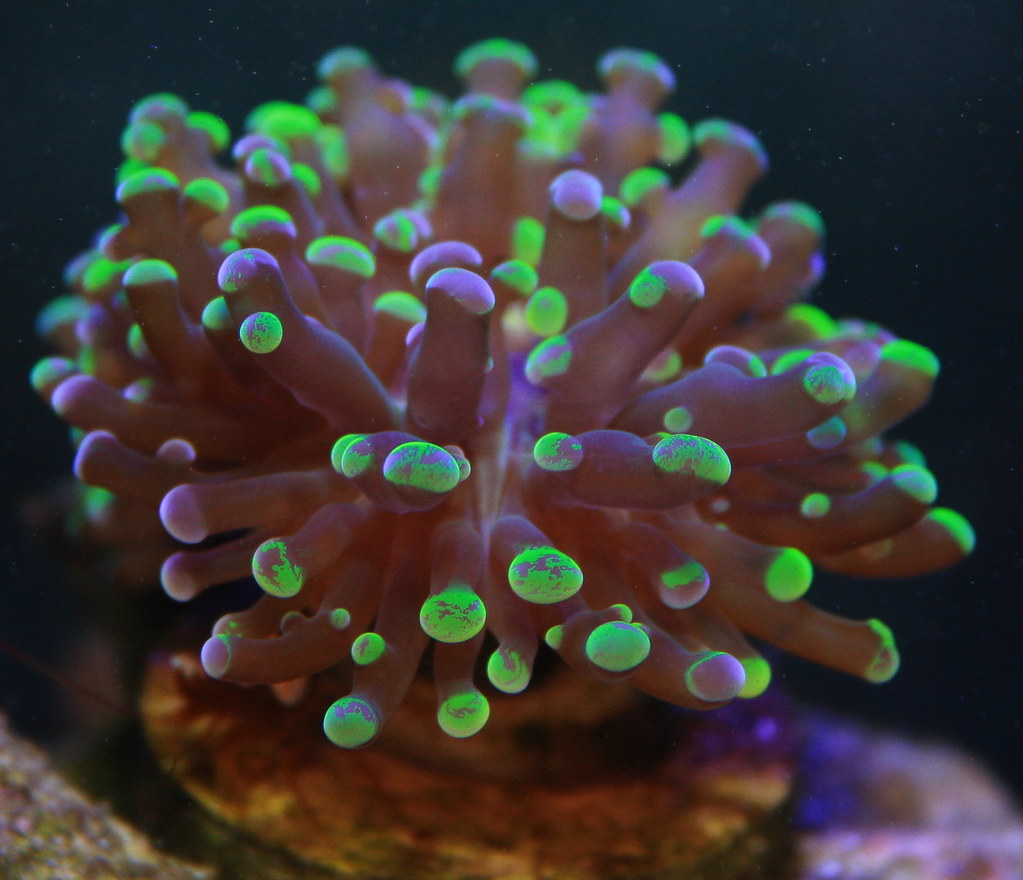
You don't need a fabulous expensive DSLR camera (although I wish I had one). Here's a pic I took today on my phone...
Tips in general -
Clean the glass before the shoot.
Don't use a flash.
Wear dark clothing and turn off all lights in room [not tank lights]. This ensures you don't get reflections of the room into your shot.
Try to steady your shots... Tripods work great, but I don't have one, I improvise. Great method I've found is to hold the camera with both hands, and put my middle fingers out and "lean on" the tank surface... Giving the camera a very stable shooting platform.
Don't have the lens right up against the glass, distortions and/or failure to focus properly might occur... leave at least 3/4-1" between glass / lens.
Be aware of how curvature of glass effects shot. Ergo, if you shoot from a skewed angle, the picture might come out even more warped.
Turn down flow to minimize agitation / debris in water column the camera might accidentally focus on.
Fool around with Camera Settings. My old camera had an 'underwater' setting. My Galaxy III phone camera has a 'cloudy' setting that removes the excess blue-saturation from the shot.
Basically you have to adjust your camera's intake of blue down to compensate for the amount of blue light we throw out. Up the red spectrum more to compensate if you can in your settings (what those camera settings mentioned earlier did).
Feed a few minutes before to make creatures feel more secure / corals open up.
Patience. Take lots of pics and hope 1-2 out of every 10 are usable.
Some fish are camera shy, and dart if you try to follow them. Pic a spot you know they will swim through and wait... wait... eventually you will get your shot.
My leopard wrasse is next to impossible to catch on camera... patience and enough photo's taken (95% blurry) finally netted me a few gems like this...
With my old camera, a Sony Cybershot, I set it to 'multi-shot' so I would hold the shutter button and the camera would take 3-5 continuous shots. This basically upped the shutter-speed for faster moving targets.
My Galaxy III tends to do that on its own.
Composition.
Most go by the 2/3rds rule. AKA have your target/focus point 2/3rds of the way into the frame.
Another good rule is to try to make all 4 corners of the photo be different (in shading, texture, etc).
Note how the leopard wrasse pic above was cropped with those two theories in mind.

Hope that helps get you going!