deangelr
Clown Whisperererer
In most haremic species there is no choice, by either male or female. That group of females is "stuck" to that harem (and it's dominating male) by a strong social structure, that's how they live. When the male dies, the largest female changes behavior, color and sex (on that order). Female wrasses don't switch harems if the male of the next harem over is prettier, there is no choice.
I dont have any sound evidence on this but I strongly disagree that there is no choice..
Now, don't take me wrong, I am not saying that sexual selection doesn't exist in reef fishes. All I am saying is that it is not what is driving the bright colors, and is much less important in reef fishes than it is in birds. If you want to see some clear examples of sexual selection just look at freshwater fishes or even some blennies. But it is not correct to say that most reef fishes are colorful because of sexual selection, it's the generalization that bothers me.
I I am not comparing birds to reef fishes. It was just to give the reader an idea of how sexual selection works... I can't think of one circumstance where flamboyant colors exhibited in sexual dimporhism are not due to selective mate choice. Reef fishes are no different.
Bright colors themselves (or even sexual dimorphism) are not per se an indication of sexual selection. If they were, how would you explain brightly colored juveniles and relatively drab adults like many damselfishes and angelfishes?
Juveniles may likeley be so brightly colored in certain species of wrasses etc. to help clearly outline the social structure duing intraspecific species interactions.. Again, I see this as a product of sexual selection.. Almost any sort of differences in phenotype based on social structed in the end boils down to sexual social structure and therofore sexual selection
The phenotypes we see exhibited by any fauna are driven by two factors
- survivability
- sexual selection
*sexual selection can also be driven by intrasex competition
Reef fishes come in such a wide variety of colors, often within genus. The same genus, same physical shape, can have drastically different color variations. This is likeley due to mate choice..
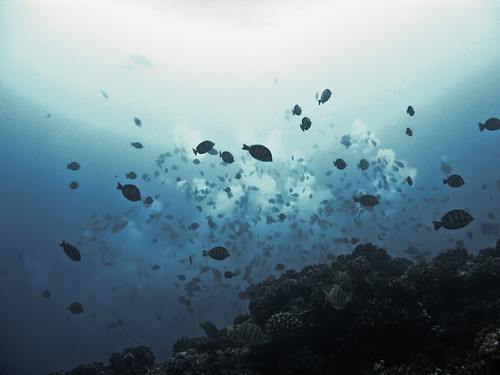
Tangs, for example... You think one went black, one went yellow, one sailfin colored. etc.. becuase certain morphs had a better chance of survival, and over time those morphs were selected for based on geographical variation? I dont..
I have already asked you this, But if you don't want to buy what im selling that the variation in reef fishes is in large part due to sexual selection.. How do you explain such bright coloration and different patterns? what factor of survivability would you accredit these features to?
Last edited: