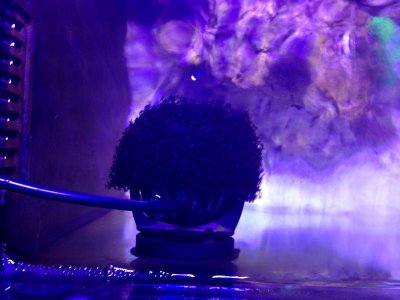
I run two MP40s in my DT and Jebao WP10s on my smaller tanks. I no longer use the foam covers on my MP40s and never had them on my WPs. However, I do recommend that all anemone owners -- especially those who have new anemones -- use covers when possible.
That said, for those who are familiar with their anemones, covers (or any sort of protection) are not needed or won't help much. Here are the reasons:
1. Most anemones are not free floaters. BTAs are the exception, and since many anemone owners are BTA owners, then covers are typically recommended. My focus is on carpet anemones and H. magnifica, and these species do not inflate like a balloon and float around the tank.
2. I have found that when conditions are right, all anemones rarely move. More important than covers is keeping conditions consistent (flow, lighting, water parameters) as this prevents wandering. In short, keeping an anemone "happy" is the key.
3. Once you know your anemone, you can predict their behavior. My H. magnifica moves only an inch or so in each direction. It likes high flow and high light, so it's towards the middle of the tank and directly in front of a powerhead. Mags will walk up tank walls if they can "feel" them, so I keep mine away from any walls.
4. Anemones are slow and if you see the signs you can react quickly. Once an anemone is on the go, all powerheads should be turned off until the nem has found a new location, in an area that it actually likes. For example, BTAs like to have their foot buried deep in a crevice. If it's attached to a flat surface, the likelihood of it moving is fairly high. Once the nem appears to be in it's final position, the powerheads can be turned on. I've found that they rarely move due to flow, unless the flow is completely wrong for the species of nem.
5. Current designs for foam covers won't guarantee safely and are more trouble than the protection they provide. As others have previously mentioned, they tend to clog quickly. When I had covers on my MP40s, I had 4 sets of covers and rotated sets; the dirty ones cleaned in a vinegar bath overnight. Even with the covers, one of my large gigs got caught in it.
6. A good design for a cover is one that doesn't hug the powerhead. Current designs only help to prevent the nem from physically entering the powerhead, but if left on too long, the nem will still die, especially if it's a strong powerhead. It only takes literally one tentacle to get stuck in a powerhead to pull in the entire anemone. I know that there are a few hobbyists developing powerhead covers but I have yet to see one that I like. The best design IMO is one that leaves at least a 1" gap between the powerhead and the cover. This allows the nem to get stuck on the cover, but not pulled into the powerhead. Unfortunately, all of the designs I've considered I envision to be rather unsightly in the tank, even clear acrylic ones, as they will eventually get covered with algae. The other issue is maintaining flow to and from the powerhead. Holes that are too big will allow minimal protection, and holes that are too small will clog. A good design may be one that incorporates both a large acrylic cover and a foam surround that can be quickly cleaned and replaced.
I am seriously considering getting a Gyre for my DT. I don't think it will need a cover, merely something to block a nem from getting near it. Even simply placing a frag rack underneath it may prevent a nem from getting too close.