
LF: Mini-BTA and/or Cribrinopsis Crassa in the US

bradleym

Premium Member
My search got some legs when I saw this thread:
http://www.reefcentral.com/forums/showthread.php?t=1935665
Specifically Post #14
What he describes and shows in the picture is EXACTLY what I am looking for.

However, when I search for the name he gave for it I get these:
http://www.actiniaria.com/cribrinopsis_crassa.php
http://commons.wikimedia.org/wiki/File:Cribrinopsis_crassa.JPG

And now I want them too!:bounce3:

I know they aren't for clown hosting, not an issue. I just really love anemones and the crazy small ones are like an addiction lol.

So what I am trying to do now is find out
1. what are the temp requirements for these anemones? As long as they don't require temps below 70 I got it covered.
2. any good info on care for them.
3. where and how to get them safely and successfully delivered ALLLLLL the way over to where I live in the midwest.

Any and all help is welcome as this may be a pipe dream, but I thought I should give it a go anyway. Thanks for reading.
 
Not to burst any bubbles, pardon the pun, I believe the anemone in the first pic is E. quadricolor. It doesn't look like the Cribrinopsis species shown in the 2nd and 3rd pics. I don't know specifically of the needs of Cribrinopsis; however, snakelocks anemones Anemonia sulcata also originates from the Mediterranean and is rarely imported into the U.S., but is more commonly kept in Europe, from my understanding. You could probably search aquarium conditions for that species and turn up some info. I expect.
 
that last pic is nice, maybe the first pic is that genus. In the last pic the anemone sort of like a BTA, but has two bulbs on the tentacles and fewer tentacles.
 
Man! How did I miss that? I love it all the more now. I'm gonna nickname it the double-bubble tip anemone. So now I'm looking for some DBTAs. :) Double your pleasure, double your fun. lol
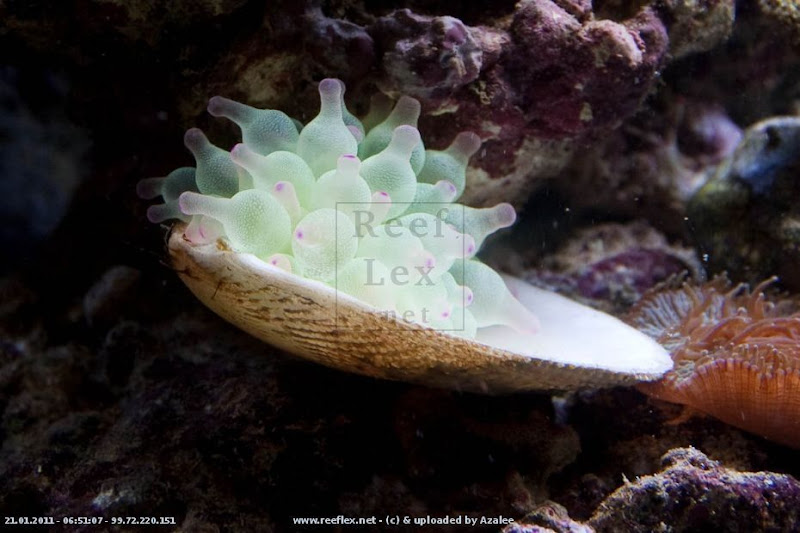
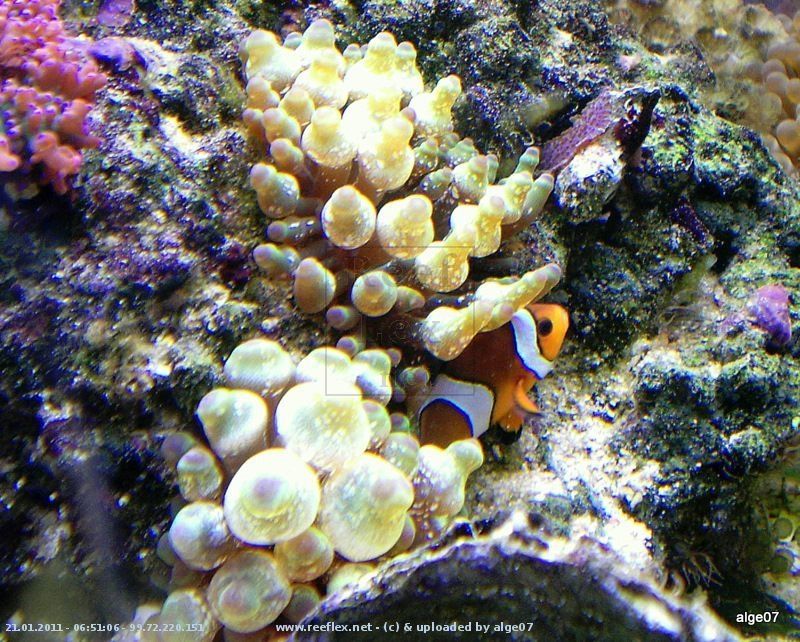
 
Gary (and anyone interested) you should first know, that I am insane. :)

That said I have translated the text because I couldn't sleep until I did. So here goes the rough translated rewrite:

The pictured Anemone could be a kind of Mediterranean, since the "real" Cribrinopsis crassa has their real occurrence there. It is possible that it has spread from there into the warm waters of the Indo-Pacific. Just as well it is possible, that this alone is a completely different stand-alone almost identical looking anemone from the Indo-Pacific. However, the name Cribrinopsis crassa has mitlerweile naturalized for this anemone.

It forms bubbles - like E. quadricolor! The anemones look different depending on the day and hour. They are usually not larger than 5 cm, but have reached 10 cm. They do not divide as frequently as the dreaded Anemonia cf majano, but almost as often as copper anemones. The images show a kind owned by Carsten Leipold, which came with Bali-rock into the pool. The anemones do unfortunately show little zooxanthellae, this will recover but surely.

Our "green" is kind owned byJรƒยถrg Griem (www.joerg-korallenkeller.de).

Added by Daniel Heerz:
This is sometimes called the offspring offered in trade. Probably a Entagmea spp, optically variable bubbling anemone, diameter about 5 -. 6 cm, under the T5 is formed very short knobby tentacles under HQI it has long tentacles. The basic color is green, the tentacle tips of each fade to pink. The first months under new burners are the beautiful pink tentacle, after a few months, this color fades a little. The anemone reproduces quite well by longitudinal division, but is not such a plague as the Majano anemones. Reacts with strong rate of increase also by regularly adding iodine. The nettle is weak, therefore, it will socialize well. The attitude in our erfolt Jaubert Aquarium here is in the side light of the 250W metal halide burner. We regularly pass on offspring of this kind. Price 5, - รขโ€šยฌ / pcs

They sell them for about $7 U.S. I guess I'm going to need a german-fluent friend to draft and read me a series of emails as I try to place an order lol!
 
I just realized they have several pictures there if you slide the bar. Ok, now that's just not fair! I really need them now lol.

untitled.jpg


untitled2.jpg
 
Interesting. they are dead ringers for E. quadricolor, just much smaller. Sometimes people post about their BTA splitting when it's very small, perhaps it's this species instead.
 
I noticed that too as I was looking into this. I am really hoping that is the case, as some of them have been U.S. tank owners. That would make my quest a nice, short one. :)
 
They don't require cold temperatures at all. They thrive well in tropical conditions.
The care is pretty much the same as for BTAs - they live from their zooxanthellae, but will also gladly accept meaty bits of extra food (mine even ate tablets). They'll wander around until they find a place they like just like their bigger cousins. My other corals didn't seem to be bothered by them when they moved through, though.

From what I gather what we know as C. crassa here in the hobby more likely is an unknown/misidentified tropical species that initially hitched in on liverock, rather than the true C. crassa from the Mediterranean Sea where it's endemic.

The absolute maximum size I've heard them reported to reach is about 6", while most of them stay smaller than 4". I'm not aware of any other color morphs but green base with purple tentacle tips, although the intensity of the coloration can vary.

In short, if you look for reports of tiny hitchhiking (purple-tipped) green BTAs, you might just get lucky.

Oh yeah, and if you need anything translated to or from German, don't hesitate to send me a private message. Always glad to help. ;)
 
Sebastian J. - thanks for the insider info! I'm glad to hear from someone who knows more about this species. :)

That makes sense about the misidentified species. It explains why those in my first search looked so similar but without any bubbling.

In the event there aren't any successful finds here in the U.S. what would you say my odds are of getting a live one across the ocean? Is it worth a try or do these things melt in the bag on day 2? Thanks in advance.
 
Well, time to make good on my promise of translation. Here's the whole lexicon page translated:

Scientific name: Cribrinopsis crassa
Common name: Mini Anemone
Natural occurrence: Bali, Indo Pacific, Mediterranean Sea
Size: up to 4"
Temperature: 66ร‚ยฐF to 82ร‚ยฐF
Food: Plancton, Zooxanthellae/Light
Tank size: ~25 gallon
Care level: very easy

Care:
The anemone pictured here could be a species from the Mediterranean because the "real" Cribrinopsuis crassa has its natural habitat there. It might be possible that it spread from there to the warmer waters of the Indo Pacific. It might just as well be a completely different, discrete species from the Indo Pacific that looks almost the same. However, the name Cribrinopsis crassa has become established for this anemone.

They form bubbles - similiarly to E. quadricolor! The anemones look different depending on day and hour. They mostly don't grow bigger than 2", but are said to reach up to 5".
They don't split as often as the Anemonia cf. majano are feared for, yet similiarly often as Bubble Tip Anemones.
The pictures by Carsten Leipold show a species that hitched into the tank on Bali rocks. The anemones pictured unfortunately don't have much Zooxanthellae, but those will surely be replenished.

Our "green" species comes from Jรƒยถrg Griem (www.joergs-korallenkeller.de).

Addition by Daniel Heerz:
This species is sometimes offered captive bred in the trade. Most likely Entacmea ssp., an optically varying Bubble Tip Anemone. The diameter is about 5-6 cm. Very short, knobbly tentacle tips are formed under T5 lighting, while under HQI longer tentacles are shown. The base coloration is green, the tentacle tips are light to rose-colored depending on lighting intensity. For the first months under new bulbs the tentacles are nicely rose-colored and after a few months the color lightens slightly. The anemone multiplies rather well by lateral fission, but doesn't become a pest like Majano Anemones. It reacts with a strong rate of reproduction to regular Iodine dosing. The sting intensity is weak, therefore it is easy to house with other animals. We keep it in our Jaubert system in the sidelight of our 250W HQI fixture. We regularly pass on offspring of this species.

Links:
Actinaria.com

User comments:
#1 - Jannes
We should be dealing with Cribrinopsis crassa here.

#2 - Heimes2
I've been keeping this anemone for half a year and introduced it to my tank with live rock.
It is very beautiful and easy to keep. I've yet to make negative experiences with it.
It barely stings and doesn't wander as much once it has found a nice spot.
I would always put it into my tank again.
Also suitable for beginners.


#3 - dreamofthedeath
This anemone species grows almost everywhere in my tank. It grows and reproduces well for me. Some get very long tentacles of up to 2", but they sting only very weakly. My Amphiprion ocellaris like to cuddle with them sometimes, too. They are relatively easy to pry from rocks.
I can only recommend this anemone.


#4 - Ralf S
I've had this anemone in my tank for some months and it has since split twice. The biggest has a an oral disc about 3.25" in diameter, the rest are only about 1.5". The anemone will form strong bubbles on its tentacles when it feels well and will then look like a common BTA, only just a bit smaller and green. My clownfish will sometimes wander away from their BTA for a few minutes to swim through the tentacles of the C. crassa.
It gladly accepts frozen food and will vehemently hold on to it. Yet it will also catch Artemia and so on that drifts by.
An eye should be kept on its rate of reproduction, although it is by far not as potent as Majanos and similiar species.


#5 - tassilo
I also have two individuals of this anemone. It looks like a green miniature Entacmea quadricolor. It contracts in the dark and reemerges in the light. Very easy to keep. Nice neon green coloration under moonlights.

#6 - Werner
I have these anemones since about 1 year ago - they have multiplied from 4 to 12 up to now. The tentacles are sometimes up to 4" long and sometimes only short, green, bubbly growths, a different shape every day. Easy to care for, wanders from time to time. One is being vehemently defended by an Occellaris and almost never left by it. Yet two other Occellaris won't settle into the remaining anemones, completely rejecting them.

#7 - lencalenca
I'm thrilled by the Mini Anemones! After a BTA taken by wanderlust was shredded in my pump three Mini Anemones have moved into my nano. They obediently stay put, don't sting their neighbors and their growth is limited. My anemones are about 5.5" in diameter. After the demise of my BTA they were immeadiately beset by my Clowns and it is exhilerating to watch the two of them swim from one anemone to the next. With strong feedings - 3 times a week with Artemia, pieces of shrimp and Mysis - they grow quite fast. It's great when they fluoresce green under moonlights. The "little ones" can only be recommended!

#8 - pallmall
I've had these Mini Anemones for about half a year and they're simply amazing. They have multiplied from 2 to about 6.

#9 - Jeddahboy
I've had this great anemone for about 5 months in my 23 gal tank. It already split once. I keep it without additional feeding. Time and time again it will catch some fish food (Artemia, Mysis, food pellets). I put it on the bottom and it quickly attached to the reef and wandered up to the light. Since then it hasn't moved an inch. It hasn't stung anything yet.
I can recommend this animal to everyone. Especially suitable for nanos.
 
In the event there aren't any successful finds here in the U.S. what would you say my odds are of getting a live one across the ocean? Is it worth a try or do these things melt in the bag on day 2? Thanks in advance.
They're know to be quite hardy, so I don't think the transport itself is the problem. Shipping might become pricey, though. I would rather worry about the legal requirements of importing them - and I have no clue what they are. :worried:
 
NICE! That's some awesome info there. Thanks! There were several things I missed, and I really appreciate the testimonials. :)

I had a guy in the UK send me some beadlet anemones once, so hopefully it won't be too difficult, but yeah pricey may be an issue. In the meantime I'm crossing my fingers that Garygb is right and there's a source somewhere in the U.S. already.
 
Update

Update

Nothing earth-shattering, but I found an old thread on RC talking about "mini BTAs" and talked with someone from it who claimed to have some. He said he's had them for over a year, they've split 3 times, and are all around 6 inches or less. He also keeps RBTAs that split just as often and get the same feeding schedule, flow, and lighting, but the RBTAs average 14 inches. This pretty much rules out the environment affecting the growth. Apparently he picked them up at a frag swap IN THE U.S from a guy who claimed they stayed small, and they did. :)

Unfortunately, he's not selling, which I can completely understand, but now at least I know they're state-side! Oh, and he sent me some pics of his variety with permission to post them - green with pink tips isn't the only kind now :inlove:

002-15.jpg

003-14.jpg


One step closer - every bit helps. Thanks to everyone who has offered opinions and assistance. I look forward to seeing/hearing more about these awesome minis! :)
 
Hmmm, interesting anemone. So I'm getting the sense that some of the European posters consider this a small variety of BTA. I hope you can track one down. Everyone that posted about them seems to love them.
 

Similar threads

Back
Top