Long term trio

Winwood

New member
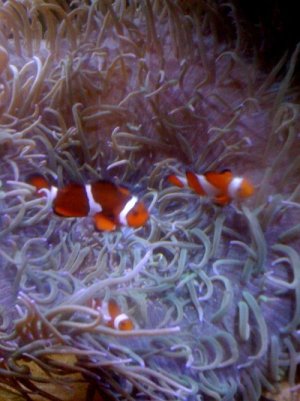
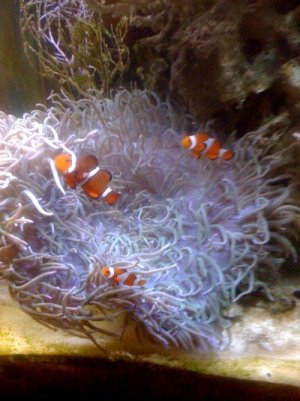
Just wanted to post evidence of a successfull trio of clownfish living and spawning together. These three clowns have been together for the last four years. It's interesting to note that all three have not grown or changed size in that amount of time.
 

Attachments

  • woekleclowns01.jpg
    woekleclowns01.jpg
    58.7 KB · Views: 10
  • woekleclows02.jpg
    woekleclows02.jpg
    62.8 KB · Views: 15
Cute picture! I'm not sure what you mean by "evidence". It is a well-known fact that clowns occupy family groups in the wild. Is there something unique going on here that I am missing?
 
Perhaps I should explain in more detail. I took these photos (apparently 1 did not upload) of my friend's father's tank. It is a 6' 210 gallon reef. The anemone and the original spawning pair have been with him for about 9 years. The smallest was given to him by his son as a gift making three clowns total. The dominant pair spawn regularly and do not exclude the smallest one from hanging around while they do it. On one occasion I have actually seen the smallest one fanning the eggs while the other two patrolled their territory. Unfortunately they were not spawning this time.

I know we see all sorts of wonderful clown communities harmoniously occupying a single anemone in nature. However, this rarely plays out ok in our aquariums where pairs are usually the norm. All I was trying to show by this post was some physical evidence of keeping more than a pair of unrelated clowns together long term. Also just a side note all of these clowns were wild caught.
 
Last edited:
Joyce Wilkerson mentioned keeping a small group of ocellaris together in her book--two were a spawning pair, one acted as a "nursemaid" as Winwood describes, and the fourth was allowed to coexist on the very fringes of the group, but got chased a lot (I hope she eventually removed him). I know one LFS in my area used to have a trio of black ocellaris in their 500G display tank, although they only have a pair now (I'm not sure what happened to the odd man out--I'll have to ask). Definitely not something I'd recommend, but it is very interesting to read about.

 
Very cool. I have never heard of the "nursemaid" behavior. In my experience clown pairs are so aggressive it is difficult (if not impossible) to add a third. I assumed you started with three juveniles and they all matured to form a trio. The fact that you added the third much later (and it did not get killed) is really amazing.
 
I have four clowns living in a mertens carpet. All things are possible.

Two are the original pair and the others juveniles
 
Winwood, thanks for sharing. This is one of those natural things which is not always easily achieved in an aquarium. :)

I'm trying to set up the same sort of thing with three ocellaris in my gigantea. So far so good, but I just started and they've not yet matured, although it is seemingly apparent which will become the female (biggest and probably dominant, from a different batch of tank raised clowns), the male (smaller), and the juvenile (smallest and hangs around the edge of the anemone, often hidden in the folds). The last two are siblings.
 
hAREM

hAREM

In my situation, its a large white bonnet clownfish with her orange skunk mate.

There is two juvi fish one a blue stripe and one a orange skunk.

They all live in the Mertens.

They bicker and all shimmy to the female white bonnet.
 
I read a paper by Dr. Fautin on competitiveness of clowns in the wild. As I recall, hosted fish have a distinct advantage versus new-comers, and all non-species new-comers were ejected.

Interestingly, species dominance was more important than size - with some small individuals of one species (A. perideraion) being able to eject less dominant species (A. percula) that were larger.
 
That is awsome. I've had a trio of clowns before but it's never lasted long term. Two decided to pair and kicked the other out of the tank, literally.
 
I think the key to it

I think the key to it

I beleive is that the any fish not in the original pair need to juvenile and slowly introduced.

My juvi blue stripe and juvi orange skunk were introduced over two weeks and were supplied with extra anemones in the main tank.
 
Oh for some reason I was thinking of Gary Marjalek or however you spell his last name. Sorry Randy my mistake.
 
Just an update. :)

My trio of ocellaris clowns have now been together for about a year, and is spawning.

I love this grouping, with a big female, a medium male, and a small juvenile. The juvenile hangs out at the edges or under the gigantea anemone, and is often not visible when watching for a few minutes. They all have great coloration, perhaps largely due to the diet they get.

Interestingly, there is another gigantea anemone in the tank, and has been for the past 9 months, but none have ever gone over to it, even the juvenile. It is now larger than the one they are in and is only 2-3 feet away. I thought the juvenile might move over and set up shop there, but it has not (and I prefer it to not since I like the trio grouping).
 
I got three Ocellaris in a large tank before. During the day, the 3rd clown never get to go into the anemone unless there is a threat like my hand in the tank. At night as the light out and the night light still on, the smallest clown got chase around and around the anemone. The anemone was a big Magnifica. The third clown in my tank never have full fins. always a missing bite mark some where on the fins. They were together for years 4+ years
 
Oh, interesting. Mine never have anything chasing them, and none of the trio go more than a few inches from the anemone (and then only to grab food). :)
 
I have 6 Amphiprion clarkii living in the same tank together now for a year. They all get along well, some scuffling, but nothing too bad. They share about 5 Entacmaea quadricolor and 1 Macrodactyla doreensis.
 
Back
Top